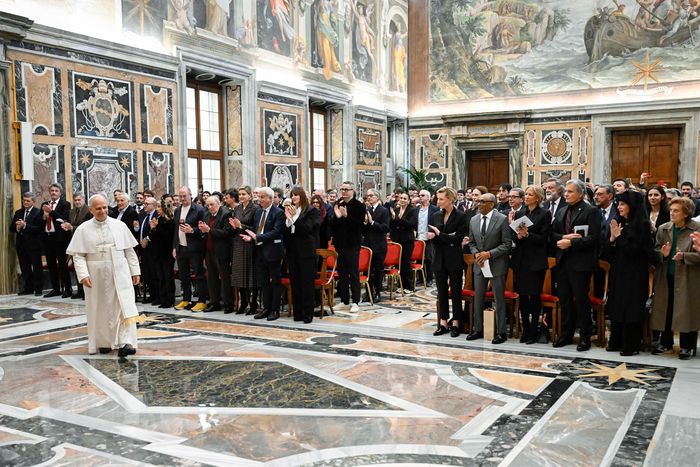
Pope Leo XIV is on the side of the angels when it comes to matters of cinema. Last Saturday, after he gathered some of the film world’s luminaries at the Vatican, the pontiff delivered one of the most remarkable speeches I’ve ever heard coming from someone not directly involved in the movie industry. (Honestly, it would have been remarkable coming from most people in the movie industry too.) While much of the coverage centered on the admittedly delightful image of guest Spike Lee giving the pope a Knicks jersey (I was also charmed to see that Gaspar Noé gave His Supreme Holiness a copy of his brutal 2021 drama Vortex), several of the things Leo said to this audience of filmmakers and festivalheads are worth discussing. They suggest he has been paying serious attention to the issues the art form is facing on a variety of levels.
“Filmmaking is a communal effort, a collective endeavor in which no one is self-sufficient,” Leo said. “While everyone recognizes the skill of the director and the genius of the actors, a film would be impossible without the quiet dedication of hundreds of other professionals, including assistants, runners, prop masters, electricians, sound engineers, equipment technicians, makeup artists, hairstylists, costume designers, location managers, casting directors, special-effects technicians, and producers.” A mention of this litany of below-the-line talent would be amazing in most circumstances, let alone coming from the Vatican. But Leo’s comments about the importance of film workers could be viewed in the context of an ongoing debate in Italy. Giorgia Meloni’s far-right government is locked in conflict with the country’s film industry, which it sees as a hotbed of leftism. The government is currently attempting to slash a huge amount of money from a film-industry support fund as part of what many view as the right’s ongoing battle against Italy’s progressive cultural sector. And the people likely to suffer the most from such dramatic budget cuts will be those same below-the-line workers Leo cited.
Leo also took aim at our algorithm-infested reality: “The logic of algorithms tends to repeat what ‘works,’ but art opens up what is possible,” he said. “Not everything has to be immediate or predictable. Defend slowness when it serves a purpose, silence when it speaks, and difference when evocative. Beauty is not just a means of escape; it is, above all, an invocation. When cinema is authentic, it does not merely console but challenges.”
Again, it’s crazy to hear a pope say these things. It’s worth noting that this audience did not include many executives, studio chiefs, or Zaslavian moguls (though it’s fun to imagine an episode of The Studio where Seth Rogen’s character tries to snag an invite). Leo is making a case for art to artists. We all know that the age of the recommendation engine has resulted in the slow death of curiosity and discovery. Streaming platforms feed us endless variations of the same thing, and even those of us who are hyperaware of such problems often find ourselves unable to escape these digital loops of slop. Will Leo’s words lead to real change? Probably not. But they were a welcome reminder we’re not imagining things when we sense that many of today’s viewers seem unable to look outside their comfort zones and process anything challenging.
The pope was also doing something necessary and surprising with these words: He was speaking on behalf of those audiences. Critics and high-minded, navel-gazing essayists often like to blame ordinary people for what’s viewed as their incuriosity and inertia (I basically just did two sentences ago). However, the pope’s words serve as a reminder that audiences themselves are at the mercy of what is fed them. The man still sees himself as a shepherd. And he is not admonishing viewers; he is reminding filmmakers that, despite what the trends or the numbers say, the mission of art is to “open up what is possible.”

Click here to preview your posts with PRO themes ››
He didn’t stop there. “Entering a cinema is like crossing a threshold,” Leo also said. “In the darkness and silence, vision becomes sharper, the heart opens up, and the mind becomes receptive to things not yet imagined … We live in an age where digital screens are always on. There is a constant flow of information. However, cinema is much more than just a screen; it is an intersection of desires, memories, and questions.”
Back during the pandemic, with movie theaters closed and many worrying they might never open back up, we had tiresome debates about the importance of the theatrical experience. Those debates have been tabled for the time being, but they haven’t been settled, and it’s heartwarming and validating to see Leo come out so strongly for the cinema as a special space. (I almost said “sacred,” which is the word I prefer … but I’m not going to presume to speak for Pope Leo XIV about what is sacred and what is not). Not just that, but he seems to understand that films are more than just “information” and “stories.” Many of us advocate for the theatrical experience not because we like movie theaters — though we do, usually — but because without the promise of being able to see films in a theater, an entire tradition of filmmaking would go away, replaced by movies as information, movies as data points, movies as episodes, movies as pit stops along the marketing funnel.
And movies are a lot more than that — in fact, as a social and cultural phenomenon, they go well beyond the boundaries of the screen. The cruelty and intolerance of our era is rooted in our increasing inability to be together in shared spaces. Why consider other people’s humanity when they seem to live entirely inside our phones? Why be uncomfortable when the digital blanket is right there, promising a life of blissfully connected isolation? Why seek challenges when it is so much easier to just … not?
A few years ago, I was quite taken with something said to me by Jocelyn Szczepaniak-Gillece, a professor of film history at the University of Wisconsin–Milwaukee. “There is something that happens when a bunch of people go sit in a dark room together and watch something,” she said. “It means that we’re kind of thinking together at the same time. It means that we’re experiencing something together. Moviegoing is a valuable social practice and something that can teach us about empathy and kindness to one another by immersing us in somebody else’s perspective for a couple of hours. When being in public together becomes impossible, the other things that become impossible include working together and reaching across borders to experience something together.” It sounds hyperbolic, but it’s true: In a world where shared experiences are becoming rarer and rarer, the cinema — as both a place and a practice — remains one of the last bastions of our common humanity. And if that’s not the kind of thing a pope should be concerned about, I don’t know what is.