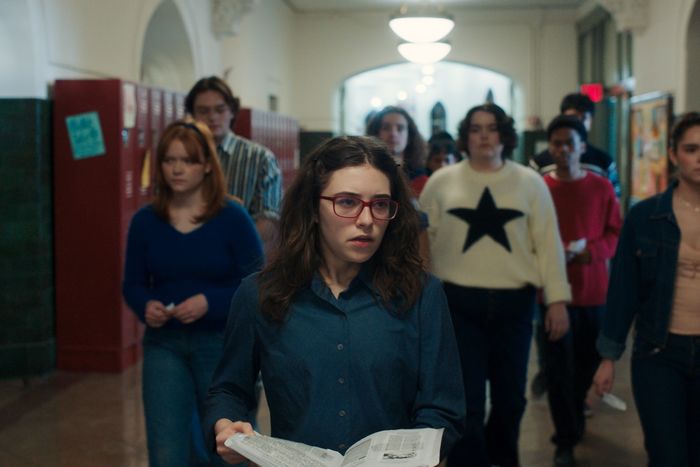
Early on in NB Mager’s Run Amok comes a scene that takes our breath away. It portrays a group of high-school kids going through the events of a shooting that happened at their school ten years ago. Led by Meg (Alyssa Marvin), who lost her mother in the massacre, they intend to create a musical commemorating the event. Scripts in hand, they walk through their school hallway, pointing out where each shooting happened and reenacting these moments, like a loose, early blocking run-through of their eventual performance. The attitude is mostly businesslike: Sober and attentive, Meg is primarily interested in the facts, in the sequence of events and the positions of the victims and the shooter. Some kids exaggerate their gestures; one does run away in genuine terror, but others crack jokes. It’s hard to read any kind of specific emotional valence into this scene. These kids know of the shooting, but it was so long ago — and so many lockdown drills ago — that there’s no rawness, no sense of trauma, shared or individual. It’s just a thing that happened, and they want to get the details right.
The rest of Run Amok is not quite as scarring as this scene (or as effective), but the specter of its mood colors the rest of the picture in moving ways. In Mager’s film, it’s the adults who are shattered, not so much the kids — not even Meg, who later discovers that she was present at school that fateful day. The instructors wear orange guns with rubber bullets, and some have become unnervingly trigger-happy. One, Mr. Hunt (Bill Camp), the woodworking teacher, spends his time taking potshots at squirrels in an effort to protect the birds in his handmade birdhouse, an overtly symbolic subplot that somehow becomes even more on the nose as the movie proceeds. Mr. Shelby (Patrick Wilson), who lost his hand in the massacre and who shot the killer dead, is supportive of Meg and her efforts to a fault, but he, too, seems to be trying to make up for his perceived failures. All the grown-ups live in the shadow of their inability to protect these children.
Meg lives with her cousin Penny’s (Sophia Torres) family, and the musical is her idea. Like her mother, Meg is a talented harpist, and Penny has a beautiful singing voice; together, they take a teacher’s suggestion of a performance of “Amazing Grace” in a wild direction, creating an elaborate, pop-music- and modern-dance-inflected pantomime of the massacre. If Run Amok doesn’t entirely succeed, it’s mostly because it dares to do too much: Our tantalizing glimpses of what this musical production might have looked like suggest an experimental vibe that the film never quite manages to deliver. Instead, it eventually becomes a tale of sisterhood, focusing belatedly on Meg and Penny’s relationship as they fall out and then back in. But their momentary estrangement feels manufactured and thin, like a script looking for a resolution. Still, Marvin and Torres, the two young actresses, are so staggeringly good that it almost works.

Click here to preview your posts with PRO themes ››
Run Amok is the second film at this Sundance about the production of a potentially inappropriate school musical (The Musical would be the other one), but it’s also the umpteenth title at the festival about our profound inability to protect our children. Whether it’s Josephine’s portrait of a young girl who must testify at a rape trial, or Carousel’s tale of a single father haphazardly trying to handle his daughter’s profound anxiety while neglecting his own, or The Musical’s comic depiction of adults pulling middle-schoolers into the vortex of their own bullshit, or One in a Million’s documentary look at a young refugee whose love for her father is destroyed when he turns abusive in a new land, so many of these films focus on adults who, under the guise of helping kids, ultimately fail them. (These are just some of the examples. A quick glance at other films’ descriptions will be quite revealing.) Maybe that’s just the way life is. Or maybe it’s something in the air now, an overwhelming sense that the world is more full of profound, unthinkable malevolence than ever before. Maybe it’s both: We’ve spent so much time worrying about the kids that we haven’t reckoned with our own ineptitude, thus ensuring that they will inherit the ruined universe we’ve left for them.
Which brings us back to that aforementioned hallway scene in Run Amok. Beyond the calm, procedural feel of the sequence, what jumps out most is the sense of grim discovery. As Meg reads through the facts detailed in her script, a quizzical expression emerges on her face: Each beat of the incident feels new, and she doesn’t quite know how to process any of this. She can’t, because it appears that nobody has ever discussed it with her before. The adults are missing from the hallway. And for most of the film, they are ensconced in their offices or homes, either catatonic and ineffective, frozen behind dinner tables and desks, or hyperaggressive, stupid plastic orange guns at the ready. All they know is inaction or violence; they can’t talk, but they can freeze, and they can shoot. The only thing the kids can do — in this as well as the other films at Sundance — is to try to navigate the ruins of their world.