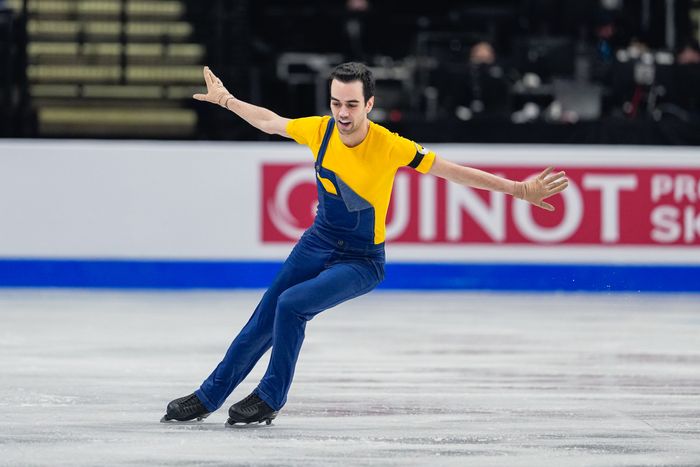
Not since the co-creator of the Minions disavowed their history have we had a despicable scandal like this. The Spanish figure skater Tomàs-Llorenç Guarino Sabaté, who’s set to compete at the 2026 Winter Olympics, will now be allowed to perform his Minion short-form routine after an initial copyright denial. Guarino Sabaté had been using the song for the entirety of the international skating season — he even wears matching blue overalls and a yellow T-shirt, cutting quite the Kevin-esque figure while landing those Axels — music of which he said was chosen to “bring joy and a playful style to the ice while still meeting every required element to show that skating as a male Olympic figure skater can be fun.” (One extended step sequence features Guarino Sabaté bumping to EDM while “papaya” is repeated in Minionese.) In his celebratory update, the six-time Spanish national champion credited those who “reposted, shared, and supported” his routine for moving the needle on Universal’s reversal, although he’s still waiting on two other musical elements to be cleared.
Jackie Wong, a skating analyst currently on the ground in Milan, says getting clearance to use certain songs was never a significant issue for figure skaters until a blowup in 2022. Alexa Knierim and Brandon Frazier, an American pairs team and Olympic medalists, repeatedly performed a routine to a cover of “House of the Rising Sun” from the composing duo Heavy Young Heathens. “They sued everybody under the sun, including NBC,” Wong explains. “So that set off a chain reaction in the figure-skating world where people were asked to preemptively go through a whole process of music clearance. That process was never a thing before those two guys sued. It freaked a lot of people out.” The case was settled out of court, with the Guardian reporting Heavy Young Heathens were awarded $1.4 million.
In the aftermath of the lawsuit, the International Skating Union has worked with a company called ClicknClear to provide a more centralized process for skaters to obtain music rights for their routines. Wong is skeptical at “how legitimate they are” when it comes to being informed enough in the intricacies of copyright law to greenlight skaters’ intended songs, as evidenced by Guarino Sabaté’s nightmarish scenario — he skated with no issue during the 2025–2026 season until being thwarted prior to the Olympics. (Guarino Sabaté noted that he submitted the routine through ClicknClear last August, during which time nothing was flagged as potentially unauthorized. He was denied on Friday, January 30.) “The company is basically saying, ‘If these skaters want their stuff cleared, go through us,’” Wong says. “They sort of led everybody into a sense of belief that if they went through them, then all of the issues would be fine. This whole ClicknClear thing is a bit unresolved, just because of the way they work and also how rules about music rights are different in every country. It becomes very complicated.”

Click here to preview your posts with PRO themes ››
The other option for figure skaters is to go directly to the artist, label, or estate and ask for permission. “That’s the most surefire way of getting it,” Wong says. “It’s everybody for themselves.” But this is a higher-risk method, especially as many skaters prefer to remix and edit tunes as opposed to gliding to the beat of one unified song. Would, say, Beyoncé approve a program set to “Tyrant” if a skater wants to mash it up with Van Halen’s “Jump”? “Oftentimes it’s one of those things where, if you didn’t ask, the artists probably wouldn’t have done anything anyway,” Wong notes. “But if you do ask, you’re gonna get a no. There’s just not one answer to it. That’s why skaters, choreographers, and coaches have been struggling with this over the past few years.”
Guarino Sabaté’s program, titled “The Minions” — creatures who, famously, were relegated to an ice cave during World War II so they didn’t have to pick a dictator — is the first instance where Wong believes widespread public outcry directly influenced a music rights reversal in the sport. “This is completely unprecedented,” he says. “We’ve never, we’ve never had anybody change their mind this publicly before.” There’s also the fact that Universal is under the same corporate roof as NBC, which is home of the Winter Olympics broadcast in the United States. “I think Universal realized it was missing an opportunity,” he adds. “They believe the program will probably go viral. It was a bigger sensation than any of us thought it could be. The Minions really broke down the walls of the figure skating community.”