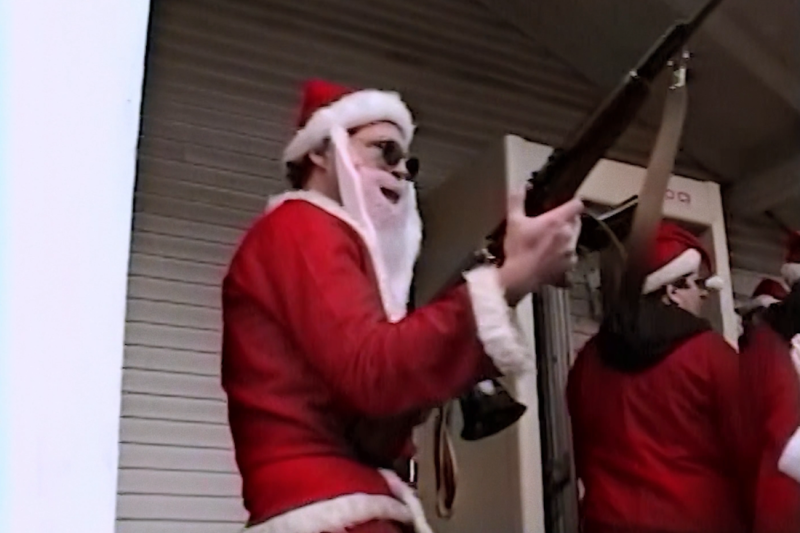
In 1996, Chuck Palahniuk attended a Santa Rampage in Portland, Oregon, one of several Cacophony Society events that would go on to inspire his novel Fight Club and the idea of Project Mayhem. This November, he’ll appear in a new documentary, SantaCon, which explores how a Bay Area anti-capitalist experiment became a drunken, commercial shitshow. Ahead of the movie’s premiere tonight at DOC NYC, Palahniuk reflects on his early days as a Cacophonist and how the intent went so sideways.
First, a story about Edith Wharton: Days after finishing the manuscript for a new book, she lost it in a fire. Her publisher asked when she’d have the work rewritten, and Wharton replied, “Why bother?” She’d already discovered the ending. The story no longer held any mystery for her.
Per the bad-boy editor and writer Gordon Lish, every story should begin with a “line of flight.” Each sentence should carry us forward from the sentence before until the story resolves itself. No steering of the plot. No outlining. Robert Frost agreed: “No surprise in the writer, no surprise in the reader.”
Extend this thinking to life. Take hundreds of people, for instance, and have them all dress as Santa Claus and assume the name Santa Claus, unleash this crowd on a city, and what could go wrong? Every month the Cacophony Society, founded in 1986 by some of the same San Franciscans who’d go on to spawn Burning Man, would host such experiments. The group’s photocopied quarterly newsletter offered events like The Mad Hatter’s Tea Party, where members (“Cacophonists”) dressed as Lewis Carroll characters and played croquet in a downtown park using 50-pound sledgehammers to smack 18-pound bowling balls through hoops of bent rebar. There was Le Art Mal, wherein the Society spent months gathering hideous paintings and showcased them in a failing gallery, duping hoards of snobs into a fake opening, complete with bad cheese and red wine.
Every month, for a sort of experiential potluck, we created these stunts to see how they’d resolve themselves.
The germ of the Society was Robert Louis Balfour Stevenson’s short-story collection The Suicide Club, about a gathering of fully consenting adults who plotted elaborate ways to kill one another and make their deaths look accidental. It was no coincidence that during my decade in Cacophony I worked at a truck builder called Freightliner, in and out of its Repairability and Maintainability Center where ignition switches and windshield wipers were run constantly under various conditions until they failed. The bearings would seize or a solenoid overheat, and we’d dissect the weakness. “We” being engineers who talked about “live primate crash testing” and “cadaver crash testing” of vehicles, both tests being exactly what you’d picture. Many of my co-workers had previously worked at the Boeing aircraft company and reeled off rollicking facts about how during the steep, screaming plunge before a jetliner crash the passengers’ internal organs will actually begin to liquify. They’re jelly before impact. Just the type of closure that would leave Wharton and Frost bug-eyed.
The Cacophony Society with its constant experiments, games really, seemed a perfect extension of what I did all day: breaking things, testing limits, as I waited for the final crash. Here was a public laboratory where people tested themselves. They didn’t want to die, just to risk looking foolish and by doing so to kill some needy, ego-driven part of themselves. We were people who had to be back at work on Monday morning — at the post office or Powell’s Books or Freightliner. It’s no wonder I became the Society’s Boswell, jotting endless notes.
Perhaps the only thing the Proud Boys and antifa have in common is their attachment to Fight Club and by extension to the Cacophony Society and SantaCon.
The Scottish anthropologist Victor Turner would call Cacophony events “liminoid” because they included the qualities of traditional “liminal” events. Liminal events include Halloween and honeymoons and other rites that mark passages in life. Such events are marked by a flattening of social status. Everyone present is equal for the duration. Turner called this general acceptance, even affection, the participants feel as “communitas.”
“Liminoid” events such as the Tea Party or Santa Rampage or Burning Man share that feeling of communitas, but liminoid events can take place anytime, anywhere, and they exist for only the window of time people come together in play. By extension, my first novel, Fight Club, came to exist only in the hours between when Fight Club began and when it ended. It might seem like a paradox, but Cacophony, like Fight Club, was a safe, structured, consensual place to enjoy some self-destruction.
Writing the book in 1994, deep in Cacophony, I would’ve called it Play Club, but there’s hardly the same zing.
Most people had two places to be in life: home and work. A third might be the gym or church, but those options were so tied to looking good and ridding yourself of self-perceived flaws. Cacophony embraced flaws. All Santas are fat and look ridiculous, there’s no getting around that. Worse yet, as Santa Claus you draw attention. As a Santa you’re a fool, and strangers are judging you. You’re tested. At the same time you’re testing the game itself: Will people enjoy the event enough to perpetuate it?

Click here to preview your posts with PRO themes ››
Another Cacophony Society event involved creating sequined salmon costumes. Members wore these to “swim upstream” by running against the tide of participants during the San Francisco Bay to Breakers annual footrace. Flashy human-size salmon Cacophony runners leapt and struggled against the flow, sweating profusely and irritating people but creating a spectacle so charming that Nike would re-create it in television commercials using professionally made costumes. The salmon experiment had succeeded by being adopted. As did Burning Man, which started as a Stalker-inspired experiment called a Zone Trip. (On Zone Trip No. 4, they burned the first man at Black Rock Desert.) As did Santa Rampage, a.k.a. The Red Tide, which I first experienced in Portland, Oregon, in 1996 and resulted in a Tonya Harding séance and police in riot gear. Nearly 30 years later, there’s SantaCon.
In his bestseller Originals, Adam Grant describes two types of innovators. The first type envisions a concept, then works to prove it. The second loves to experiment for the thrill of experimenting. The first, the Concept guys, tend to peak very young; their creativity wanes early. The Experimenters enjoy careers that span decades. The Cacophonists were the latter. Every newsletter offered a dozen proposed events, a.k.a. experiments, most of which flopped. For example, few people remember Hoot & Holler, Paint & Burn which involved setting trash fires and spray-painting graffiti under an abandoned freeway overpass in Southeast Portland. No one got caught. Nobody was arrested or shouted at or adored. At one point a member, Lana, threw down her can of Krylon and walked away shouting, “This is stupid!” All Cacophony events were stupid, but what Lana meant was we knew the ending here, and there would be no train wreck to marvel over or regret. No scar to show off.
Events invented so people could look bad are now used as a backdrop for people to showcase their interesting lives.
For each Cacophony event that survives countless events fizzled out, including the passion play that crucified a man-size plush rabbit outside the doors of a Baptist church during Easter service — an event I did not attend. Such stunts echo faintly in the Project Mayhem antics of Fight Club. That said, even the successful events, those re-created on a larger and larger scale each year, those surviving their Cacophony roots, those are a mixed bag. Burning Man has become a playground for the superrich. New York SantaCon has become a vast income source for bars and venues, although the group’s ticket money goes to charity. Few if any of the originators attend now that the Santas are less social pariahs and law breakers and more fraternity brothers and junior bankers. Would Edith Wharton attend? We know how it ends.
Even the phenoms that spun off of Cacophony have been co-opted. Search for the novel Fight Club and you’ll find dozens of books using those words in the title. Perhaps the only thing the Proud Boys and antifa have in common is their attachment to Fight Club and by extension to the Cacophony Society and SantaCon. It all started as play. A spontaneous game. Maybe the only solace is that such games still unite people.
To Victor Turner such liminoid fun tends to preserve the status quo: The radical outliers self-destruct during the high jinks (they get arrested or killed), but most people exhaust themselves and are happy to return to their workweek lives.
Maybe secret tribes are inventing new games, but they have an uphill battle. Evading the police during SantaCon seems like small potatoes compared to dodging the social-media claimers. Victor Turner would love to put claimers under his magnifying glass. These are the bucket-list people who drop into an event for the photo op: Here I am surfing in Bali; here I am at SantaCon. Events invented so people could look bad (during the voodoo weddings at ExoTiki 2000, the Cacophonists threw raw, rancid chicken entrails at each other) are now used as a backdrop for people to showcase their interesting lives. Sigh. Where’s the risk in looking good? Where is the test?
For the claimers, such events are items to check off the list. Any future version of Cacophony will have to, what? Confiscate phones?
As a writer launched by my experience in the Cacophony Society, I’d like to think Edith Wharton was doubly thrilled to complete a novel, to discover its hidden destiny, and then to lose it all in a fire. A completion beyond the completion. No one would ever misinterpret the work. No one would ever boast about reading it on BookTok, now that reading fiction has become performative.
As for the fire itself, I seem to remember that it was a train wreck in which Wharton survived but her manuscript did not. Whatever the case, the world never got to read the book; but clearly, that wasn’t the point of Wharton writing it. Good on her.