Spoilers ahead for the plot and ending of Send Help.
It’s hard to watch Send Help without feeling an intense twinge of déjà vu. Sam Raimi’s desert-island-set horror film is a deliberate throwback to a bygone era of thrillers — the Danny Elfman score, shoddy CGI, and surface-level gender politics can’t help but provoke warm ’90s nostalgia. But there’s another, more recent point of comparison lurking just beneath the surface for much of the movie’s run. By the time Send Help reaches its inevitable twist, you have to wonder if writers Damian Shannon and Mark Swift were paying intentional homage to 2022 Best Picture nominee Triangle of Sadness, or if this is simply a case of twisted minds thinking alike.
In terms of its basic setup, Send Help has little in common with Ruben Östlund’s Palme d’Or–winning film. Rachel McAdams stars as Linda Liddle, a socially awkward and widely disrespected employee at a company headed by sexist nepo-baby CEO Bradley Preston (Dylan O’Brien). Despite the fact that Bradley’s father had promised Linda a promotion to VP, Bradley hands the role to his underqualified frat brother instead. Linda is not the right kind of people person for the job, Bradley tells her — and yes, Send Help’s insistence that McAdams’s character is frumpy and repellant requires more suspension of disbelief than anything else in the movie. As a consolation, Bradley invites Linda on a trip to Bangkok to discuss the company’s merger plans, but she’s immediately ostracized on the private plane, where the men gather around a laptop to mock her Survivor audition tape. It does feel a little karmically just, then, that extreme weather sends the plane tumbling toward the ocean. In the end, Linda and Bradley make it to shore as the only survivors on a seemingly deserted island in the Gulf of Thailand.
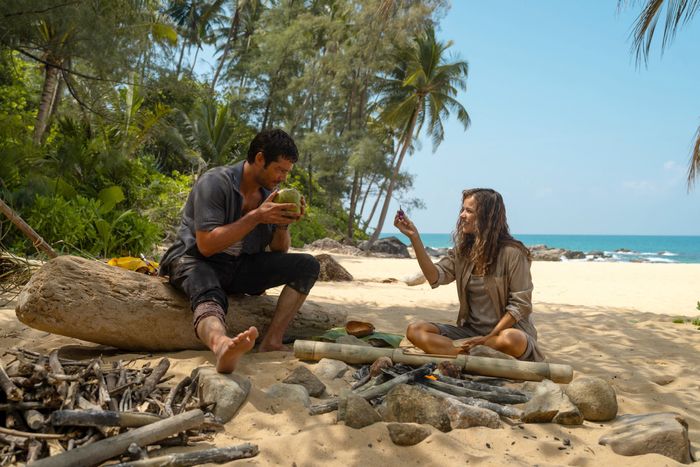
On the island, Linda puts her survival skills to work, immediately crafting a shelter, collecting fresh water, making a fire, and cooking a fish. Who’s laughing at the Survivor audition tape now? The power dynamic between Bradley and Linda shifts almost immediately. As soon as she leaves him to fend for himself overnight, he realizes that he can’t survive without her, which means Linda has the upper hand. “We’re not in the office anymore, Bradley,” she reminds him, an edge of menace in her voice. And yes, it’s at this point that your mind travels from genre classics like Cast Away and The Blue Lagoon to Triangle of Sadness, another pitch-black comedy about a reshuffling of the social order on a deserted island. Sure, there’s a bit of Lord of the Flies here, too — Linda proudly proclaims that she has the conch and kills a wild boar — but the abused office worker gaining control over her boss is straight out of Östlund’s playbook. In Triangle of Sadness, former yacht-toilet manager Abigail (Dolly de Leon) becomes the “captain” of the sole survivors after their ship sinks, forcing the rich passengers’ allegiance because she’s the only one who knows how to catch fish, make a fire, and otherwise stay alive. As in Send Help, it’s a notable subversion of gender norms, though Östlund, with his target firmly fixed on capitalism, is more concerned with class.
In Triangle of Sadness, Abigail begins sleeping with hunky model Carl (Harris Dickinson), paying him for his sexual services in food and shelter. The relationship between Bradley and Linda, on the other hand, never quite turns romantic, though you can tell she’s nudging it in that direction, especially after she ogles him bathing. But putting aside any sexual domination, what unites both movies beyond the switch-up of power is the way these women’s refusal to return to a lonely life of subservience leads them to extremes. There are hints of Linda’s heel turn early on in Send Help, when she sees a boat nearby and decides not to hail it down. “Not yet,” she reasons, even though they’ve already been stranded for two weeks. As it turns out, Linda’s desire to stay put runs deeper than one bad decision. When another boat arrives, carrying Bradley’s fiancée, Zuri (Edyll Ismail), and a Thai boat captain (Thaneth Warakulnukroh), Linda sabotages their rescue efforts by leading them up a treacherous path and refusing to help once Zuri finds herself hanging off the side of a cliff. Soon after, Bradley stumbles on Zuri’s body and confronts Linda, resulting in a brutal fight that includes stabbing, scalp ripping, and some really upsetting eye gouging. This escalation of violence leads to the movie’s big reveal.

Click here to preview your posts with PRO themes ››
Fleeing to the other side of the island, an area Linda had warned him against venturing into, Bradley discovers an opulent, unoccupied mansion. Linda has been stealing food, water, and supplies — like the knife she claimed washed up on shore — from the stunning (and air-conditioned) home. In a flashback, we discover that the boat she chose not to signal was bringing provisions to the house. She waited until the coast was clear and disabled the security system to avoid detection and subsequent rescue. We also learn, via another flashback, that she did more than passively let Zuri fall. Using a giant rock, Linda bludgeoned the local boat captain and sent both him and Zuri plunging to their deaths. If this is starting to sound familiar, that’s because the scenario is remarkably similar to the ending of Triangle of Sadness. In that film, Agnes and Yaya (Charlbi Dean), Carl’s model girlfriend, venture to the other side of the island and learn that there’s been a luxury resort there the entire time. Facing the prospect of a return to normalcy, and perhaps emboldened by Yaya’s thoughtless offer to hire Agnes as her assistant, Agnes picks up a rock and prepares to murder the model with it. Note the overlap in weapon of choice!
Triangle of Sadness ends on a note of ambiguity, cutting from Agnes before she goes through with it to Carl running through the jungle. In contrast, Send Help offers real closure. Inside the house, Linda holds Bradley at gunpoint. He tries to save himself by apologizing for the eye gouging and, more importantly, confessing his love. He’s changed, he insists. He wants to stay on the island and start a life together. For a moment, it looks as though Linda might actually fall for it — that is, until she notices an animal horn missing from the wall. Bradley tries to make his move and stab her, but Linda is able to overpower him. As she towers over her boss, a man who prioritized golfing with his bros over paying any attention to her work, she lifts a golf club and swings it down on his head.
When we catch up with Linda some time in the future, she’s been rescued from the island and is now a world-famous golfer and best-selling author whose story of survival has inspired millions. Her message to the masses: “No help is coming, so you better start saving yourself.” It’s a brutal punchline, but Linda isn’t wrong. She has finally achieved the life she always dreamed of, even if she had to venture into psychopathy to get there.
There’s some bravery to Send Help letting Linda become a monster and get away with it, though Bradley’s boys’ club misogyny makes it easy enough to root for anyone putting him in his place. At the same time, the movie pulls its punches by never letting Linda and Bradley consummate their relationship. Perhaps the writers worried that embracing the uncomfortable psychosexual dynamics of Triangle of Sadness would be a bridge too far for audiences. Linda even says she’s not the kind of person who would take advantage of someone under her, the way (at least by implication) Bradley does with the scantily clad women he interviews. By the time Linda has become a serial killer, however, the restraint feels a little silly. But the movie not wanting to open that particular can of worms isn’t surprising — this is a film that thrives on bloodshed and thoughtlessness. While Send Help and Triangle of Sadness both paint with broad strokes and a surprising amount of vomit, Raimi’s latest effort takes itself a lot less seriously. That makes it a much longer shot for Academy Award recognition, but critically, a more fun hang.