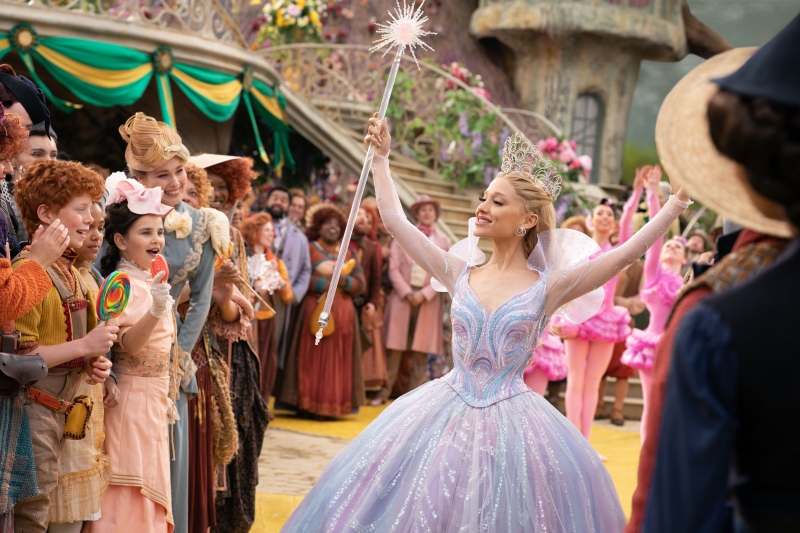
Wicked: For Good is Ariana Grande’s movie. And the film knows it, bending toward her every chance it gets. If the first Wicked centered Elphaba (Cynthia Erivo), the shy outcast whose discovery of her magical powers and the sinister machinery behind the land of Oz led to her being branded the Wicked Witch of the West, Wicked: For Good focuses intently on her opposite number and best friend, Glinda (Grande), now positioned by the powers that be as the good (but secretly powerless) witch who can keep the people happy and placated as their world slides into paranoid dictatorship. Many of those who saw Wicked onstage were understandably curious about how splitting the story into two movies would function. The second half of the stage musical in no way feels like it would lend itself to a complete work. It’s quicker, looser, more fragmented, relying for its cohesion not just on what happened in the first half but also on references to the original Wizard of Oz, whose tale it shadows (and recontextualizes) with brief flashes of Dorothy Gale and her friends’ classic adventure. But director Jon M. Chu has somehow pulled it off. Wicked: For Good is shorter than the first film and, while it might be a step back in terms of spectacle, it’s a leap forward in (go ahead, laugh) subtlety and emotion. My audience was audibly sobbing by the end.
A shocking amount of the picture plays out on Grande’s face. And the actress — one of the most photographed, written-about, obsessed-over women on the planet — holds our attention with her character’s secret heartache. Erivo was the brooding, beautiful star of Wicked Part One; there, Grande made a welcome foil, with her sunny imperviousness and light-as-a feather delivery. Now, Grande revitalizes Glinda’s demure little chin-dips, her perfect posture, and her skip-dance footwork as elegant expressions of a gathering inner turmoil. Though she still loves Elphaba and secretly wants her to succeed, Glinda has been co-opted by the craven Wizard (Jeff Goldblum) and the sinister Madame Morrible (Michelle Yeoh) into serving as a kind of floating brand ambassador for the rapid autocratization of Oz. A rose-tinted princess whose self-absorption fueled her inadvertent cruelty in the first film, Glinda now starts to question her choices. A flashback shows her as a young girl, enchanted by the idea of making people happy and being liked. As she slowly realizes that she can’t always be a people-pleaser, we get a surprisingly relatable portrait of how the world eventually forces us all into dark corners. Glinda becomes a full-blooded character in Wicked: For Good and an often heartbreaking one.
Erivo burned brightly in the first film, but Elphaba has already entered the realm of myth (and marketing) as Wicked: For Good starts: Giant banners warn about the terror she’s allegedly spreading; she leads acts of resistance in heroic silhouette; stores sell special “Wicked Witch” editions of products. She’s still a rather sad avenging angel, though, and Erivo brings vulnerability and melancholy to Elphaba’s stridency. Her rebellion hasn’t liberated her; it’s just left her feeling like more of a pariah. There’s almost zero chemistry, however, between her and Captain Fiyero (Jonathan Bailey), the fought-over hunk of the first film, whose secret love for Elphaba is compromised both by his imminent wedding to Glinda and by the fact that he now disingenuously leads the patrols trying to smoke the Wicked Witch out. But maybe that lack of chemistry is intentional: Though they’re both ostensibly in love with Fiyero, Glinda and Elphaba are too connected to one another for any man to truly come between them.

Click here to preview your posts with PRO themes ››
In case it’s not yet clear, Wicked: For Good is an altogether darker movie than Wicked Part One, and that’s a welcome development. As anyone who’s seen the play knows, some of the supporting characters will become Dorothy’s legendary companions, and Chu has a good time with these transformation sequences, turning them into creepy little moments of body horror. Ethan Slater lends Boq, the once-lovestruck munchkin and embittered manservant, a nice snarl of savagery as he finally mutates into the Tin Man. On the other hand, the final reveal of the Scarecrow’s face is, I suppose, meant to be endearing, but I cackled, and another friend was deeply disturbed; Wicked contains multitudes.
In keeping with tradition, the film is unafraid of its political moment. Gregory Maguire’s 1995 novel was partly inspired by the Gulf War and the 2003 stage musical by the aftermath of September 11 and the imminent invasion of Iraq. Now, as we watch the creatures of Oz being stripped of their voices and their rights, we hear distinct echoes of the real world. But these ostensibly playful metaphors can ring hollow, or go rancid quite quickly. (You might remember Tom Hooper trying to push Cats as a warning about the perils of tribalism.) And as much as I might have briefly entertained the notion of Chu going full-on Battle of Algiers with his sequel, Wicked: For Good embraces its allegorical qualities just long enough for them to be unmistakable — and that’s about as far as it takes things, probably to its credit. For all the speechifying (and singing) about the people and animals of Oz and how their fates hang in the balance of this conflict, neither Wicked movie has ever given us a sense of what this world really feels like. Sure, we have the bright colors and the cool castles and the sweeping vistas and that yellow brick road (which we see being built in this film, a brutal construction project intended to consolidate the Wizard’s dominance), but the citizens of this world remain reduced to crowds, choruses, and cutaways. They’re still there mostly to punctuate story points.
This new picture’s insularity becomes one of its strengths. I admitted in my review of the first Wicked that the songs for the show have never done much for me, and that goes double for this second film, which offers even fewer memorable tunes. The show-stopping numbers of Broadway, where the pyrotechnics and the mechanics of making live humans look like they’ve taken flight can still impress us, can become meaningless when carried over to a movie screen. Interestingly, this time around, director Chu seems less interested in staging epic sequences and choreographing ambitious dance sequences, opting instead for an old-school intimacy with his musical numbers — less West Side Story, more Meet Me in St. Louis. And even though their pop-cultural status requires them to be divas, the two stars are actually better suited to minor keys; they’re more balladeers than belters. All this not only keeps Wicked: For Good from feeling like a rehash, but it also fills out the drama. It would be silly to call this new movie quiet — it’s so totally not — but it is altogether more somber, more focused, more human than the first film. And it brings the Wicked cycle to a surprisingly satisfying conclusion, at least for now.
Sign up for The Critics
A weekly dispatch on the cultural discourse, for subscribers only.