When I was 18, the 20-year-old white guy I was dating wanted to introduce me to his parents. He still lived at home, a completely normal thing for a Mormon-raised boy, since most marry by 22. We walked through the front door down a long hallway into his high-ceilinged living room, where his parents sat on the couch, wrapped in matching blankets and holding caffeine-free Diet Cokes in their hands. “Mom, Dad, this is Shaq,” he shouted. “We’re going down to my room. Yes, she’s Black. Bye!” I froze, awkwardly waved, and followed him down the stairs. We dated for three years. But that’s what it’s like to be Black in Mormon Utah: most relationships start with a disclaimer.
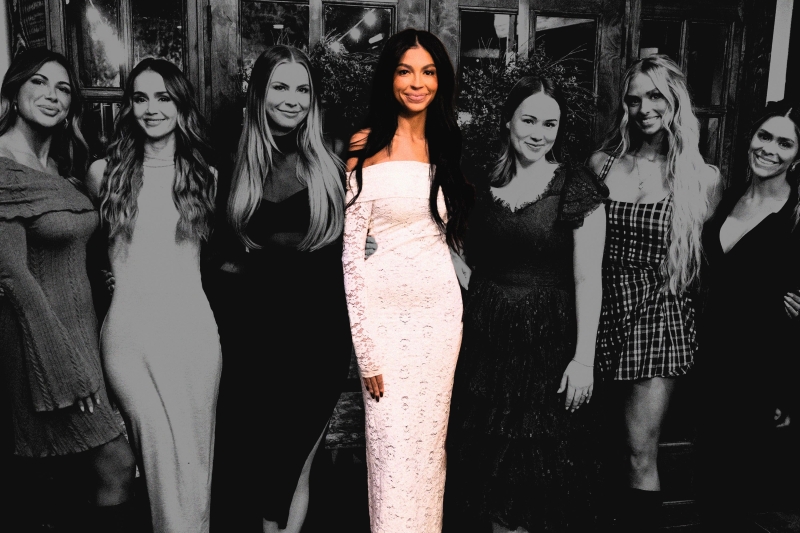
This is the kind of memory that remains dormant until something, or someone wakes it up. And as Mormon mania has taken over screens, from Dancing with the Stars to The Bachelorette, there’s one woman I can’t stop thinking about: Layla Taylor, from The Secret Lives of Mormon Wives. This hugely popular show may be the first time I’ve seen traces of my own life reflected onscreen, and watching her is equal parts fascination and secondhand heartbreak. It took me three days to get through the pilot on Hulu—not because it was bad, but because every frame brought up feelings that I’d buried years ago.
I’m from a sweet town called Ogden with a population of nearly 90,000 people. It’s an hour’s drive from where the Secret Lives women live. Of that number, only about 1,500 of those people are Black. And overall, according to a Pew Research Study, the state ranks 40th among the 50 states in the number of Black residents, with Black Utahns making up a mere two percent of the population from the 2020 census. This scarcity is what made me both hyper-visible and invisible at once. Like Layla, I am mixed-race. My mother was white, from Arizona. My father is Black, from Oklahoma. They met through the military, my mother an Army brat who worked at the local Air Force base where my father was stationed. While I’m very obviously Black looking, in Utah, I was just an enigma. People couldn’t pinpoint what I was: too light to be Black, too obviously not white, so… Mexican? In first grade I had a lisp, which resulted in me being put into an ESL class for a day, as they believed I talked this way because I must speak Spanish.
That’s a prime example of how racism works, in many places, but especially in Utah. There were moments where the racism was blatant, the jokes about my nose and yells of “Penelope” — as in, the girl who was born with a pig’s snout in the 2006 movie of the same name — that followed me down the hall. Those car rides that ended under red and blue lights, my arms held out and trembling for 30 minutes, never happened to my white friends. But ultimately, Utah is a quiet place. The social fabric, woven by Mormon hands, leans toward being docile and placid. LDS culture is about keeping the peace, staying in line, and not causing a scene. And thus, the racism is harder to pinpoint. That’s what makes it so dangerous. It shows up in discreet moments: comments about how much prettier I look with straight hair, or backhanded compliments about how “articulate” I am.
Utah is always ten years behind, so if you were to visit today, it would feel like you time traveled back to 2016: long barrel curls, eyelash extensions, and newly discovered gold jewelry are in. Sweatpants and flip flops are not an uncommon sighting either. Rooted under these easy-to-ridicule surface quirks are deep issues of control, power, and violence spawned by purity culture. It’s hard enough to figure out who you are in your twenties by yourself, let alone in a culture that expects you to be married and raising children by then. When I watch Taylor Frankie Paul being slut shamed by her own stepfather for being sexually active as a grown adult, while the man she was sleeping with is absolved by her family for this and far worse sins, I am reminded that Utah was a place where fitting in meant cutting away pieces of myself, and I knew I wouldn’t make it out whole if I stayed.
Layla joined the church as a teenager, but like the other girls on the show, I grew up in the Mormon Church. On my mother’s side, I have LDS ancestry that traces back to early Utah settlers. That side of my family is still active. After my parents became addicts I was adopted as a teenager by a Mormon friend’s family, and thrown headfirst into the faith. I’d always suspected it was bullshit, but I couldn’t let anyone know I felt that way. Church rules dictated everything: no dating until 16, no caffeine, no breaking the mold of any kind, including rebellions, like lying about smoothies when it was really Starbucks in my cup. My clothes clung to my knees and swallowed my shoulders, even in 90-degree heat. On Sundays, I was the only Black person in the pews, praying over dry bread and lukewarm water, listening as people bore their testimonies about “the first true prophet, Joseph Smith”—a known racist who preached white-supremacist ideology and used his supposed divine authority to coerce women into secret marriages.

Click here to preview your posts with PRO themes ››
I’m 32 now, and it’s been about 13 years since I last stepped foot in a church. I left Ogden for California and never looked back. But Utah, it seems, found me. L.A. friends ask me about dirty soda chains like Swig or tell me what they’ve learned about Mormonism from watching the show. Knowing my background, and having also seen some of the discourse about Black Mormons on Reddit or TikTok, they also ask me about Layla.
Layla often seems distant, and I think part of that is just her personality—she’s clearly more introverted than the other girls. But there’s an episode in season 2, when Layla assures Taylor that she’s got her back, but falls silent when there’s a real confrontation. I think most viewers interpreted her lack of speaking up as cowardice, but I understood the reason for her silence. Forgiveness is not extended to Black women in the same way it is to white women. Taylor or Whitney Leavitt’s defiance (raising their voices, crying for attention), makes them powerful, but would mark Layla as a problem. And if their skin was darkened by genetics rather than spray tans, society would be treating this same group of divorcées and single mothers with far more judgment. For someone like Layla, her social calculations are not just about losing her place in Momtok; it’s about risking her bag, her safety, and a sense of belonging altogether.
And so I get frustrated when my girlfriends ask me about Layla. Their tone is familiar, sharp with judgment. These are judgments I’ve felt rise in myself, too: Why does Layla stay loyal to these white girls, who call themselves feminists while secretly voting for Trump? How could she remain in a church that upheld racist doctrine, a church that restricted Black members until 1978–fourteen years after the Civil Rights Act? Why won’t she just climb out of the sunken place?
In a Teen Vogue interview from earlier this year Layla notes that her desire to join the church stemmed from a dysfunctional family that made her yearn for familial warmth. (She’s posted previously on her socials using hashtags like #MommyIssues, something that I once also declared within my own IG bio.) I wince when I see that a lot of the online comments about Layla are actually just racist, and tend to reduce her to a number fulfilling a quota rather than treat her as a person. I know what it’s like to have a “rough” upbringing, to crave family and stability in any form the world offers. For me, steadiness came in the form of online chatrooms, music, and books. For Layla, it was joining the Mormon Church, which unfortunately is an institution built on hierarchical conformity. I remember how easy it was for my friends to roll their eyes about me not wanting to go to the pool, when one splash would destroy the silk press that had taken me three hours to get right. I still see boys from high school viewing my Instagram Stories, the ones who had crushes on me but couldn’t imagine what they would say when they took me home to their Mormon mothers.
It is not easy for me to be empathetic to Layla—it hurts to revisit what it felt like when I was in her shoes. I have fallen for the intoxicating illusion that whiteness offers—privilege, protection, status—and I once convinced myself it could give me what I craved, only to later learn that it made me hungrier. The insidious systems of patriarchy and white supremacy are not just external forces, but subtle everyday distortions of self. They creep into how you see yourself in the mirror, how you choose who to love, and how you measure your worth in a room that wasn’t built for you. It’s so deeply ingrained that it often escapes notice, even your own. For me, that’s the most difficult part of watching Layla on the show, knowing how much those compromises cost. It’s easy to call out her choices from the outside. It’s much harder to live them.