One of the most encouraging items among this year’s Sundance prize winners was Kosovar director Visar Morina’s Shame and Money nabbing the Grand Jury Prize in the World Cinema Dramatic category. (This category has, in recent years, become one of the more interesting parts of the Sundance line-up.) Morina’s small, well-made picture could use the higher profile brought by an awards win, because it probably can’t otherwise preen for attention through controversy or hot-take-friendly subject matter. That’s not to suggest that it’s alienating or difficult; in fact, it’s probably more accessible than your average superhero movie, because it’s about two universally understood concepts. (You get one guess as to what those concepts might be.) Shame and Money’s power lies in its hyper-realistic depiction of the everyday challenges of economic survival and its psychological toll. Still, its perspective is unlike any I’ve seen in recent years.
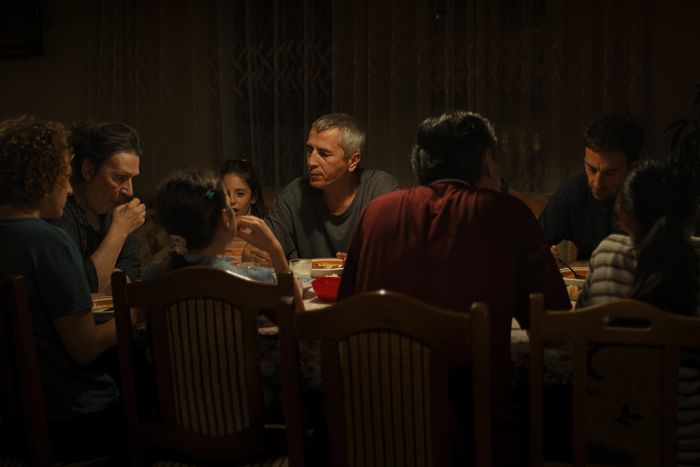
The film begins in a small family farm where Shaban (Astrit Kabashi) and his wife Hatixhe (Flonja Kodheli) spend their time tending to their cows, whose dairy products they sell and barter to earn a living. They reside with Shaban’s mother (Kumrije Hoxha) and his brother Agim (Abdinaser Beka), a schoolteacher — one big, seemingly happy family, crowded around a dinner table. When the youngest brother Liridon (Tristan Halilaj) comes around asking for 1800 Euros so he can move to Germany for a job, the family mostly ignores him; Liridon, it seems, has a reputation as a deadbeat. After one contentious confrontation, however, the younger brother disappears — and so do the family cows. Suddenly left with no way of making money, Shaban, Hatixhe, Shaban’s mom, and their three kids move to the big city of Pristina, where Hatixhe’s brother-in-law Alban (Alban Ukaj) owns a night club and helps them find part-time work and a place to stay. Realizing they don’t have enough, Shaban starts working as a day laborer, hanging out at gathering spots on the street.
That’s not a particularly dramatic story, and Morina doesn’t treat it as such. Oddly enough, that’s where Shame and Money’s power lies. Shaban and Hatixhe are so industrious and pragmatic about their predicament that they approach the issue of labor in matter-of-fact fashion. When they arrive in Pristina, they go hand in hand to any business they can find — restaurants, construction sites, garages — and directly ask if anyone’s hiring. They might be middle-aged, but they can handle physical labor and aren’t too proud to get down and dirty. Back at the farm, we see them regularly handling sick cows, so it’s not too much for them to later deal with everything from Hatixhe’s sister’s invalid father-in-law or a woman who’s passed out in a nightclub bathroom.

Click here to preview your posts with PRO themes ››
No, it’s everyone else’s response to their guilelessness that causes problems. The bourgeois Alban can’t handle the thought of his well-to-do neighbors seeing members of his own family on the street looking for work. When he tries to give Shaban some money so that he won’t have to work, Shaban looks at Alban like he’s from outer space. (The wiry, understated Astrit Kabashi gives Shaban an admirable innocence; he looks like his moral compass has been unsullied by years of social status bullshit.) Shaban and Hatixhe don’t want handouts, and they also don’t understand the unspoken social codes of capitalism and class. They just know what they need to do to survive, and they even take some pride in that. When Hatixhe’s sister gives her some money, she swears Hatixhe to secrecy. The sister also tells Hatixhe not to tell anyone that she’s getting fertility treatments. The mirage of prosperity also requires the illusion of ease in all other matters.
Morina’s direct style — following Shaban and Hatixhe closely, highlighting the physicality of their labor — adopts the matter-of-fact attitude of his protagonists. At times, I was reminded of the work of the Dardenne Brothers, or Mike Leigh, but Shame and Money is even more understated than the films of those directors, which often resolve towards something more climactic. Shame and Money does have striking, violent moments towards the end, but Morina also leaves us wondering if those are actual incidents or something more symbolic and dreamlike. In other words, the film’s relentless authenticity dissolves into the visionary as it proceeds — suggesting that Shaban and Hatixhe have gained something resembling dual consciousness, a class sense of how they look to everyone else around them. Shame and money finally become intertwined in their minds. The movie is a tragedy.