The world never stops, but it does sometimes freeze. Postapocalyptic movies have taught us that, as they’ve presented all manner of wastelands strewn with the physical and cultural remnants of a past when the world was whole. Danny Boyle and Alex Garland’s 28 Days Later films (is that what we’re calling the series?) began with such images — of an empty London frozen at the moment of the zombie apocalypse — but last year’s 28 Years Later, reviving the franchise after nearly two decades, showed us how the survivors of that long-ago calamity tried to forge on in their own ways, combating the “rage virus” with twisted new societies and cults built from history’s detritus. Now, with 28 Years Later: The Bone Temple, directed by Nia DaCosta, we witness a different kind of freeze: a psychological one. The minds of the people in this movie are also stuck in the past, even the ones who weren’t around to experience it.
The Bone Temple is in many ways a more conventional film than 28 Years Later; DaCosta thankfully doesn’t try to re-create the herky-jerky rhythms and mixed-media montages of Boyle’s picture. But it is a more psychologically acute effort. The earlier movie ended with a rather out-there finale that saw its 12-year-old protagonist, Spike (Alfie Williams), encounter a bizarre gang of blond-wigged, tracksuited, acrobatic zombie killers, all answering to the name of Jimmy. Now, we learn more about this little band of wannabe cretins and the twisted pseudo-satanic cult that their violent leader, Jimmy Crystal (Jack O’Connell), has conjured around himself. Jimmy’s look is seemingly inspired by that of legendary British DJ and notorious sexual predator Jimmy Savile, whose crimes were mostly uncovered after his death in 2011. In this picture’s world, in other words, Savile (or at least some fictional version of him) would always have remained a beloved figure, his whole shtick there to be repurposed and exalted by The Bone Temple’s psychotic villain, whom we saw in the previous film’s early scenes as a young child surrounded by Teletubbies and religion at the time of the apocalypse. All that iconography, it seems, has conjoined and curdled in his mind to create the stunted-child monster he is in this movie’s present.
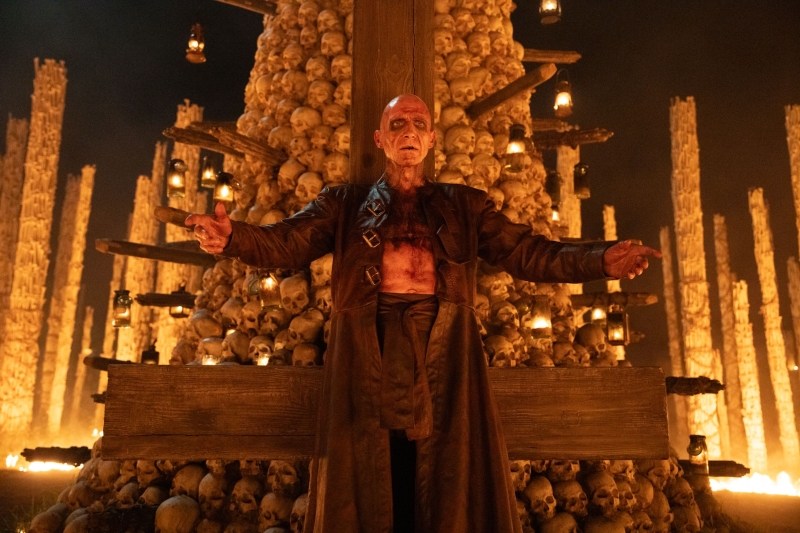
The somewhat fragmented, traveloguelike narrative of 28 Years Later is also replaced here by more fluid intercutting. While Spike struggles to fit in with the Jimmys’ murderous ways (it turns out they don’t kill just zombies), Dr. Ian Kelson (Ralph Fiennes), who was introduced in the earlier film as a kindly, nutty hermit, tries to find ways to commune with the undead, dosing the massive alpha Samson (Chi Lewis-Parry), he of the infamously large zombie member, with morphine to see if that might pacify the beast. Kelson’s continuously growing temple, trees festooned with bones around a central tower of skulls, serves as a tribute to all the dead, including the zombies. In 28 Years Later’s most moving scenes, he spoke eloquently about trying to maintain one’s humanity and empathy amid such savagery by maintaining memories of the universality of death. That in order to do so he had to become something of a savage himself — a tough and crazy loner covered in red iodine and ready to do battle at a moment’s notice — was a supreme irony. Now, however, Kelson wants to see if his morphine concoction might bring Samson back to the person he once was. Does the infection destroy the mind, or is it more like a cloud, something that could conceivably be lifted? But Kelson doesn’t have enough morphine to make a real cure; mostly, he just seems to want a friend. He and the sedated Samson sit in the moonlight looking up at the stars. They even dance together. This is a very strange movie.

Click here to preview your posts with PRO themes ››
That the big zombie starts to show more humanity than the ostensibly non-zombified Jimmy Crystal should come as no surprise — genre films love that kind of humans-are-the-real-monsters reversal, and the previous entries in this series also touched on such ideas. What distinguishes The Bone Temple is that all these little paths into the characters’ inner lives start to cohere into a vision of human cruelty. In a brief flashback, we see Samson back when he was a happy young child riding the train with his parents; presumably, that was his infection point. In another moment, we see one of his victims through his eyes, and it looks like he’s basically attacking himself, as if trying to kill the thing he has become. Compare that with Jimmy Crystal’s desire to turn the kids he gathers into perverse photocopies of himself and the style he has adopted. Both extremes, each incapable of seeing others for what they are, result in immense barbarity.
The beauty of DaCosta’s film is that these particular ideas are worked in subtly, even though The Bone Temple itself is not what one might call subtle. In fact, it’s downright looney tunes, from Kelson’s occasional dance parties (powered by his collection of early-’80s LPs) to the screwy antics of the Jimmys to one spectacular extended climactic sequence of heavy-metal bravado that had my theater cheering and hollering. But even such scenes of crazed flamboyance fit into the film’s overall sense of a civilization stuck in time, of people mentally frozen at the moment of collapse. The only way to transcend and survive a dying world, it suggests, is to cut loose and find ways to be yourself.
Sign up for The Critics
A weekly dispatch on the cultural discourse, for subscribers only.