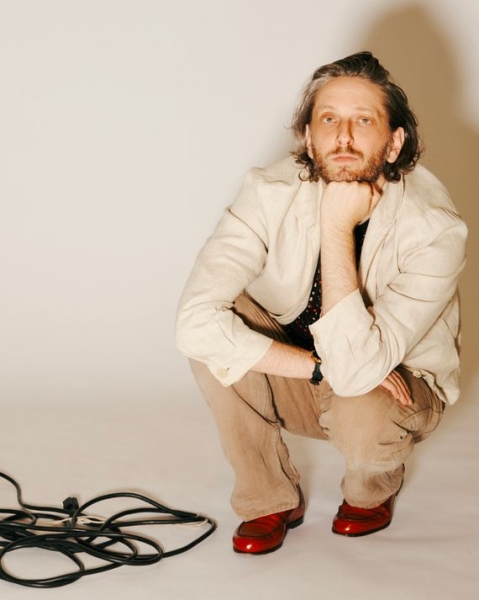
Daniel Lopatin, better known as the musician and film composer Oneohtrix Point Never, used to make music for advertisements. “The consulting firm that hired me was always like, ‘You’re the man, do whatever.’ I’d be like, ‘Okay, cool.’ They’d ask me to be myself. And then the brand would go, ‘What is this? This is insane,’” he says, comparing the unconventional jingles he created to the surrealist short films David Lynch made for luxury fragrances and midsize sedans between movies. “They’d ask me for a revision, and I’d be pissed and dejected and make joke music — music for clown cars. Then I’d never hear from them again. That’s usually how it went.”
Since his debut album, 2007’s Betrayed in the Octagon, which reimagined the supposedly cheesy synthesizer sounds of 1980s New Age into an enveloping soundtrack for dread and ennui, the 43-year-old’s uncompromising approach has attracted some of the most influential ears in Hollywood. He has become a creative docent for artists seeking an injection of his outré sensibilities, including Charli XCX, ANOHNI, Soccer Mommy, and pop megastar the Weeknd.
But it’s his film scores that have put him in the awards conversation. A fan of Lopatin’s early ambient releases, Josh Safdie contacted him while working out the sonic and emotional landscape of his 2017 neon-noir movie, Good Time, which he co-directed with his brother, Benny. Lopatin’s score modulated between tension and unbearable anxiety until its poignant (Iggy Pop–assisted) catharsis. He worked again with the Safdies on 2019’s Uncut Gems, adding a contented, meditative spaciness to match the Pollyannaish dreams of the film’s protagonist, played by Adam Sandler. And now, for Josh’s ’50s-set Marty Supreme, Lopatin has composed a score full of sounds from the ’80s and beyond. Like Trent Reznor and Mica Levi, he has transported compositional styles more common at basement noise shows to big-screen success. His music is made for headphones; it’s simultaneously optimistic and alienated, like so much of virtual life. Through his ability to undergird a scene with these kinds of complex feelings, he has begun his ascent into an elite echelon of star composers. He can “make the music weave into the picture to become one complete, immersive, living thing,” says Sofia Coppola’s music supervisor, Brian Reitzell.
In person, Lopatin is disarmingly sweet. When he talks, his hands never stop moving, whether to demonstrate a keyboard part or to gesture toward a heady, philosophical idea. We meet at a dumpling spot inside a semi-abandoned mall in Chinatown, where he has joined me from his home in Williamsburg. Mid-meal, a fan who had been eating nearby stops at our table to acknowledge Lopatin’s influence on his own development as an electronic musician. Lopatin seems genuinely interested in the guy’s music and his opinion of the food. This kind of thing tends to happen: Years ago, Timothée Chalamet came up and introduced himself at a party. “He’s like, ‘OPN, what do you know about guitar? I can’t really talk about it, but I gotta learn guitar. Can you help me out?’” Lopatin recalls. “I was like, ‘Not really.’” Chalamet, unable to suppress his excitement, whispered, “I’m playing Bob!”
Lopatin comes from a musical family. His mother was a conservatory-trained pianist and musicologist, and his father, an engineer, improvised on synths in a psych-rock cover band. They emigrated to Massachusetts from the USSR in 1982 and worked in tech. “I am the exact product of my circumstances,” says Lopatin. While living in Boston, bored with his textbook-publishing job, he started recording as Oneohtrix Point Never, a jokey reference to the local soft-rock station he grew up listening to. In 2009, he began making “eccojams” by overlaying snippets of schlocky, mall-friendly radio fare from his childhood on compilations of footage ripped from YouTube and ancient VHS tapes, turning them into experimental film scores of glitchy, uncanny longing. He moved to New York to attend Pratt’s library-sciences grad program and escape the aggro masculinity of New England’s experimental-music scene.
In 2011, Reitzell heard Lopatin’s haunting television samples on his album Replica and emailed him. “Brian was like, ‘Hey, I think you should really consider getting involved in scoring. Do you want to come out to L.A. and shadow me?’” Lopatin says. How could he say “no”? As a child, he had wanted to become a filmmaker, going as far as to apply to NYU’s film program (he didn’t get in), and had long thought about his own music as if it were a soundtrack for a nonexistent movie. “Whatever Brian was working on, I was working on,” Lopatin says. That soon included The Bling Ring’s many needle drops, which Lopatin’s compositions spritzed the edges of. Reitzell told him, “Sofia says your music sounds like perfume.”
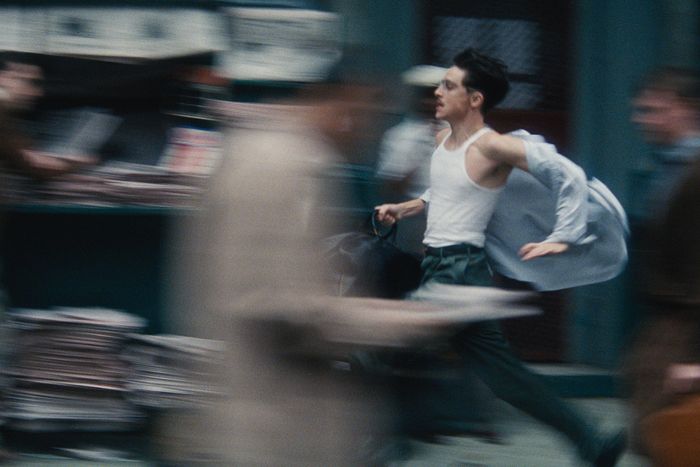
Timothée Chalamet in Marty Supreme. Photo: A24
In 2013, Lopatin signed to the storied electronic label Warp Records. His first album for it, 2013’s R Plus Seven, sounded like a joyous roller coaster of MIDI instrumentation. Subsequent releases have incorporated harpsichord and touched on nü metal and the “dead air” of radio format changes. Brands and TV shows wanted his music (or so they thought), and his work started appearing in major art institutions such as MoMA, Tate Britain, and the Hammer Museum. Lopatin began to grow wary of the compromises he was being asked to make for commercial work. In 2015, Josh Safdie reached out after returning to Lopatin’s 2007 song “Behind the Bank,” which he first heard on a mix CD while working at a video store in Little Italy. He sent over a mood board for Good Time featuring a picture of SpongeBob and, in Lopatin’s words, “weird heist imagery.” “This is exactly the contrast that I’m into,” Lopatin said at the time. “I was really impressed. They were definitely speaking my language.” Soon, he and Safdie were pirating plug-ins for weird sounds and discussing how synths can function in a film score.

Click here to preview your posts with PRO themes ››
While Good Time and Uncut Gems are set near the present day and their scores roughly reflect those time periods, Marty Supreme is about the past. The titular character, played by Chalamet, is a scrappy kid trying to claw his way out of the shtetl of the Lower East Side through his Ping-Pong prowess and charismatic hucksterism. The original script Lopatin read included cues for anachronistic songs. “Marty is envisaging a version of himself that is totally out of step with everyone else,” Lopatin says. “He has to create this self-image of the man he wants to be. And that is represented by the music of a time that has yet to happen.” (As Lopatin’s music usually incorporates synthetic textures, it’s hard to imagine him making authentic ’50s-style compositions.)
Lopatin and Safdie spent around four months in the summer and fall of 2025 working on the score in a cramped midtown studio. Safdie asked him to include intricate, quasi-Baroque arpeggios. “I’m sending him the Brandenburg Concertos,” Lopatin says. “ ‘Is this what you’re looking for?’ He’s like, ‘Not quite.’” The music for a sex scene in Central Park begins with a buoyant minimalist melody and then erupts into a power-ballad guitar solo. Other moments evoke the epic mall music of the Trans-Siberian Orchestra. The combination of those Baroque sounds with ’80s hits like Tears for Fears’ “Everybody Wants to Rule the World” and a fantastic choral arrangement of Alphaville’s “Forever Young” adds to the film’s temporal unconventionality. The score is currently on the Oscars shortlist.
Lopatin’s work with the Safdies connected him with Abel Tesfaye, who records as the Weeknd; they first worked together on music for Uncut Gems that ultimately didn’t make the soundtrack. They’ve since collaborated on multiple albums, a Super Bowl halftime show, and a full-length movie. “I’m just so smitten with him as a vocalist that it’s hard to work. He has the voice of a cherub. And I’m like, Okay, lock in — this is work. I need to finish this piece of music,” Lopatin says. He scored the Weeknd-starring Hurry Up Tomorrow — essentially a feature-length music video about how hard it is to be a pop star. The film, which accompanied the Weeknd’s final album under that moniker, was widely panned. The New York Times called it a “hollow core” of a movie; Pitchfork saw it as “caught in the strangulating grasp” of Tesfaye’s “self-made mythology.” Lopatin gets briefly defensive when asked about it. “Hurry Up Tomorrow is way more interesting than people want to give it credit for. I love the film as a rock opera. I think Abel was being retroactively maligned for The Idol,” he says, referring to the heavily criticized HBO series also about the travails of pop stardom. “I think sometimes critics parrot each other more than reach their own conclusions.”
His sympathy isn’t reserved for entertainment royalty. A few days before we spoke, he’d been viscerally upset by the cruelty of an Instagram Reel he’d seen of someone using an AI video to confuse and frighten an older person. “I don’t think the world is necessarily going to fall into pieces, but it’s a lack of consensus reality that is painful and exhausting,” he says. “Humanity is just out of reach now. It’s right there on the shoreline, and we’re drifting away really slowly.”
He’s not opposed to AI on principle. For his 2023 album, Again, Lopatin incorporated music generated or altered by AI software, including OpenAI’s Jukebox. “It was this really sweet-spot moment for AI because it was so bad. As it’s gotten better, it’s just become more standardized and mid,” he says. He thinks the tech industry is mostly selling snake oil, but he won’t rule out AI as a potential tool for artistic experimentation. “You can’t reject ugly things just for being ugly,” he says. Otherwise, “you’re just closing your eyes to what is all around you.” Still, he avoided AI while making his most recent album, November’s acclaimed Tranquilizer, and composing Marty Supreme’s score.
Lopatin has often described his artistic ethos as “compressionism,” an attempt to embrace and distill the chaos and grotesquerie of contemporary life. “It’s asking, ‘Do you want to be in control of your destiny and enjoy your reality as everything’s fragmenting around you?’” he says. (Incidentally, this is the central struggle of Marty Supreme.) “‘Or do you just want to be subdued and imprisoned by it?’”
Thank you for subscribing and supporting our journalism. If you prefer to read in print, you can also find this article in the December 29, 2025, issue of New York Magazine.
Want more stories like this one? Subscribe now to support our journalism and get unlimited access to our coverage. If you prefer to read in print, you can also find this article in the December 29, 2025, issue of New York Magazine.