A couple of years ago, at the height of awards season, I moderated an onstage Q&A with Brendan Fraser after a screening of The Whale. It was a SAG-AFTRA event, so the audience was made up largely of actors. Fraser had already been nominated for the Best Actor Oscar, but not everyone was convinced at the time that he would win; many considered Austin Butler the favorite for Elvis, while film critics were hoping for a Colin Farrell upset for The Banshees of Inisherin. As soon as Fraser took the stage, however, it was clear that the thing was his. The audience went bananas, and the star held them rapt for the next half-hour or so as he talked about not just his performance in The Whale but also his career ups and downs. Fraser had achieved success early — he was 23 when Encino Man came out and a megastar by his early 30s thanks to The Mummy — but because of the fallow periods of his later career, he could relate to the challenges of the jobbing actor. He understood the seesawing anticipation and disappointment that came with the profession.
I kept flashing back to that evening as I watched Japanese director Hikari’s new film, Rental Family, in which Fraser plays a lonely, middle-age American actor living in Tokyo for whom the good parts have largely dried up. Phillip Vandarploeug (Fraser), we’re told, went viral in Japan some years ago for a series of toothpaste commercials in which he played a goofy, toothbrush-riding superhero. Now, he spends his time either auditioning and getting rejected or sitting around soundstages waiting to portray sentient plastic trees. One day, he’s enlisted to pretend to be a “sad American” at a real-life funeral and is startled to discover that the dead man lying in the coffin isn’t dead at all; rather, the whole event appears to be a cathartic pantomime designed to get the “deceased” to feel better about his life. These so-called “specialized performances,” arranged and orchestrated by a company calling itself Rental Family, are all designed to help clients “connect to something they thought was missing.” Sometimes they’re acts of self-deception, and sometimes they’re outright ruses: For one of his first gigs, Phillip pretends to be the American groom at a Japanese wedding; the unsuspecting parents want peace of mind and a memory, while the savvy bride intends to move to Canada with her girlfriend as soon as the ceremony is over.
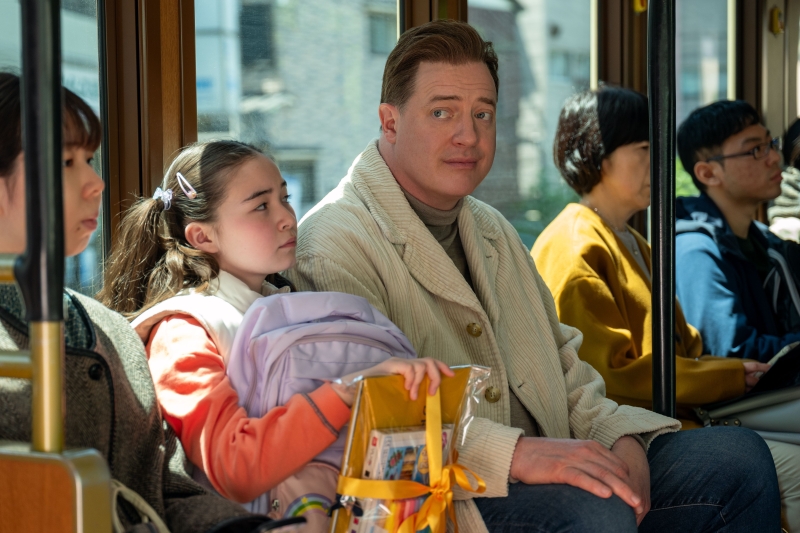
The bulk of Rental Family follows Phillip as he pretends to be the long-absent father of a young Japanese American girl, Mia (Shannon Mahina Gorman), whose mother (Shino Shinozaki) hopes to get her into an exclusive school; the girl needs both parents to be there for the application process. Angry at her father for abandoning the family, Mia initially lashes out at Phillip but soon warms to the lovable lug. He gets to be the “fun parent,” the dad who shows up and plays with her at school and takes her out to street fairs and other events; the mom warns him, however, not to get too close, since he’ll eventually have to disappear out of their lives forever. During this period, Phillip also pretends to be a journalist interviewing an aging, fading, forgotten screen legend (Akira Emoto) for a big tribute interview.
These setups might prompt you to doubt their plausibility. Rental Family’s soft, breezy tone — complete with a gently jaunty score that never seems to stop — keeps things moving along, but its polished ease can leave questions in its wake. Is posing as someone’s parent for this long really that easy? Is it truly an act of kindness to pretend to interview someone if you have no intention of ever publishing anything? Sham weddings are one thing, but a sham wedding to a total stranger? And besides, isn’t somebody in Tokyo eventually going to recognize the enormous six-foot-three American who once played a superhero in a series of popular TV commercials? Rental Family has some grounding in actual rent-a-family services in Japan; Werner Herzog made a film about it in 2019, and Elif Batuman wrote an award-winning and controversial 2018 piece for The New Yorker about it. (That specific article was partly debunked, but as far as I can tell, the rent-a-family phenomenon is quite real.)
To its credit, Rental Family doesn’t try to present an anthropological portrait of an exotic, “weird” Japan. The combination of practicality and complication demanded by the rent-a-family business startles us — so many moving parts and so much pretending just to conjure something so simple — not so much the fact that ordinary people have such a need for friends, family, and affirmation that they’re willing to pay for it. Questions of logic aside, the whole thing slowly starts to feel like a not-so-terrible concept. Is it so wrong to hire someone to fill the gaps in our lives?

Click here to preview your posts with PRO themes ››
The growing appeal of this idea might also owe something to Fraser’s onscreen charm. All the parts Phillip must play take advantage of his affability and outward kindness. As a parent, he’s eager to please; as a groom, he’s deferential; as an interviewer, he’s curious and patient. (We also see him play-acting as a simple friend for one unnamed man; he seems like an attentive and supportive pal.) It all works because Phillip could be Brendan Fraser, whose easygoing and sunny demeanor made him a unique star back during a time when most leading men were trying to smolder and brood their way into our hearts. Fraser was always something of an innocent, from Encino Man to Blast From the Past to George of the Jungle; his characters were perhaps a bit dim, but their personalities exuded brightness. Even when we didn’t like his films — and, let’s be honest, the man appeared in some terrible films — we couldn’t help but like him, because he always seemed so approachable. That was what made his performance in The Whale work, too: For all that film’s darkness, the character at its heart struggled to hang onto his wounded innocence, even as he embraced his self-destruction and death.
This quality — of openness, of purity — is not just the key to Phillip’s success as a fake father and journalist and husband, it’s also why he eventually buys into his own deception. He starts to believe on some level that he must be a father to Mia. That’s not an unpredictable plot development; the movie probably couldn’t exist without it. But there’s enough of a child peering through Fraser’s wide eyes and huge, all-American half-smile that we understand how this man would get carried away with his own ruse. Make-believe runs through Rental Family on all levels. Phillip and Mia build phony animals out of found objects; they go to carnivals where they get face paint applied. This is a world of karaoke bars and digital aquariums and screens — a surface-deep universe of constant performance not unlike our own. Everybody’s pretending, all the time, everywhere, and Fraser makes an ideal avatar for our own desire to disappear into phony realities (though because this is a movie, he actually gets to find enlightenment amid all this fakery).
Fraser has had solid credits the past few years (he was in Killers of the Flower Moon, after all), but there’s still something slightly out of step about him. He’s signed on for another Mummy movie — which will hopefully be more like the 1999 original and less like its middling sequels — but he’s also far removed from his hunky heyday. He’s at his best when he’s exuding sweetness and light, and those qualities are not in high demand among big, important movies nowadays. His Oscar for The Whale made for a great comeback story, but it also put him in an odd position, because Fraser had never really been a critical darling; he made hits, sometimes dumb hits.
Which brings us back to the image of the struggling actor, to which he clearly connects. Watching Rental Family, I kept thinking, Wow, this is a perfect role for Brendan Fraser, but where the hell does he go from here? It’s not like there’ll be other roles like this. But here’s the thing: I also thought the same thing while watching The Whale. Sometimes, an actor seems so well suited for a part that not only can you not imagine anyone else doing the part, you also can’t imagine that specific actor ever doing any other part. It’s rare enough for it to happen once, and yet it keeps happening with this guy. This probably sounds insane, but maybe there’s just an empty spot in today’s cinema where Brendan Fraser needs to be. Rental Family might be a modestly likable, often uneven movie about a fictional American actor in Japan, but it’s also a thoroughly fascinating movie about a very real actor in the midst of one of the strangest careers I’ve witnessed.