Taste Test
What is “good taste” anyway? Allow your favorite actor, musician, celebrity, or comedian to let you in on what they’re watching, reading, and consuming.
“You’re awakening my brain back up,” Brooklyn-based writer Sasha Bonét tells me. She’s feeling incredibly well rested after spending winter break in upstate New York with her daughter, her boyfriend, and zero cell service. It was bliss.
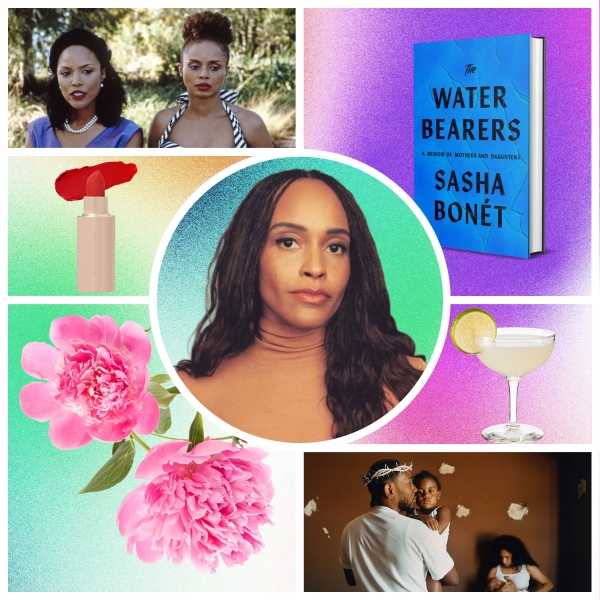
The break was certainly needed: The Houston-born author and professor of creative writing at Columbia University began touring her debut book, The Waterbearers: A Memoir of Mothers and Daughters, last year and still has a few stops left in 2026. In the book, she explores the interlinked concepts of sacrifice and womanhood using a blend of narrative nonfiction and memoir, looking to Black women who are mothers and who mothered America “from the beginning” as tributaries who converge into the river of herself, and who help her understand lineage’s flow. Bonét gracefully unspools the “generations of repressed grief” that exist within her body and her country that shaped her own motherhood journey beginning with her grandmother Betty Jean, who was born on a cotton plantation and raised 11 children, and bridging her story to her mother’s and other Black foremothers’ including Recy Taylor and Ona Judge. “I’ve inherited the duty to feel it all,” she writes.
The title of your book is inspired by Lorna Simpson’s 1986 photograph Waterbearer. Where did you first see that image and what does it represent to you?
Lorna is my neighbor who I run into all the time. I first saw the image in person at the Brooklyn Museum’s “We Wanted a Revolution: Black Radical Women, 1965–85” exhibition in 2017. It was so striking that I hung it up in my workspace. I use visuals to help me understand what I’m trying to do, and I was like, Exactly what this image is saying and what it’s moving inside of me is what I want to create on the page with this project. It wasn’t until the very end when we were preparing to sell the book that I came up with the title. We were pushed up against the wall, and I didn’t have one. The photograph reappeared in my mind and I was like, Oh, of course, this is the title.
Did you tell Lorna immediately?
Yes, as soon as I saw her at the local wine bar. She was sitting with Thelma Golden, and I was like, “I’m sure whatever y’all are talking about is important, but I just want to say that I named my book The Waterbearers.” And they were like, “Oh, nice, let us know when it comes out.” I sent them both copies.
You initially wanted to write about Black womanhood, but you write in the book you “kept being pulled back to motherhood.” Can you explain how that happened and how it changed the scope of the book?
I wanted to try to understand the experience of Black womanhood in the Americas, how the culture has been built, why we do what we do, why we say what we say, and all of the research that I could find was always about the women in relationship to mothering. I was getting so frustrated because I was a young mother, and I was really pushing back on this idea of motherhood being my identity. I wanted to prove that I wasn’t just a mother, and I’m going to accomplish everything even though I’m young and have this baby. But there was absolutely nothing that wasn’t related to motherhood in tracing Black womanhood to the early development of the country. I can’t escape it because this is how it started. This has been the role of Black women in the American empire from the beginning. I needed that information in order to build the book and build the characters within the book.
You wrote something funny in the book, that you can always tell when someone was raised by their grandma. Can you remember the last time you clocked someone like that, and what gave them away?
I suspected that my boyfriend was raised by his grandmother because of all of the metaphors he used when he spoke and told stories. On our second date, he made dinner for me and placed a framed photo of his grandmother on the table with us while we ate. It felt like it was the three of us there. I thought it was so strange and so sweet.
Another significant time is listening to Kendrick Lamar. I was listening to Mr. Morale & the Big Steppers, before his beef with Drake, while I was writing the book. That album felt very connected to the work. The references that he was using, the place setting he had, it all sounded like he grew up in someone’s granny’s house. I don’t even know if that’s true, but if he wasn’t raised by his grandmother, he definitely spent at least a lot of time with her. Listening to that album, I would cry a lot because there was so much connection in what he was saying.
There’s a surprising line in his GNX album that’s like, “I cut my granny off if she don’t see it how I see it.”
Right, which is so funny. I think he understands the power of that line because he was raised by his grandmother, that’s my theory. He has this other line in another track where he says “where your grandma stay?” because there’s this idea that your grandmother is your orientation to the world. People would ask me that all the time, it’s like your validation tool, your rooting and your tethering. It says you come from a place and that there are people who know you there and who can vouch for who you are, your character. And the idea of not having that, it really does say you are untethered.
In the book you explore your mother’s love for Douglas Sirk’s Imitation of Life and how it influenced her understanding of womanhood. Is there a movie like that for you?
I would say Eve’s Bayou is one of those films that I saw when I was very young, similar to when my mother saw Imitation of Life, and it stayed with me. It was haunting and scary, but I also wanted to be these women. I felt like I was the girl in the film, who’s kind of observing everything, seeing what’s going on but staying quiet, and then, in the end, kind of erupting with all of the information she had. And how that knowing can be such a burden, and you have to carry it by yourself, and you can be surrounded by people who are telling you that the story you have seen and calculated is not true. You have to trust yourself and trust that these people aren’t ready to see what you’re able to see. I’ve definitely forced my daughter to sit down and watch that film with me, and she’s not as impressed with it as I was. Plus, it was set in the South. I recognized these people as my family, and it felt very true, the way the women kind of collectively hush each other. There’s always that one girl that stands out that’s like, Actually, everybody’s lying. I guess my book is like that in some ways.

Click here to preview your posts with PRO themes ››
So, we talked about you running into Lorna Simpson at the wine bar — what’s your go-to bottle of wine?
I don’t really drink wine. Everywhere I go, I order a gin gimlet; that is my drink, that is all I drink. That particular wine bar also serves cocktails. And I love Neversink Gin, a New York–based small-batch gin company.
What’s the best gift for a party host?
I love to host dinner parties. I write a bit about this in the book, that as a single mother I had to host things at my house in order to be social. First of all, you need to bring something. It is so impolite to come to a dinner party with nothing. Wine is great, but I love flowers that are already prepared to be put in water or already in a vase so the host can just put it right on the table without having to do extra work.
What’s your favorite flower?
Peonies. I love how they’re like a rock, essentially; they’re curled up, and then they burst open in this really indecent way that reminds me of magnolia-tree flowers. The way that they end up looks nothing like how they begin, and they can never go back to that shape. It’s beautiful.
Do you have a favorite beauty hack to look instantly pulled together?
I am not a beauty-hack person. I do the absolute minimal beauty routine. I wear my hair in braids. I don’t wear any makeup. I would just say the hack is drinking water and moisturizing. As long as I’m moisturized and hydrated, I feel I look good. I don’t have a whole lot of patience for getting myself together. But a red lip is definitely my go-to because it instantly elevates everything. I used to be a Ruby Woo girl, but it gets so dry on your lips so I switched my red to Pip from Westman Atelier. And a beautiful coat. I don’t even really have to get dressed if the coat’s nice. I recently got a Rohé double-breasted coat. It looks like menswear. Very bossy.
Is your Spotify Wrapped still top of mind? Do you know which artist or song you listened to the most last year?
It was “He Loved Him Madly,” by Miles Davis. The song is like 30 minutes long, and I put it on loop. It plays nonstop while I’m working.
Is that the ideal writing soundtrack?
Yes, any type of jazz: Miles Davis, Don Cherry, Alice Coltrane, and classical ambient music, those are my go-tos for trying to hypnotize myself into the moment.
What’s the best concert you’ve ever been to?
The last concert I went to before the pandemic shutdown, Roy Ayers on the top of the Standard Meatpacking, in the Boom Boom Room. It was intimate; it was gorgeous. I just love him so much. The way people were, I haven’t experienced that since we’ve come back from the pandemic. And my very first concert, Destiny’s Child at the rodeo in Houston, I was maybe 10. It was incredible because they were so young and new, no one was really there. They were just singing to a few of us. The rodeo is in the middle of the pit with the cows and the bulls, and I remember the sand and gravel getting between my toes. That was an iconic moment that I can’t forget.
What’s the most Texan thing about you was one of my questions, and it might be that memory.
Oh, I’m so country. When people come to visit me in Houston, they can’t even understand me and my family talking. But I’ve developed a way to at least try to talk to people up north. I love riding my horse Eli in Queens at GallopNYC. He’s a gorgeous Palomino Rocky Mountain horse. I’m totally a horse girl. It’s my absolute favorite thing to do.
I do things very slow, that’s another southern thing. When people start to rush, it really stresses me out. Obviously living in New York, that’s happening all the time. But it’s like, you can stand on the corner and speak with someone at the coffee shop as you’re leaving, and stay there for an hour with a stranger you’ve just met. I do that all the time.
What’s your go-to take-out order?
I love to order from Cafe Mogador in Williamsburg. Or I’ll order Peruvian from Pio Pio. They have this chicken combo. You get the rotisserie chicken — yum — avocado salad, rice and beans, plàtano, and salchipapa. It comes with this great little green sauce. The sauce is so good that people order it by the quart for dipping anything in. I don’t know what’s in it, but it is very spicy and delicious.
What’s your favorite bookstore and what makes a bookstore great?
I have different bookstores for different vibes. There’s always your neighborhood bookstore, which is where the people know you, and they know what you want. For me, I would say Liz’s Book Bar is that. It’s not even in my neighborhood, but I go there all the time. I also love Three Lives & Company, which I used to go to all the time when I was living in Manhattan because you can find old books, deep cuts, books that are very obscure that most bookstores don’t have. The biggest thing for me is being able to find all types of books that are not just what’s on the New York Times best-seller list right now.
I also love Dashwood Books for my art books. It’s like you’re going into a little vortex because you have to go down the stairs to get inside. In Houston, I don’t have a lot of friends, I have a lot of family, so I spend a lot of time at the bookstore when I’m visiting, and I love Basket Books & Art there. It’s one of the few bookstores that has both really great literature and really great art books, which is super-rare.
This is swiped from the “Proust Questionnaire”: What is your greatest extravagance?
I’m an extravagant person. I live my life like, Why would I not be extravagant? We’re alive, why not live in the beauty? There are very few things that I do or engage in that aren’t extravagant. The lotion that I put on my body, that’s a moment for me, so I would want to make sure that my lotion is wonderful. Right now I’m using this lavender lotion that I got from a farm upstate. Very rich and natural and lovely. I’m never going to say, “Well, I don’t really need to do that because that’s not a big deal.” Most of my extravagance is in the mundane practices of my life. When we wash our hands, when we do our dishes, when we’re cooking, everything is more pleasurable when there’s beauty. But I have found a way to live the lifestyle that I love on the budget I can afford. Somehow I always find a way.
This interview has been edited and condensed for clarity.