Spoilers ahead for the plot and ending of The Running Man.
Stop me if you’ve heard this one before: In a dystopian future, a desperate underclass willingly submits to a dangerous competition where death is all but guaranteed with the event televised as a distraction by autocratic leaders who are siphoning resources from the populace. If I told you this is the plot of a 2025 movie adapted from a novel by Stephen King (writing under the pen name Richard Bachman), that would at least narrow it down to two films — The Long Walk, which came out in September, and The Running Man, in theaters now. Both movies follow King’s eerily prescient books closely, pulling from the past several decades of real-life class warfare and our current burgeoning dystopia for added resonance. But while Francis Lawrence’s The Long Walk swaps out King’s downbeat conclusion for an even bleaker ending, director Edgar Wright’s new take on The Running Man opts for a hopeful finale that feels downright naive.
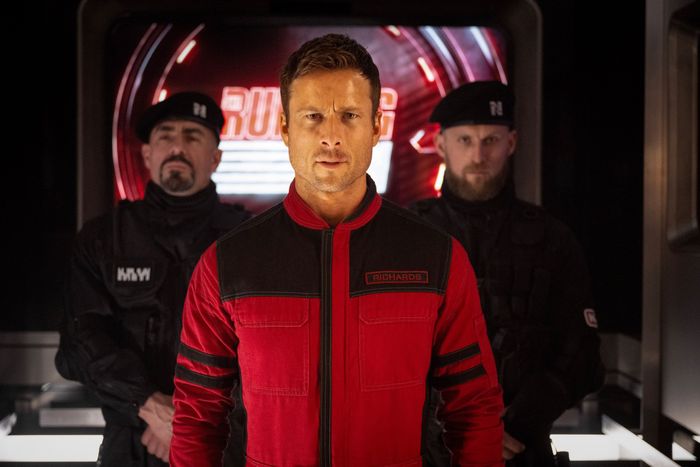
This isn’t the first adaptation of The Running Man, which was previously turned into a 1987 film starring Arnold Schwarzenegger. But while that movie borrowed just the basic concept and some of the character names from the book, the latest version stays largely faithful to King’s 1982 novel. Glen Powell stars as Ben Richards, a blacklisted worker living in the Co-Op City slums with wife Sheila (Jayme Lawson) and daughter Cathy struggling to make ends meet. When Cathy gets sick and the family can’t afford medication, Ben reluctantly agrees to become a contestant on The Running Man. The televised competition follows three players as they try to stay alive for 30 days while being targeted by a team of killers known as the Hunters. The contestants must also hide their identity from ordinary civilians, who can win cash prizes for narcing on the runners or taking them out themselves. If Ben makes it to the end, he’ll win $1 billion, but even the $65,000 he’d collect after a week would put him in the top 1 percent of global society. The catch is that the runners never make it to the end. The capital-N Network that airs The Running Man, led by producer Dan Killian (Josh Brolin), controls everything — including the country at large. And the house always wins.
However ambivalent he was about playing, Ben shows remarkable staying power as he dons disguises and evades the Hunters across the Northeast. He’s aided by anti-Network activists like Bradley Throckmorton (Daniel Ezra) and Elton Parrakis (Michael Cera), who offer protection and the means to keep going. But he’s up against an institution that has eyes everywhere in the form of omnipresent cameras and The Running Man’s snitch-happy audience. As in all iterations of this story, the Network has branded Ben a criminal and an enemy of the state, crafting a narrative that appeals to viewers looking for someone to blame for their hardships. There is, of course, a grim familiarity to the idea of a propagandized public ratting out their neighbors to masked federal agents based on the false belief that it’s the runners — and not the executives at the top of the food chain — who are responsible for their plight.
At a moment in history when politicians shamelessly promote conspiracies using AI fakery as evidence, the film is on point in its depiction of media manipulation. Ben is forced to film daily updates that will air on the show — even The Running Man relies on Real Housewives–style confessionals — but his attempts to alert the public to the Network’s misdeeds prove futile. When he sends in a video that contradicts the story they’re trying to sell, they simply replace it with a deepfake of Ben celebrating the deaths of Network soldiers. The audience is riled up for revenge as beloved show host Bobby T (Colman Domingo) reminds them, “Bloodlust is our birthright.” Even as “Richards Lives” graffiti begins to pop up across the country, suggesting a resistance movement that has tied Ben’s survival to their own, it’s hard to imagine what hope he has in the face of the Network’s overwhelming control. That makes The Running Man’s surprisingly rosy conclusion a tougher pill to swallow.
In the movie’s third act, Ben finds a hostage in Amelia Williams (Emilia Jones), a privileged woman who has fully bought in to the Network’s portrayal of him as a remorseless killer. Ben shames her for her ostentatious wealth, calling out the pricey scarf she’s wearing. “That is a human life hanging around your neck,” he scolds. As in the novel Amelia is shocked to discover that the Network may be the real villain of the story, ultimately assisting Ben with his end-game plan, but in the movie she becomes an even more willing accomplice. This is where The Running Man’s believability starts to fray: A woman who’s been fed a lifetime of propaganda is instantly radicalized into rebellion by the man who carjacked her and held her at gunpoint. Amelia helps sell the lie that Ben has a bomb, and the two are able to escape on a plane, but the Hunters — including their leader, the mysterious Evan McCone (Lee Pace) — are also onboard. Once in the air, Ben gets a private call from Killian, who offers him a deal. If he kills the remaining Hunters, he can get his own show where he’ll take McCone’s place. To motivate Ben further, Killian shares a heartbreaking revelation: Sheila and Cathy were murdered by the Hunters gone rogue, and Killian has the footage to prove it.

Click here to preview your posts with PRO themes ››
All of this plays out almost exactly as in King’s novel, as does Ben’s subsequent killing spree. But the movie introduces a seed of doubt when McCone, the last Hunter standing, reveals that he is a former runner who was similarly coerced into his role — and that the footage of Sheila and Cathy being slaughtered was faked. In a final fight to the death, a badly wounded Ben prevails, but when Killian invites him to give a victory speech on live TV, he decides to share the truth about The Running Man. Ben’s resistance, alas, is futile, as he’s replaced by a deepfake version of himself announcing plans to fly into Network headquarters. The Network takes control of the plane and steers it toward the studio, shooting it down with a missile before it can reach its target and ending Ben’s story.
Or so they think. As we soon learn, Ben is ejected from the plane at the last moment. He even manages to reunite with his very much alive wife and daughter. And the good news doesn’t stop there. The plane’s black box is found and reveals what really happened on the fateful flight, including Ben’s stirring anti-Network speech. Meanwhile Elton’s radical zines spread far and wide, exposing the corrupt Network executives for who they really are. It’s enough to spur the populace into rebellion, and they show up to the next taping of The Running Man ready to start a riot. Bobby T makes a hasty departure but, when Killian tries to take control of the studio, he’s thwarted by an audience armed with Molotov cocktails. In the film’s final moments, Ben arrives and shoots Killian dead.
The Running Man’s happy ending is an entirely new creation from Wright and co-writer Michael Bacall, who embrace a far more optimistic conclusion than King’s. (The 1987 movie also tacked on a Hollywood ending, with Schwarzenegger’s Ben Richards joining forces with the resistance to take down the Network and get the girl.) In the novel, a fatally wounded Ben deliberately flies the plane into Network headquarters, killing himself and Killian in the ensuing explosion. For obvious reasons, a 2025 telling of this story was never going to end with a plane flying into a building — beyond the unfortunate 9/11 allusion, an ending that depressing is exceedingly rare in a mainstream studio release. This iteration of the story is hoping to inspire instead of bum out: In depicting a beaten-down country rising up against tyranny, it’s clear the new Running Man has its heart in the right place. That doesn’t change the fact, however, that the rebellion itself feels rushed and unearned. How do we square the masses’ sudden about-face with the movie’s portrayal of a country so steeped in incessant disinformation that audiences cheer watching children burn a runner alive? There’s no question that the world of The Running Man would include an active resistance, but the idea that Ben could inspire such a speedy overthrow of the Network rings false.
The movie wants to present two contradictory ideas: a society warped by a media conglomerate that has gained complete control over everything that people see and a revolution incited by the power of zines. As much as I appreciate an ending that celebrates print media, it’s awfully hard to compete with terrifyingly seamless deepfake technology. Would a population primed to accept everything they see on television immediately turn against the Network thanks to some rapidly disseminated pamphlets? Movies don’t have to be completely true to life, of course, and the heightened nature of The Running Man allows for added flexibility. The problem is that the film’s wishful-thinking ending arrives at a time in this country with a massively polarized and propagandized culture. We see the damage of misinformation every day. The Running Man may want to be a galvanizing story of hope and resistance in the face of impossible odds, but it requires a suspension of disbelief that’s too big an ask for viewers: not only to ignore the reality of the world within the movie but also to ignore the 2025 reality outside it.