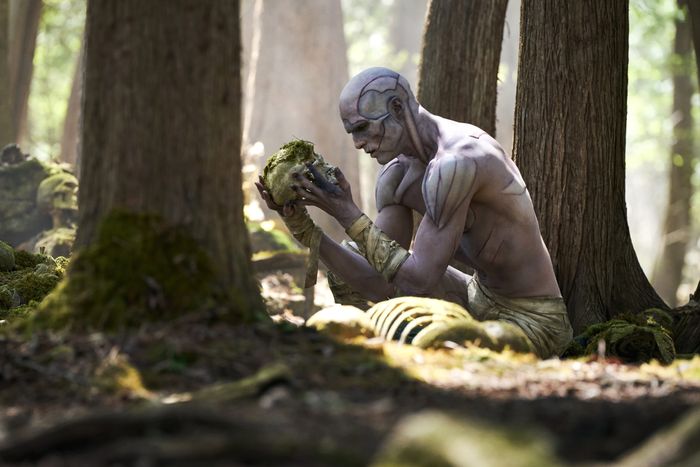
Spoilers follow for Guillermo del Toro’s adaptation of Frankenstein.
Chances are that if you’re watching a Guillermo del Toro movie, the monster in it is going to be hot. Federico Luppi slurping up blood in Cronos? Dashing. Luke Goss’s bone structure as a vampire prince in Blade II and an elf prince in Hellboy II: The Golden Army? Breathtaking. The muscle definition on Doug Jones’s Amphibian Man in The Shape of Water? Yowza! Del Toro’s films ask us to see the other for all their qualities, beyond our stereotypes or assumptions. So of course the Creature in del Toro’s Frankenstein is a tall, muscular babe with bedroom eyes and glass-cutting cheekbones. Jacob Elordi may have sat for ten hours of prosthetics application each day, but it’s not like those prosthetics hid the hot. That alone may not be a problem, but Frankenstein also can’t bear to give its version of the Creature any flaws, either physically or morally, turning him instead into just another misunderstood pinup.
In the Netflix film (streaming now), the Creature is a handsome brooder just looking for a special kind of girl. It’s the film’s greatest hindrance, especially when it comes to the ending. Spoiler alert: Mary Shelley’s original Frankenstein novel ends with the Creature announcing that he’s going to end his life. Creator and creation chase each other to the Arctic Circle, where Victor Frankenstein dies on a ship, leaving the Creature with a sense of regret for what they’ve put each other through. He now believes that only in death “must I find my happiness … my only consolation. Polluted by crimes and torn by the bitterest remorse, where can I find rest but in death?” He leaps from the ship and disappears into the icy waves, seemingly to fulfill his vow. Elordi’s Creature also leaps from a ship onto ice at the end of his film. But he does so after reconciling with Frankenstein, forgiving him and being forgiven in return. Having received his creator’s love, the Creature believes that he can now “be human.” The film ends with the Creature removing his hood, feeling sunlight on his teary face, and lowering his head in a gesture of overflowing emotion. He’s going to live. (He may even be immortal — earlier, we see him heal from gunshot wounds, Wolverine-style, and he survives a couple of explosions, including one when he’s holding the stick of dynamite.) It’s a tidy, happy ending that saps the character of its original complexity.
The final pages of Shelley’s novel deliver a message about how pompous and misguided humanity is for playing God. Frankenstein, in creating the Creature, doomed him to a life of loneliness and misery; the Creature returns the favor by taking the lives of Frankenstein’s brother, William, and his wife, Elizabeth. They are two sides of the same coin, tethered together by the same frantic obsession with and ultimate disregard for human life. Whatever the Creature is, Frankenstein made him, and whatever blood is on the Creature’s hands is on Frankenstein’s, too. Are they both worthy of forgiveness? And if they can forgive each other but not themselves, is death a kind of absolution?
Del Toro presents Oscar Isaac’s Frankenstein and Elordi’s Creature less as equals terrorizing each other and more as an abusive father and neglected son, a dynamic that keeps the Creature in a sort of infantilized state. Unlike in Shelley’s novel, where the Creature befriends an older man, saves a young girl, and then vengefully kills William and Elizabeth (a real character arc!), here Elizabeth’s death is Frankenstein’s fault, and William is an accidental casualty amid Frankenstein’s efforts to frame the Creature for Elizabeth’s death. (The Creature’s innocence is made painstakingly clear as William tells his brother, Victor, in his dying moments, that he’s the real monster.) This is the Creature as Edward Scissorhands, a sadboi who just needs love and finds it in Elizabeth, Victor’s sister-in-law; it’s a representation of del Toro’s belief that all of us are monsters, taken to such an extreme that the Creature has no other qualities aside from being “wronged.” In Shelley’s novel, the Creature has increasingly contradictory feelings about life and death — he loathes that he exists, but also believes Frankenstein owes him a companion; he thinks Frankenstein is wrong for destroying his would-be mate, but he doesn’t see any problem with killing Elizabeth. Del Toro’s film nearly erases all that inner turmoil. It reduces the Creature to a childlike figure, swaddling him in medical gauze and insisting that he only wants protection and love. (The film doesn’t bother adapting Frankenstein’s attempt to create a bride for the Creature; after Elizabeth dies, the Creature’s demand for a companion gets dropped.) Del Toro wants to emphasize the contrast between Frankenstein, corrupted by ambition, and his Creature, born blameless. But by keeping the Creature’s hands mostly clean, he denies him the needed coarsening that makes the story’s themes work.

Click here to preview your posts with PRO themes ››
Frankenstein blames the Creature for Elizabeth’s death in the film, though it was his own fault. In response, the worst thing the Creature does is break Frankenstein’s nose and engage in some light BDSM-tinged flirting, telling Frankenstein he’s his “master” now. This mild reaction makes their dynamic feel lopsided, so that their final confrontation lacks the bristling resentment necessary on both sides of the relationship. Without that sense of desperate loneliness, what dooms Frankenstein and the Creature to their deaths? Instead, surging strings in the score and candle-lit close-ups of the men’s tear-streaked faces attempt to give this reconciliation a somber weight that the film hasn’t earned. Frankenstein urging the Creature, “While you are alive, what recourse do you have but to live? Live,” and the Creature lovingly calling Frankenstein “Father,” are nice moments for a film about daddy issues, but that’s not what Frankenstein is. Forgiveness isn’t the point of the story; Shelley’s critique of the folly of ambition for ambition’s sake gets lost in this new framing. Del Toro has so much sympathy for the Creature that he gives him a walk into the sunshine and a second chance at life on his own terms — a happy ending that once again shows off Elordi’s surprisingly subtle facial expressions but largely feels empty, like it missed the point of the Creature’s anguish entirely. Del Toro used to be brave enough to kill his darlings, especially Goss’s beleaguered-by-destiny heirs. But here, keeping the Creature hot and alive is the most predictable thing del Toro could do.