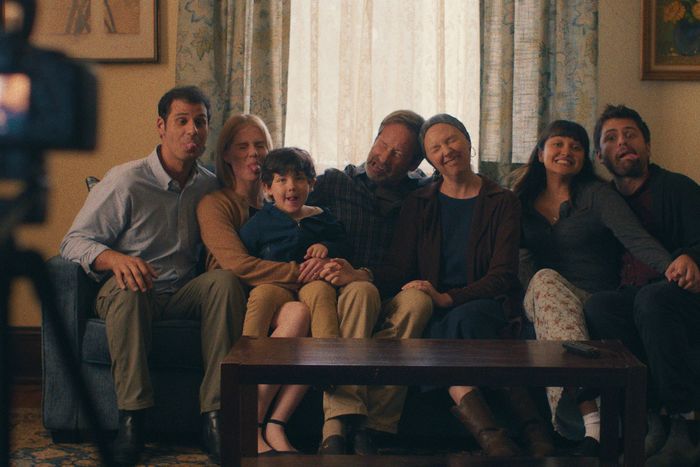
Last year, Jay Duplass made a quietly triumphant return to directing after a 13-year hiatus with the charming comedy The Baltimorons. For all its levity and warmth, that film opened with a botched suicide attempt, and a subtle gloom lurked over its ensuing comic-romantic shenanigans. Now, Duplass returns to Sundance with See You When I See You, an earnest adaptation of comedian Adam Cayton-Holland’s 2018 memoir, Tragedy Plus Time, about the author’s attempts to deal with the trauma of his sister’s suicide. Both films are comically-inflected portraits of depression and grief, and they clearly come from a very personal place. (Cayton-Holland wrote the script for this latest one.) But the more direct approach of See You When I See You falls flat. The movie is so intent on trying to literalize its characters’ emotional turmoil that it forgets to breathe.
As Aaron Whistler, a comedy writer who had an extremely close, almost conspiratorial bond with his sister Leah (Kaitlyn Dever), Cooper Raiff gives basically the same performance he always gives, delivering his lines in affectless bursts. Perhaps the idea here is to depict Aaron’s inability to work through his pain, but that requires a kind of charisma Raiff might not have — he doesn’t really convey much of an inner life. The difference is particularly striking in the actor’s scenes with the supremely talented Dever, whom we see in flashback-slash-dream visions. In these, we witness Leah’s vibrancy, but we’re also supposed to understand how tight she and Aaron were, how they were in some senses two sides of the same coin; instead, we start to suspect that Raiff is mismatched to the material. He doesn’t even bring the kind of misplaced levity we might expect of a comedy writer. At times, we suspect the film wants to show us Aaron using humor to deflect the pain (The Baltimorons did this particularly well), but the movie seems too afraid to actually be funny.
Aaron was also the one who found Leah’s body, and the young man keeps replaying that night, his present life occasionally blurring into that disturbing memory. One of the tasks he must accomplish in therapy is to find a way to control these thoughts, to turn them into happy ones or to give himself some agency over how and when they emerge. See You When I See You actually depicts this process, replaying these flashbacks in different ways, and there’s certainly something admirable and maybe even bold in that. But the truth is that Duplass is not the kind of stylist who can charge such sequences with emotion and portent. When Aaron revisits the night of his sister’s suicide, we should be filled with dread, heartbreak, anguish… something; we shouldn’t think, Oh god, not this thing again. Just because the film shows these things doesn’t mean that the director has figured out how to do so cinematically.

Click here to preview your posts with PRO themes ››
The supporting cast has better luck. As Aaron and Leah’s father, David Duchovny compellingly conveys the distractions of a grieving parent. A civil rights attorney, when he brings up his dead daughter to a prospective client, we feel all the cringey pain of the exchange. As their mother, Hope Davis also expresses worlds of feeling with a simple glance. Looking into the mirror one day, she senses a lump. It feels like a macabre joke: Here’s a woman who just lost her daughter in the most shocking way, and she might be about to discover she’s got cancer. But we can tell just from looking at her face that she can’t deal with going to a doctor. Such scenes with the film’s secondary characters are effective, but like the flashbacks with Dever, they further remind us of what we’re missing with the central storyline and the lead.
It is entirely possible that viewers who have endured such traumas and spent more time in therapy will find much more of value in this movie. The film’s depictions of the painful process of controlling one’s memories are not particularly compelling, but I can’t fully assess their honesty or accuracy either. Maybe this’ll hit hard for some people. See You When I See You grapples with serious subjects, and everybody involved surely meant well. That’s just not enough.