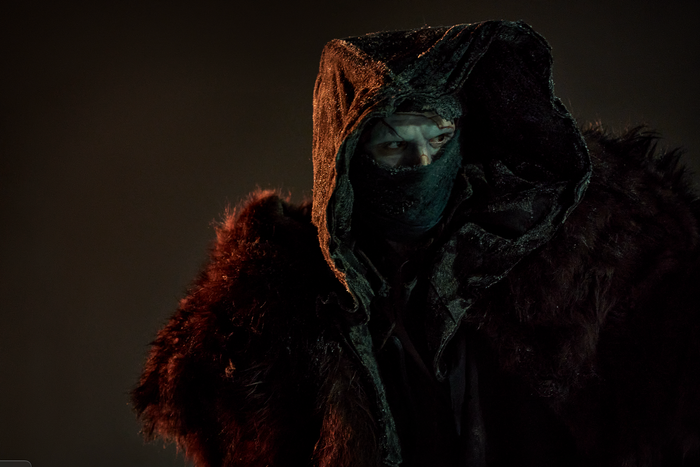
This review was originally published on August 30, 2025 out of the Venice International Film Festival. Frankenstein is now streaming on Netflix.
“The achievement felt unnatural, void of meaning,” mulls Oscar Isaac’s Victor Frankenstein right after he gives life to his creation, played by Jacob Elordi, in Guillermo del Toro’s adaptation of Mary Shelley’s novel. It’s an odd thought to have at that point, since Victor has just spent most of the story obsessively and breathlessly pursuing his unholy dream of reanimating the dead. And del Toro has accompanied the good mad doctor’s journey with similar cinematic conviction. The screen is awash in cadavers and severed limbs and skulls and peeling patches of skin and ornate scientific devices and buckets of blood, all shot with gliding cameras and low angles and color-coordinated costumes and deep dark shadows and massive sets and accompanied by a seemingly never-ending Alexandre Desplat score. I don’t think anyone yells, “It’s aliiiive!” in this picture, but someone probably could at any point and it wouldn’t feel entirely out of place. For its first half, Frankenstein the movie (premiering at the Venice Film Festival ahead of an October theatrical run and its November Netflix release) is an infernal construction not unlike the monster at its center, a lavish assemblage of elements that have electricity but no soul. The movie roars to life but seemingly forgets to breathe. That is, until it finally does.
For that we must at least give some credit to Jacob Elordi. “Of all the parts that made this man, which one holds his soul?” asks Elizabeth Harlander (Mia Goth), the pious object of Victor’s affection and fiancée to his brother, as she looks at the jigsaw-like construction of the creature’s body. It’s a good question, since Victor would deny the existence of something like a soul. He can play God because he mocks God, and he hasn’t stopped once to reckon with the idea of what his reanimated man will be like. But Elordi makes the creature’s awakening, his growing curiosity and hurt, feel fresh, vital, new. We know the Frankenstein story, even via its many abridged and bastardized versions; it’s one of the most familiar stories we have. And yet, the dawning of light in Elordi’s eyes breathes life into the old tale. Of all the parts that make this movie, it turns out his is the one that holds its soul.
Everything quiets down after that. The film begins to live in its pauses, as this creature discovers what the world is truly like, and we understand his sense of entrapment. Until the monster finally takes over the story, Frankenstein feels busy but weirdly lifeless, and this is also probably part of the design — the monster isn’t just a character, he’s also a corrective. Isaac can be a very subtle actor, but all subtlety has been hammered out of his performance, as Del Toro’s close-ups distort his already distinctive features. That seems like a misstep, because so much of Victor’s determination is driven by his own hurt as a child; we need to see him thinking in order to really buy his unfeeling cruelty. It’s not a bad performance, just not a very interesting one. At times, the actor feels more like a design element, akin to the marble coffins and gape-mouthed friezes of this gothic world. Again, though: Until Elordi’s new man enters, the picture can’t be complete, and Victor gains further dimension later, as we see him through the monster’s longing, desperate gaze. (It really does feel weird calling Elordi’s character “the monster,” as he’s the most human character in the movie.)

Click here to preview your posts with PRO themes ››
Del Toro has been working on this project for well over a decade, and he sticks closer to Shelley’s text than most other versions. The film opens in the desolate Arctic, where Victor has chased his creation, and flashes back as Frankenstein relates his life’s story to a Danish sea captain whose ship is stuck in the ice. Of course, Kenneth Branagh’s insane 1994 adaptation, Mary Shelley’s Frankenstein, probably hewed closest to the novel, and that movie and this one share a similarly frantic, gothic-romantic expressionism. Branagh was nearly crucified by critics and audiences back in the day, but his film has grown in estimation over the years. Some of us still consider it, perhaps blasphemously, the most moving version of the novel to date. (“Who are you?” “He never gave me a name.” “Why do you weep?” “He was my father.”) Del Toro’s comes into a marketplace more open to gothic delirium, and he’s such an expert craftsman that the film is a momentous technical achievement. But it’s more than that. Whatever its flaws, the director has filled Frankenstein with seemingly everything he loves, and it reflects his obsessions. It feels like the work of a true madman, and that’s really the only way anyone should make a movie of Frankenstein.
Sign up for The Critics
A weekly dispatch on the cultural discourse, for subscribers only.