Andrew Stanton may be the most successful director at this year’s Sundance Film Festival. His three Pixar movies — Finding Nemo, WALL-E, and Finding Dory — haven’t just made billions of dollars; they represent some of the high points of that company. (WALL-E is probably the best thing Pixar has ever done.) Yet he’s always seen himself as a live-action filmmaker. 2012’s John Carter was a notorious flop, but there are more good things in it than bad. Over the years, Stanton has directed lots of live-action TV and streaming, including episodes of Stranger Things, Better Call Saul, and 3 Body Problem, all while continuing to work in a leadership position at Pixar. (He co-wrote 2019’s Toy Story 4 and directed Toy Story 5, which comes out later this year.) When I interviewed him a few years ago, he told me, “I never did go to the Church of Animation. I went to the Church of Movies.”
Still, one can see traces of WALL-E in Stanton’s latest live-action effort, In the Blink of an Eye, which shares with that earlier film a belief in the ability to find civilizational metaphors in the smallest moments. WALL-E’s visions of robot love and hopeful flashes of organic green amid its dystopian, garbage-strewn landscape gave us a sense that things would ultimately turn out okay for both humanity and its machine helpers. And the earlier movie’s largely wordless first half is here evoked by a story strand (one of three) following a Neanderthal family in 45,000 B.C. who speak in a rudimentary language that is left untranslated, resulting in a kind of silent-film-like simplicity.
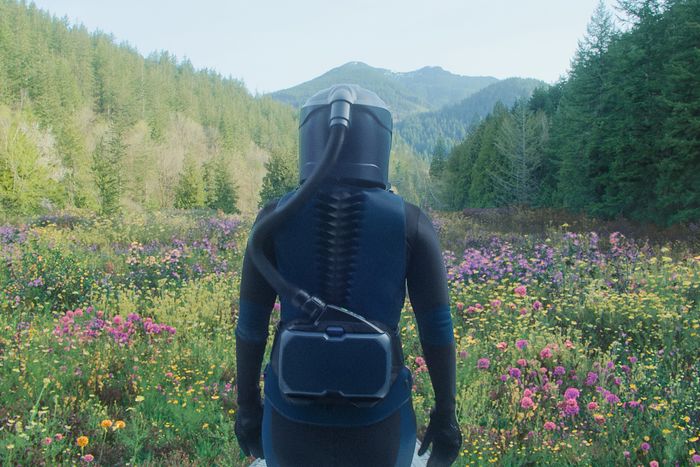
The other two story strands follow Claire (Rashida Jones), a present-day Princeton researcher studying the fossilized remains of a Neanderthal man as she navigates what might be a new relationship with anthropologist Greg (Daveed Diggs) while also dealing with her mother’s terminal illness; and Coakley (Kate McKinnon), the sole human inhabitant of a spaceship carrying human embryos on a 400-plus-year mission to populate a distant planet. The stories aren’t connected, but, of course, they are Connected™: The cavepeople face basic, albeit existential, challenges, while humanity’s present-day avatars face emotional questions of commitment and professional relocation, and our future representative deals with a seemingly minor oxygen problem on a spaceship that could mean the end of our species altogether.
Not a lot happens in any of these story lines. Which probably sounds like an insane thing to say since at least one of them involves the survival of the human race. But that’s sort of the point: Stanton is reaching beyond questions of localized and individualized drama and toward a kind of cumulative, cinematic power. Through intercutting, he wants each timeline in the film to feed off the others — to show the echoes between, say, the death of one simple caveman and what grief might look in a distant future world. And occasionally, the film does give us moments of undeniable power. (Thomas Newman’s score helps, too.)
Unfortunately, Stanton is so eager to build his overarching vision that the film avoids spending time with any of these people. We don’t sit with these characters’ grief, their personal dramas. We don’t really know them. Again, that is perhaps part of the design — Stanton has bigger conceptual fish to fry — but compare how this film treats a moment of devastation with something like The Tree of Life, another great auteur project about our place in the cosmos. Both films feature an early phone call which is clearly shattering for their characters. Here, it involves Jones’s Claire learning about her mother’s cancer diagnosis, while in Terrence Malick’s film we get Brad Pitt’s character finding out his son has died. In both cases, the scene happens early enough that we don’t yet know much about these characters. And in both cases, we don’t hear the other side of the phone call, relying instead on just a few words from the onscreen protagonist to ascertain what has happened. And yet there’s an ocean of difference between the two scenes. Malick closes in on his actor’s face and stays there, giving us access to his pain. Stanton treats the exchange in such rudimentary, flat fashion that any connection between us and the character is lost.

Click here to preview your posts with PRO themes ››
Similarly, compare the lengthy, ostensibly mundane (but actually hypnotic) passages among the cavemen and astronauts in Stanley Kubrick’s 2001: A Space Odyssey with the purely functional way that Stanton presents similar scenes here. To be fair, he’s not a bad storyteller: He has a way with visual shorthand that keeps things going, and he conveys story information quickly and economically. (The man is, after all, one of the great animation directors of our time.) But the mad alchemy of Kubrick’s patience is here replaced by generic, efficient delivery of story beats. And we’ve already established that this isn’t really a “story beat” kind of movie. As a result, we’re just sitting around waiting for the movie to get to its point. It’s all thesis and almost no argument.
Okay, so he’s not Terrence Malick or Stanley Kubrick — who is? These are admittedly high standards by which to judge anybody, but In the Blink of an Eye is so ambitious that a rather dramatic artistic balancing act is required to make it all work. In that aforementioned interview, which was done while he was preparing to shoot In the Blink of an Eye, Stanton described the film as “a very art-house, quiet, slow-cinema kind of movie.” The finished picture currently runs a quick 94 minutes, so maybe there’s a longer version of it out there somewhere. But there’s nothing “slow cinema” about it. It feels hurried, generalized, inattentive. There’s no specificity, no immersive sense of people actually living their lives. Again, that’s probably partly intentional. But it sure feels like a miscalculation for a movie about the survival of humanity to have so little humanity in it.