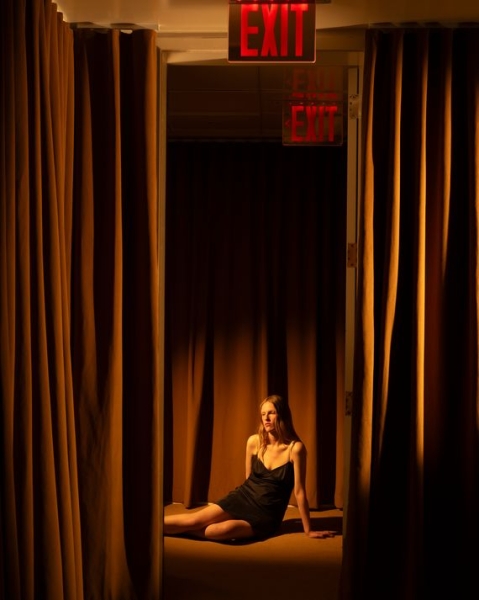
This article was featured in New York’s One Great Story newsletter. Sign up here.
The 26-year-old pop star Audrey Hobert kicked off her first major solo tour in December with a brief stroke of misfortune. The venues she booked are relatively small and shaggy, but she isn’t holding back on theatrical flair: The five-foot-seven singer has been starting each show at double her usual height on a ladder hidden by a long trench coat. She sings her opening number, a playful piece of guitar pop called “I like to touch people,” staring down at the crowd and spotlit from above. On the tour’s third night, in Toronto, Hobert was so ill with the flu that she warned her prop person, who happens to be her cousin, to follow her lead at the end of the song: “If I want to keep my trench coat on, it’s because I shit my pants.” That performance turned out to be her best yet, pants unsoiled.
A few nights later, I met Hobert at a bakery in downtown Manhattan, just a few blocks from where she’d lived as a freshman at NYU in 2017; she graduated four years later with a degree in dramatic writing. Hobert, a Los Angeles native, was cradling a hot tea and munching on a piece of banana bread. She was back in town to headline Music Hall of Williamsburg and was trying not to let her persistent flu slow her momentum. Hobert is lanky, with pin-straight strawberry-blonde hair and a deep speaking voice. Every half-hour or so, she pulled out a piece of Nicorette gum and chewed it furiously, a habit she’s had since she quit smoking and vaping two years ago. She wore a knee-length chocolate-brown ’70s shearling coat. Underneath was her usual style, a sort of early-aughts throwback: a three-quarter-sleeve fitted T-shirt, medium-wash boot-cut jeans, and ballet flats. It’s a look that could seem goofy — either out of touch or affected — but Hobert inhabited it with ease. She wears the same thing onstage. “I just throw on whatever’s on my floor,” she told me, “and that sounds maybe corny, but I look like crap most of the time and then it does feel weird to me to, like, go onstage and try to look better.”
This off-kilter confidence is the crux of her appeal. To her fans — some of whom arrive at the venues she’s playing 12 hours in advance of showtime to ensure they get the best spot possible — weird and winning are one in the same. There’s no shortage of young women making confessional, wry pop music these days, but Hobert has carved out her own lane with a bookish persona and shrewdly specific lyrics bound in tidy and broadly appealing pop songs. She often portrays herself as an outsider, taking notes on the sidelines. In “Bowling alley,” one of her most beloved tracks, she writes about hyping herself up to attend a party at a bowling alley only to go entirely unnoticed when she arrives. Then she rolls a strike. “Everybody loves a winner,” she sings, her voice unadorned. “Who’s gonna tell them I’m a lucky beginner?” At the same time, her debut album of slick pop-rock and synth-pop songs (Who’s the Clown? released in August), is threaded with an unwavering self-assurance. “I like to touch people” is about the thrill she gets from being charming: “It’s just so fun / I’m at a random party / Hand to her heart, some girl I’ve never met completely loves me.”
Hobert’s tour is named “The Staircase to Stardom,” but her rise has been more of a joyride. She started out in music 18 months ago, when she was working as a writer on a Nickelodeon show, a gig she got shortly after graduation. In fact, Hobert’s ascent has been so fast and smooth that there’s something almost suspicious about it — suspicions confirmed when you learn that Gracie Abrams, among the biggest pop stars in the world, is one of her closest childhood friends and her younger brother Malcolm (stage name Malcolm Todd) is a popular singer. His lo-fi white-boy R&B made the Billboard “Hot 100” chart in April, after two years of going lightly viral on TikTok. Hobert’s father is also a successful Hollywood screenwriter; he was her boss at Nickelodeon. “I see people call me a ‘nepo friend,’ and I see ‘nepo sibling’ because of my brother,” Hobert said. “What are you supposed to do — not go for a career because you, like, got into it easier?”
Hobert taught herself the basics of guitar in high school. But she didn’t pursue music in a real way until her 20s, when she was living with Abrams in L.A. and somewhat accidentally ended up co-writing a chunk of the songs for Abrams’s massive sophomore album, The Secret of Us — including the hit single “That’s So True,” which joined an elite list of songs with a billion-plus streams on Spotify.
Once Hobert decided she wanted to be a performer, it was only a few months before she had a major-label deal, an impeccably tight album, a worshipful fan base, and a headlining international tour with a full band — a classic four-piece with Hobert occasionally joining in on guitar or six-string banjo. The first song she released, “Sue Me” — another one about loving being loved, this time addressed to an ex who judges her need for attention — made the Billboard “Pop Airplay” chart and has over 44 million streams on Spotify.
Hobert moves through the world in a way that reads as a bit naïve — like a kid singing into a hairbrush alone in front of the mirror — and certainly her path has been charmed, but she’s also brought a studious rigor to her career so far. She’s a musical-theater acolyte and a scholar of pop swinging for its highest fences. The genre got into her bloodstream early — at 12, she wrote a Tumblr post declaring that she was “no longer going to hide” that “Party in the USA” was her favorite song — and she speaks worshipfully of Taylor Swift, her lyric writing in particular. “I would be the biggest, fattest liar on the planet if I didn’t say she was my god growing up,” Hobert said. “I think her staying power is entirely attributable to the fact that she is penning these songs herself and people care about her perspective.”
Hobert’s writing is puckish, often delivered in a half-speaking, half-singing register that emphasizes her words above melody. She has been described as pop’s funniest new artist‚ which she is — but the superlative is a bit reductive. When Hobert sings “Sue me / I want to be wanted,” the line is powered equally by humor and real feeling. She compares her songwriting process to that of Beth Harmon, the chess-prodigy protagonist of The Queen’s Gambit who lies awake in bed envisioning her moves on the ceiling. “I can see the path ahead of me,” Hobert said, “and I always know immediately if a line is weak. I will sit there for hours and hours until I feel it is strong enough.”
Her public trajectory has likewise been an act of artful choreography. When she started taking meetings with major labels last year, she used all that she’d learned in the writers’ room, mapping out every element of her pop debut for the executives: the album cover, rollout dates, and how she’d be received. She was scripting her own rise. “I know I was impressive because of my ability to articulate myself,” she said. She knew, she told me, that critics and fans would call her an “unlikely pop star,” an “anti-pop star,” “quirky.” “I knew everything. Everything people have said about me is something I said people would say about me.”
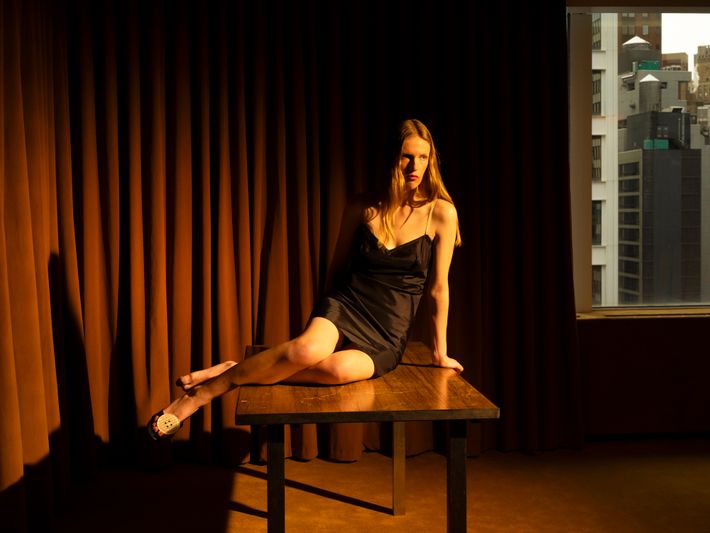
Photo: Tania Franco Klein for New York Magazine
Hobert’s profuse confidence is somewhat unlikely for a 20-something who spent her teen years grappling with a major threat to her self-image. She grew up in Santa Monica, the eldest of four children. As a freshman in high school, she developed trichotillomania, which caused her to pull out, in her description, “a lot” of her hair. “It took like ten years for it to fully grow back,” she said. “So my entire high-school experience, I would see myself in the mirror, and see photos of myself, and I would just wish it weren’t that way. I had to tell myself anything I could to make me stop disliking my appearance so much and to get out of bed every day.” Rather than hide, she immersed herself in musical theater — her mother was a Broadway buff — and dance classes. “What was I going to do?” she said. “Not go out and live in the world?”
It was around this time that Hobert saw Lena Dunham’s Girls and made up her mind: She would move to New York for college. COVID hit in her junior year, and she shipped home to L.A. to take classes remotely. The summer before her senior year, she was prepared to skip out on the rest of school — she’d made it to the final rounds of interviews for the writers’ room of Mindy Kaling’s The Sex Lives of College Girls. In her mind, she was going to be just like Donald Glover, who’d gotten a job writing for 30 Rock while he was enrolled in the same writing program years before.
She was distraught when she didn’t land the job. “So much was devastating at that time” — mid-pandemic — “and that felt just like one of hundreds of nails in the coffin,” she said. She buried herself in her schoolwork. After graduation, she stayed in L.A., where she started the Nickelodeon job.

Click here to preview your posts with PRO themes ››
When Hobert moved into an apartment with Abrams in Venice, in the spring of 2023, Abrams was making moody, whispery pop and was reaching new heights: She’d been invited to open for Taylor Swift on the Eras Tour. She was rarely home, but one weekend the pair started messing around with a song. Within six months, they’d written about 13 together. Abrams’s first album had a tendency to live in the dour, muted end of the pop spectrum, but the songs she wrote with Hobert that made it onto The Secret of Us nudged her into a more full-throated, upright vocal style. Abrams invited Hobert out to Long Pond Recording Studio upstate to join sessions for the album, and Hobert contributed background vocals. She had a great time, she said, “but it was still not, like, Now I’m going to be an artist.” In the fall of 2024, Abrams invited her to join her to perform songs they’d written together. Onstage, Abrams seemed the more demure of the two, strumming her guitar behind a mic stand while Hobert held her microphone in her hand and gesticulated with authorial flair.
In 2024, Hobert’s Nickelodeon show was canceled, and she decided to double down on music. She signed a publishing deal with Universal Music Group and began working as a songwriter for untested young artists. Her chief purpose in these sessions, she said, was to assist pop hopefuls who were fans of Gracie Abrams; she was a hired gun tasked with helping strangers imitate one of her best friends. “It was sometimes okay, but mostly — and I’m apprehensive to use the word devastating — but at times it felt like, What am I? You’re a little show monkey,” Hobert said with a shudder.
She lasted about four months in the role before abandoning it and starting to write songs for herself. It was in August of 2024 that she began courting labels in Los Angeles and New York with a demo EP of some of her punchiest songs. This was in the thick of Charli XCX’s Brat summer and the Chappell Roan explosion — a period when label executives were especially attuned to the commercial possibilities of young, clever, and charismatic female pop singers. Hobert’s songs, including “Bowling alley” and “Shooting star” — a whirly synth-pop track about admiring boys from a distance — impressed them. In her pitch, she described the photo she wanted for her album cover, which would later grace Who’s the Clown?: Hobert standing grinning for the camera while a menacing clown leers through a window behind her. She narrated the music videos she was planning — exaggerated, humorous reenactments of the scenes she lays out in her lyrics, largely shot in her own lightly shabby apartment. “I told them, ‘You will not be able to put your finger on what I am because I’m going to be just me. I’m going to wear my own clothes,” she said, “and I write all my songs completely by myself.”
Several labels made offers, and in the end, Hobert signed with RCA. The executives wanted to “get this girl onstage right now,” she told me. Live performance is vital to Gen Z’s most passionate pop fans, and Hobert had only a handful of guest appearances with Abrams under her belt. This past summer, before booking a proper tour, she took her guitar on the road, playing solo at tiny venues — fitting 100 to 200 people — in Europe, Australia, and the U.S.
In the fall, Hobert was invited to perform in a couple of cities alongside other rising artists with iHeartRadio’s Jingle Ball Tour, a traveling industry showcase. The experience felt impersonal and baldly promotional. “The press obligations and the backstage shenanigans of TikTok collaborations — it’s not something I frankly give a shit about at all,” Hobert told me. “When I see bigger artists getting snapped together kind of on purpose, like, ‘Let’s put these two bigger artists together and take a picture,’ I walk right past that and I don’t wish I were in the picture.”
“I’ve found myself in these places for years because of my friendship with Gracie,” she went on. “But I’ve always been very comfortable being a little on the outs. You can probably hear it in themes on my album, but observing that world is far more interesting than talking to the people who are part of it.” She said that she’d been “sort of courted to be part of certain groups” now that she was established in the industry, “and I have pretty much rejected them every single time.” It was hard not to wonder how this might catch up with her. She didn’t think she was better than anyone, she said; it was just a matter of “Do we connect?” The second song she ever wrote for herself, “Chateau,” describes the misery of going to a party at Chateau Marmont — a kind of “Royals” (Lorde, 2013) for the I Love LA era. She sings in the chorus, “I’m thinking, like, High school was better than this.”
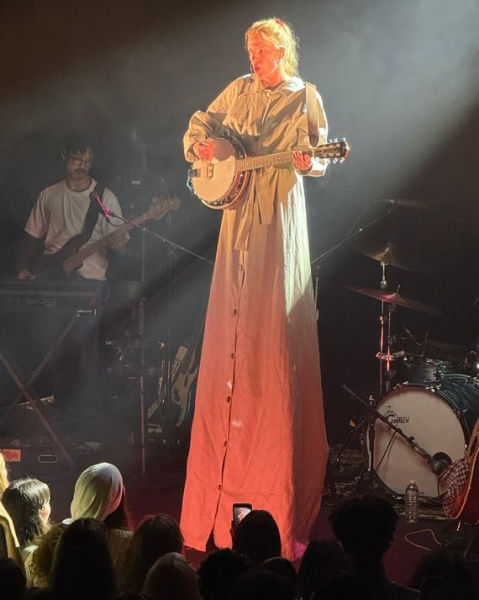
In San Francisco in December. Photo: Courtesy of Audrey Hobert
By the time Hobert hit the stage at Music Hall of Williamsburg in mid-December, her flu was mostly gone and she was energized. The venue was crammed with excitable 20- and 30-something women, among them Willa Bennett, the editor of Cosmopolitan and Seventeen. Across the floor were Hobert’s doting parents — a couple of youthful and energetic Gen-Xers bopping along in general admission rather than VIP.
Hobert had told me she doesn’t really get nervous before shows. “It sounds a little pick-me, but I really just throw on my lipstick and clothes and go out there,” she said. When it was time to take off her trench coat, she revealed a variation on the usual, a red long-sleeve boat-neck top and a pair of tight boot-cut jeans. There was no opener, and her set was brief (she’s released only 12 songs to date). Her performance was vigorous, with tight transitions and minimal chatting, and unusually physical for the size of the stage. It often seemed as if Hobert, enjoying her own music immensely, was desperate for more room to twirl. She sang “Sue me,” the crowd favorite, third from last and then again as the final song, changing nothing. It seemed completely sincere — a gift to the fans — and a self-deprecating joke at the same time.
When Hobert was writing Who’s the Clown?, she was mostly concerned with the storytelling and making sure every word in her lyrics came through clearly. This made for songs that are especially fun to close-listen — dense, evocative, full of surprises — but technically challenging to sing without losing her breath or tripping over lines. “The songs are so fast,” she told me, “and I’m pretty hell-bent on not missing a word.” In the end, there was nothing to worry about; the fans sang along to every syllable. They knew when the hook would shift just slightly, singing “Sue me, I wanna be toxic.”
Hobert is still at the stage of her career when it’s possible to believe that the future will always follow her script, as it has in these auspicious recent months. And though she hasn’t yet reached the peak of her run in pop, the narrator in her is already drafting its resolution. “I don’t necessarily think I’ll make music forever,” she admitted. She was beginning to attract inquiries for film and television projects — both writing and acting — and theater looms large in her mind too. Still, Hobert feels like she needs to earn the end of this act first. “I think I need to prove myself as a songwriter one more time,” she told me. “I need to make another album before I can, with true confidence, cross over into anything else.”
Her pop career is at least in part an elaborate creative-writing experiment. As it plays out, though, it seems she’s becoming more absorbed in the lead role. Who’s the Clown? closes with a song she wrote about a weekend trip across the country to celebrate a cousin’s birthday. It’s called “Silver Jubilee,” and it’s a part-cheeky, part-earnest riff on a party anthem that finds her joining in on the fun, rather than looking in on it, and contemplating the shine of her future. “I wanna make it, but it’s fun to be a normal girl,” she sings. “I wanna make it though, make it though, make it though.”
Production Credits
- Photographs by Tania Franco Klein
- Styling by Emma Oleck
- Hair by Shinya Nakagawa
- Makeup by Allie Smith
- Special thanks to WSA
- Wardrobe: THE ARCHIVE X YANA Dress, at thearchivexyana.com. SANDY LIANG Shoes, at sandyliang.info.
Thank you for subscribing and supporting our journalism. If you prefer to read in print, you can also find this article in the January 12, 2026, issue of New York Magazine.
Want more stories like this one? Subscribe now to support our journalism and get unlimited access to our coverage. If you prefer to read in print, you can also find this article in the January 12, 2026, issue of New York Magazine.
One Great Story: A Nightly Newsletter for the Best of New York
The one story you shouldn’t miss today, selected by New York’s editors.