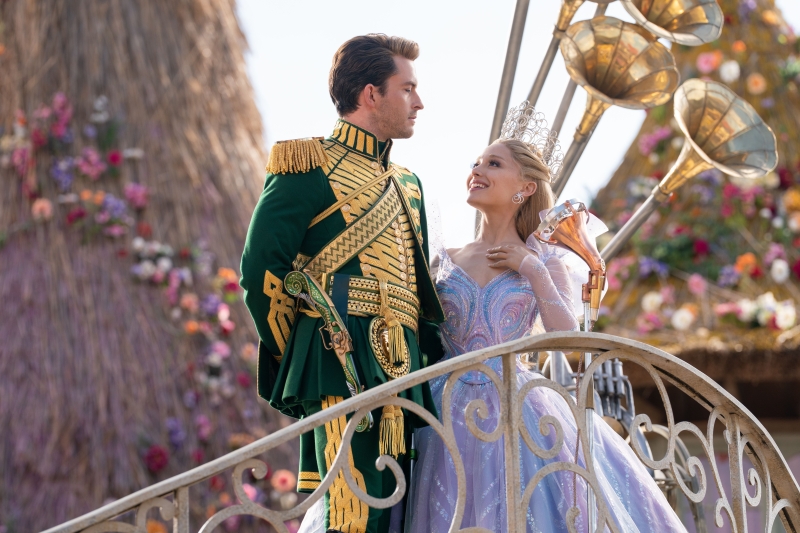
How many clock ticks are in Wicked: For Good? At a run time of two hours and 17 minutes, there are technically 8,220.
But that’s not what you actually want to know. As for how many times the characters actually say the phrase clock tick, as a way of saying “one sec,” in Wicked: For Good? I clocked five clock ticks. At first, spoken mostly by Glinda, it just sounds like another goofy Oz-ism, like “obsessulated” or “thrillifying.” But then they keep saying it. Nessa says it to a servant in Munchkinland, and in the juiciest moment of the movie, when Glinda calls Elphaba out for taking her man, Elphie deflates the drama like a balloon by going, “Now you wait just a clock tick.”
Lest you think this all came out of nowhere for the sequel, Dulcibear actually does ask Elphaba to watch her sister “just a clock tick” in the first movie. But you could chalk that up to a quaint Dulcibear-ism delivered beautifully by Sharon D. Clarke. In For Good, all of Oz is cuckoo for clock ticks. They can’t get enough clock ticks. And Wicked fans on social media have an obsessulate-hate relationship with it.
But why do they keep saying “clock tick”? Were the Wicked characters’ clocks born ticking, or did they have clock tick thrust upon them? I have a theory, and I’m sorry in advance about it.
Something you need to know about the Broadway musical Wicked is that it is aesthetically and conceptually, for better or for worse, very steampunk. There are gears and cogs and tiny little glasses and top hats throughout. Some of this bleeds over into the film, namely via the Wizard and his penchant for inventions like model trains, wind-up toys, and the big metal Wizard mask itself. (The mask operates sort of like an automaton and sort of like a carnival organ.) And the movie Wicked includes all of these steampunk motifs … because the whole story — all of Wicked — takes place within a damn clock.

Click here to preview your posts with PRO themes ››
Before you burn my effigy in Munchkinland Square, hear me out: In the Wicked novel by Gregory Maguire, on which the musical is based, mind you, there is an invention in Oz called the Time Dragon Clock. The beguiling and fantastical device travels from town to town, where people gather to watch its shows: under the gaze of a mechanical dragon, and operating entirely by clockwork, puppets move in and out of little doors and through little sets performing entire scenes. These characters act out the pasts, presents, and futures of people’s lives, and in a pivotal moment in the book, Elphaba’s own story is told to her via clockwork puppets. That’s why, in Wicked onstage, there is a giant dragon above the proscenium that activates at the very beginning of the show, roaring and swaying. The sides of the stage are flanked by clockwork — a visual mess of gears, pulleys, and rafters — and the backdrop is a clock face. The audience is watching the Time Dragon Clock show, and the actors are all clock puppets. Even Glinda’s bubble looks like a gadget on a clock face, moving on an arm like a minute hand.
The idea that the whole story takes place within a clock is the sort of concept and motif that works better in theater, or animation, than in a live-action movie, but Jon M. Chu & Co. don’t abandon the conceit entirely. The first Wicked movie opens with Glinda in voice-over saying, “According to the Time Dragon Clock, the melting occurred at the 13th hour.” From the get-go, we’re getting set up to believe the whole story through the Time Dragon Clock’s telling.
So everyone keeps saying clock tick because the Wicked-verse exists in a clock. There’s your answer. I hope you’re happy. I hope you’re happy now.