Spoilers ahead for the plot and ending of 28 Years Later: The Bone Temple.
For those paying attention, Danny Boyle spoiled the big reveal at the end of 28 Years Later: The Bone Temple this past summer. Speaking to Business Insider for an interview pegged to 28 Years Later, he shared key intel about the 2026 sequel, for which Nia DaCosta took over directing duties. “She gets a bit of Cillian at the end,” Boyle said. “All I can say is you have to wait for Cillian, but hopefully he will help us get the third film financed.” Yes, Cillian Murphy, who broke through to American audiences in 2002 with Boyle’s 28 Days Later, makes his grand return to the don’t-call-them-zombies franchise in the cliffhanger conclusion to The Bone Temple. It’s a moment designed to provoke delighted murmurs from an audience — even those who already knew it was happening.
As for why Boyle let that detail slip, well, he has a trilogy to complete. While 28 Years Later and 28 Years Later: The Bone Temple were filmed back-to-back, the long-planned third chapter in the story wasn’t green-lit until December. The director was presumably working to build buzz for the already-completed installments by teasing the eventual arrival of Murphy, who has become a much bigger star (and an Oscar winner) since he first played a bike messenger named Jim. But whether you’re prepared for a familiar face or not, the Murphy cameo works as intended. Much like the gonzo open ending of the first 28 Years Later, the parting moments of The Bone Temple demand a follow-up, offering a tantalizing tease of a sequel that (in this case) hasn’t yet been filmed. The scene is also a much-needed respite from the staggering brutality that precedes it and a return to the warmth and humanity that ground this series.
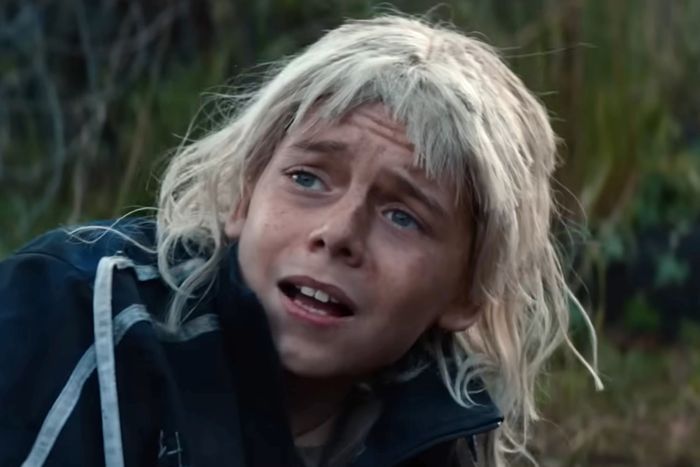
That the first 28 Years Later ended its somber meditation on grief with a scene of Sir Lord Jimmy Crystal (Jack O’Connell) and his acolytes doing Power Rangers moves on a horde of the infected suggested that the next movie would be a more lighthearted affair. Indeed, The Bone Temple is a funnier film than its predecessor, but it’s also, it turns out, far more gruesome. When the movie starts, young Spike (Alfie Williams) is forced to fight to the death to become one of Sir Jimmy’s followers, which he calls his Fingers. Spike manages that, however unwittingly, with a well-placed stab of his opponent’s femoral artery. Once admitted to the gang, however, he finds that his nightmare is far from over. Sir Jimmy is a psychopath who believes that the voice in his head belongs to his father, Old Nick (an archaic name for the Devil). To serve him, Jimmy and his Fingers roam the land in search of innocent people to torture to death as sacrifices. As we learn in The Bone Temple’s most harrowing sequence, their preferred method for what they’ve termed “charity” is skinning their victims alive.
For his refusal to participate and for letting a pregnant woman escape, Spike runs afoul of Sir Jimmy and his Fingers. His fate will be decided by Old Nick — not the voice in Sir Jimmy’s head but by Satan himself, whom Spike’s sole ally, Jimmy Ink (Erin Kellyman), believes she has found. In fact, the mysterious red man she encounters is Dr. Ian Kelson (Ralph Fiennes), who explained in 28 Years Later that he covers himself in iodine to ward off the virus. In a private conversation, Sir Jimmy comes to realize that Kelson is not the real Devil, but he forces the doctor to play along if he wants to stay alive. Kelson ends up putting on an incredible show for Sir Jimmy and his Fingers, complete with pyrotechnics and a thrilling performance of Iron Maiden’s “The Number of the Beast.” But when he recognizes Spike among the group, he goes off-script to demand a sacrifice of his own: his “son.” In retaliation, Sir Jimmy outs Kelson as a phony with a fatal stab to the gut, though that’s not enough to save his own life. Accepting the sham of the Jimmy cult, Jimmy Ink kills the last loyal Fingers, then nails her former leader to an upside-down cross. She lets Spike bid a tearful farewell to Kelson, after which the two set off together, leaving the bleach-blonde wigs and the torture (here’s hoping) behind.

Click here to preview your posts with PRO themes ››
It’s the closest thing to a happy ending a movie this grisly could have, but The Bone Temple doesn’t stop there. In the film’s final scene, we reconnect with Jim, who appears to be living a relatively peaceful life. We catch him in the middle of teaching a history lesson to his homeschooled daughter. “Those who forget history are doomed to repeat it,” he quotes, explaining the importance of never forgetting the atrocities of World War II. (Jim’s naive assertion that fascism was “totally dismantled, never to return” does reflect one silver lining of these characters’ world ending in 2002.) The two are interrupted by sounds of movement outside. From the window, they see Spike and Jimmy Ink running for their lives from the infected. “Do we help them?” Jim’s daughter asks. The Bone Temple ends on his answer: “Of course we do.”
It would be easy to dismiss this last beat as nothing more than a way to get butts in seats for the next movie — and let’s be clear, it’s not not that. At the same time, there’s real thematic resonance to the brief scene. The 28 Years Later movies have largely focused on the loss of civilization, underlined by the infected who have long since abandoned clothing. In The Bone Temple, Sir Jimmy and his gang further work to strip Spike of his humanity, forcing him to abandon his name, his morality, and his sense of self. It’s a notable shift, then, that the ending brings us back to family, something that Spike left behind at the end of the last movie when he struck out on his own. There is, of course, a nostalgia to seeing Jim again, but there’s a feeling of comfort that runs deeper. After an onslaught of extreme violence and degradation perpetrated by Sir Jimmy and his Fingers, Murphy’s Jim has arrived to set things right again. This is a man who doesn’t think twice when he’s asked to save the lives of two strangers, even at great personal risk.
The contrast between Jim and Sir Jimmy is obvious, and yes, the name overlap was clearly in screenwriter Alex Garland’s mind from the beginning of the 28 Years Later trilogy. Sir Jimmy is emblematic of the fascism that Jim lectures his daughter about: a strongman leader who demands absolute loyalty from his followers and whose sole goal is to increase his numbers. While the first 28 Years Later reflects isolationism — the rest of the world leaving Great Britain to fend for itself, and Spike cutting all ties to set off alone — The Bone Temple depicts the danger of tribalism. It’s only in the final scene that we see a better path forward, one of community and solidarity. In 28 Days Later, Jim faced a strongman of his own in the form of Christopher Eccleston’s Major Henry West, surviving through the creation of a new family unit with Selena (Naomie Harris) and Hannah (Megan Burns). This is the personal history that Jim “never forgets,” and it’s also the lesson he’s passing down to his daughter.
Because the movie gives us so little time to catch up with Jim, there are still countless questions to be answered about what he’s been doing in the 28 years since the initial outbreak. In the meantime, though, his presence in The Bone Temple and the power of his final words provide a much-needed balm. In 2026, there are few messages more comforting than what this closing scene imparts: The world can never return to what it was before, but civilization — and humanity — can still be clawed back.