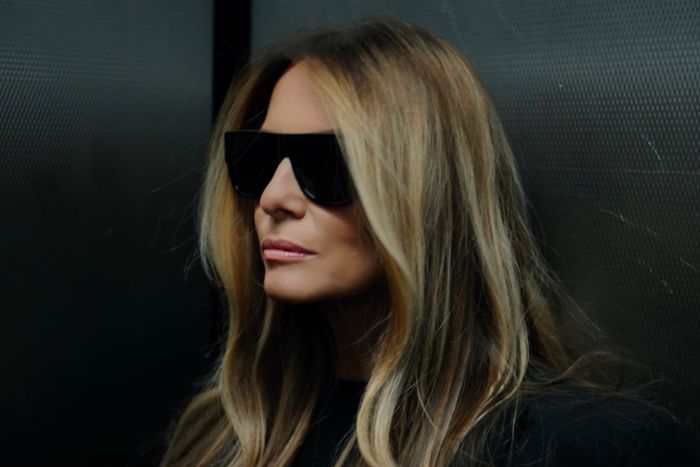
As a matter of simple mathematics, opening-weekend box-office returns for the Amazon MGM Studios documentary Melania: Twenty Days to History are shaping up to be less than … presidential.
Heading into “wide” release on 1,500 screens across North America on Friday, the nonfiction narrative feature chronicling First Lady Melania Trump during the three-week run-up to Donald Trump’s Oval Office return in 2024 is on track to take in somewhere between $1 million and $5 million, according to prerelease “tracking” estimates. Which wouldn’t be such a bad outcome for most documentary films — arguably moviedom’s most beleaguered genre due to diminishing audience appetite at the multiplex level. But as ten-dozen recent headlines like “Melania ‘Doc’ on Course for Box Office Armageddon” and “Melania Documentary Flops as Crew Reveals Behind-the-Scenes Chaos” may have tipped you off, Melania is not like most documentaries. The film division of Jeff Bezos’s all-consuming retail behemoth notoriously paid $40 million for distribution rights to the doc (the biggest outlay for any filmic content by Amazon ever), pledging another $35 million for an all-out marketing blitz (a print-and-advertising budget around ten times higher than most high-profile documentaries normally get, which has included nontraditional buys such as TV commercials during NFL playoff games).
By a standard box-office calculus, such a low- to mid-seven-figure debut for a nonfiction film with $75 million in negative costs means Melania has little to no chance of avoiding flopping theatrically. (To the extent reviews would have a bearing on its commerciality, Amazon refused to screen the Brett Ratner–directed 104-minute film for critics prior to release. The trailer’s soft-focus glamour treatment, meanwhile, suggests it won’t showcase the First Lady processing her husband’s relationships with Stormy Daniels or Jeffrey Epstein.) “On the face of it, there is no way this can break even,” says veteran industry analyst David A. Gross, who writes the FranchiseRE newsletter. “There have been a handful of political profile documentaries over the years that received a wide theatrical release, mostly bashing Democratic politicians (2016: Obama’s America, Hillary’s America), that actually made a few dollars. But I can’t find another wide-release documentary that’s essentially a hagiography. Not one.”
Like so many things in the Trumpworld orbit, however — say, the Minneapolis shooting of Alex Pretti, the president threatening to take “ownership” of Greenland, or ABC’s suspension of Jimmy Kimmel — Melania’s performance this weekend will be subject to intense partisan debate. MAGA adherents and those suffering from Trump Derangement Syndrome will ascribe the movie’s numbers the importance they respectively see fit. Put another way: Any assessment of its success or failure will ultimately lie in the eye of the beholder (more specifically, his or her interpretation of this weekend’s box-office tallies). “What I’m afraid of is, there will be a narrative — depending on what the gross is — of I told you so, this film did very well or I told you so, it didn’t do very well,” says Daniel Loria, senior vice-president and editorial director at BoxOfficePro. “I think we need to have very modest expectations for a documentary going out in late January on 1,500 screens.”
The film arrives in the denouement of the megalucrative holiday-movie-release corridor. January is considered a cinematic dumping ground for major studios’ less-than-premium product: its most forgettable films that test-screened poorly and/or are considered to have crummy commercial prospects. Despite Melania’s nosebleed price tag (which includes the rights to a limited docuseries that will stream on Amazon Prime Video), industry analysts say there is little marketplace gusto for a Vaseline-lens documentary about Mrs. Trump. The January 2025 bidding war among Paramount, Disney, and Amazon for its distribution rights culminated in what has come to be regarded throughout the entertainment industry as an “outright bribe” by Bezos to curry Trump’s goodwill and (hopefully) preempt the president from raining down regulatory hell on his companies, which include the Washington Post and rocket manufacturer Blue Origin. (Amazon paid $26 million more than what Disney, the next closest bidder, was offering for Melania.) “One million dollars would be a fantastic opening for a documentary about a political figure,” says Loria. “I can’t think of the last time we had a documentary do that well.”
While expository docs (driven by facts, figures, and analysis) or observational “fly-on-the-wall”-style docs are basically never produced by the people they cover, Melania would seem to hew closer to a nonfiction film subgenre of “preapproved” celebrity vanity reportage. Things like Netflix’s four-part docuseries Beckham or Disney’s Elton John: Never Too Late, which gently probe but never muckrake, leaving the hardest-hitting questions unasked in exchange for privileged access.

Click here to preview your posts with PRO themes ››
Having been exiled from the director’s chair since 2017, when multiple women accused him of sexual harassment and misconduct, Ratner has precisely zero experience helming documentaries. His primary qualification for infiltrating the innermost sanctums of Trumpworld would seem to be a vast capacity for cozying up to friends of the Donald. In 2013, Ratner formed the now-defunct TV-movie production company RatPac-Dune in connection with Steven Mnuchin — Trump’s first-term Treasury secretary — briefly partnered with 75th richest person in the world/Trump supporter Len Blavatnik (who contributed $1 million to Trump’s first inauguration), and developed an unlikely friendship with Israeli prime minister Benjamin Netanyahu (who invited Ratner to be his guest at the United Nations General Assembly in 2023). It didn’t hurt, of course, that Ratner had helmed the Rush Hour movie franchise. Trump is an avowed fan of that buffoonishly macho, anti-woke action-comedy trilogy (that grossed more than $850 million between 1998 and 2007), whose leads, Chris Tucker and Jackie Chan, perhaps not coincidentally have also spoken glowingly of Trump. (In November, the president leaned on Paramount Pictures proprietors Larry and David Ellison to green-light a fourth film with Ratner once again at the helm despite apparently nonexistent market demand for more Rush Hours.) Since wrapping the documentary, Ratner has reportedly been living in a villa at Mar-a-Lago and continuing to film Melania — presumably for the limited docuseries.
In the face of less-than-spectacular ticket sales to date, Republican-leaning groups have been organizing at a grassroots level to drum up attendance for Melania. Even while posters for the film have faced “extensive and severe” vandalism (with devil horns and Hitler mustaches scribbled onto the First Lady’s head or scrawled expletives serving to remind the public of her husband’s long association with Jeffrey Epstein), the Kern County Young Republicans in Bakersfield, California, organized a watch party for Saturday, January 31 (tickets are free for members). The Women’s Republican Club of Miami Federated has block-booked tickets for a January 30 premiere party and screening at Miami’s Cinepolis (price: $35). While in Boston, a perhaps apocryphal Craigslist post purports to offer not only free tickets but a $50 stipend to attend screenings of Melania (“Must remain in seats for entirety of film,” the posting notes).
Although Amazon insists on calling Melania’s 1,500-screen domestic rollout a “wide release,” Loria points out that the technical definition of wide comprises 2,000 screens or more (relinquishing the documentary to the less prestigious “wide-limited-release” category). And although some recent box-office prognoses have contemplated whether Melania could perform along the lines of Am I Racist? (the Borat-esque, DEI-skewering mockumentary produced by the Daily Wire that shocked Hollywood by grossing $12 million theatrically in 2024), Loria feels the more accurate “comp” would be RBG. That documentary, about the life and career of Supreme Court Justice Ruth Bader Ginsburg, opened in 34 theaters in 2018 and platformed onto 432 screens, eventually grossing over $14 million to set the genre’s financial high-water mark for a film about a stand-alone political figure. “I don’t know how big this is going to get,” Loria says of Melania. “Would a $5 million opening weekend surprise me? That would be a great number. Because I have no reference to say this film is definitely going to hit that on 1,500 screens. But it’s also not what I would call a big swing from Amazon. If it hits $5 million, that’s a very strong result for a film about a politically adjacent figure in a highly politicized, charged time when there is a giant snowstorm in late January.”
At the Trump Kennedy Center premiere of Melania in Washington, D.C., on Thursday night, Mrs. Trump addressed the audience to adjust expectations for the film. “Some have called this a documentary. It is not,” she said, per Deadline. “It is a creative experience that offers perspectives, insights, and moments.” A reporter at the event asked how she would measure the project’s success. “For myself, it’s already successful, what we did,” she said. “And it will speak for itself.”