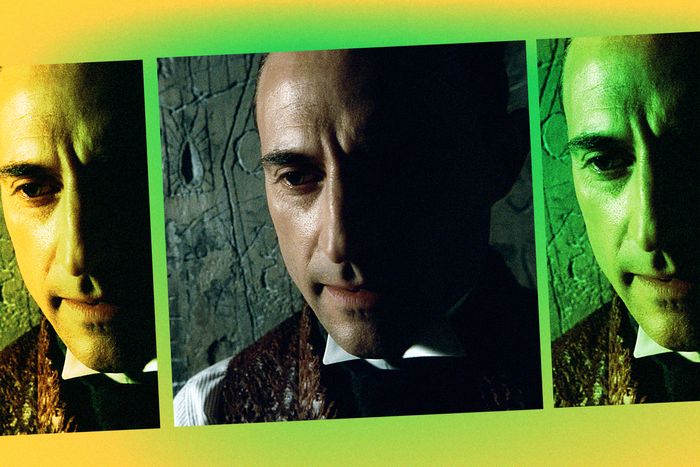
There’s a long tradition in American filmmaking of having a sneering, classically trained British actor step in to play the villain in a big-budget production, whether that’s Claude Rains, Anthony Hopkins, Jeremy Irons, or, in the case of Guy Ritchie’s 2009 adaptation of Sherlock Holmes, a leather-clad and deeply intense Mark Strong. “It’s an honorable profession, Brits going over to Hollywood and playing villains,” Strong says over a video call. The call to become vile when he wants is one Strong has embraced throughout his career, whether as a gangster in Kick-Ass, a mad supervillain in Shazam!, or an intelligence agent in Body of Lies. (Right now, Strong is channeling extreme darkness in Oedipus on Broadway as a man who isn’t necessarily a villain, but does discover he’s his own worst enemy.)
Strong’s career as British villain for hire was majorly catapulted with his appearance in Sherlock Holmes as that version’s antagonist, an occult-obsessed aristocrat named Lord Henry Blackwood who doesn’t appear in the Arthur Conan Doyle novels and was invented for the film. Blackwood dies early in the movie, only to mysteriously resurrect himself. This, like all his “magic,” turns out to be a trick that Robert Downey Jr.’s Sherlock has to solve. Then Lord Blackwood tries to enact a plan that involves poisoning much of Parliament, and he’s finally thwarted in a third-act fight sequence that plays out on top of London’s Tower Bridge, then in construction. The movie was Strong’s highest-profile project to date, and it gave him the chance to enjoy the thrill of being on a big, well-financed American set, alongside Downey, who had just released the first Iron Man in 2008. Here, Strong runs through his memories of playing Lord Blackwood and muses about why Brits are so good at going bad.
Lord Blackwell is quite a fun character visually. He’s got a big leather coat and a distinctive undercut. Do you remember what it was like coming up with how he’d look?
We wanted a kind of severe, almost Germanic kind of shaved-head thing. I had shaved hair at the sides, and we added hair at the top. Jenny Beavan, who was the costume designer, decided he would have this sort of leather trench coat. He looks incredibly authoritarian and slightly nasty. The real genius was, actually, she found this material for the waistcoat that was this destroyed red velvet and looked like it was offal or rotting meat. She was very particular about the way he looked because that character doesn’t appear in any of the Sherlock Holmes novels, so we were at liberty to create him from scratch.
It must have been fun to have those resources and to have the sort of room in which to play and to really go for it.
There’s a sequence at the very beginning, when you first meet Blackwood, and he’s got a hood on and he’s got his arms open and he’s over the body of a girl who’s sort of trembling on a marble slab. We shot that sequence in the crypt of St. Bart’s Hospital, which really is, like, a 13th-century space. That’s the privilege when you are making a movie of that kind, to work somewhere like that. In the script, it said that he’s doing an incantation, and I said to Guy, “What do you want me to say here?” He said, “Just do anything that comes into your head.” So the words I’m saying, I just made up. I wish I could say it was actually ancient Aramaic or something. But it’s just me making something up that sounds spooky.
You’d filmed two movies with Guy Ritchie before this, RocknRolla and Revolver. What was it like to work with him again on a larger scale?
I love working with Guy. RocknRolla had a roll call, actually, in it of actors who were all starting out around then — Thandiwe Newton, Idris Elba, Tom Hardy, Gerry Butler. It was a great cast, and I’d had fun making those two films. When Guy was stepping up to make a much-bigger-budget Hollywood movie, he asked me to go along with him because I think directors like to work with people that they know. We got on as friends. We knew each other’s dance, if you like.
The movie builds to a set-piece fight between you and Robert Downey Jr. on the Tower Bridge. You’ve got a sword. How much of that was stunt doubles, or were you filming all of it?
We were doing all of it. I mean, that’s part of the joy of playing a character like that. You know there’s going to be some fight at the end, and you know the morality tale dictates that the bad guy has to lose. I’ve done a number of movies, like Kick-Ass, where the same thing happens, and I have a fight to the death with a 12-year-old girl. In Stardust, I have a fight to the death with the dastardly witch who’s trying to kill me. But a sword fight on top of a half-built bridge was genius. The set was actually built in the Armory here in New York City, in a green-screened room. The tricky thing about fighting on that set was it was on a raised platform, so you had to be really careful where your footing was because it was all on planks of wood.
Had you done much sword work before?
Funnily enough, yes — at drama school. So much of that training is nebulous, doing scene study and character work, but the stage-fighting training has a whole certificate at the end. It’s the only physical thing you get when you leave drama school. In my case, it was three of us who worked out a whole three-way sword fight that we choreographed and did ourselves. In classic male behavior, we all went for it and did a really great fight. So I was very competent with a sword.
This film was big, at least for myself and the Americans I know, in introducing us to Mark Strong as a guy who plays these British villains. Was there a point in your career when you realized that was a type you could play? In other coverage, I’ve seen people point to your role as the mid-century London gangster Harry Starks in the 2004 TV series The Long Firm.
That was really rather brilliant, The Long Firm. It was four episodes, and each one was a kind of love story. That character was very dark, and up until that point, I had played young men who were romantic leads — Ferdinand in The Tempest, Romeo — these juvenile leads. It was the first time I had played a party that required the depth of something a bit evil, something nasty going on. I had to fight for that part. A lot of people who were casting it thought I was too nice! [Laughs.] They weren’t sure I could plumb the depths. But anyway, I played the part, and I’m sure Guy Ritchie saw that and realized I could play Lord Blackwood because it involved the same kind of dastardly, evil machinations that Blackwood takes part in.

Click here to preview your posts with PRO themes ››
That kind of darkness must be fun, in some ways, to access as an actor. Is there something you feel like resonates with you about playing that type of role?
I find it more difficult to play parts that are close to me. There is the idea, in acting, that you want to play something that’s removed from yourself. That’s why I really enjoy what a costume can do to a role, what a wig can do to a role, what an accent can do. I find it much easier to play an evil or villainous character because, obviously, I don’t go around my daily life threatening people. It’s a removal from me, and it’s cathartic in a way.
Speaking of morphing between personas, as a fellow bald guy, I respect how much you’ve played with different hairstyles on film.
I mean, I’m in the business of transformation. Anything that can help with that is welcome. I did a film called Sunshine with Danny Boyle where I was burnt from head to foot, and that was literally eight hours in makeup. I did Green Lantern and played Sinestro, which was, again, a complete transformation. That’s what I always enjoyed as a younger actor. At drama school, I loved the idea of playing something that wasn’t yourself. We did this 18th-century play, The School for Scandal, and I played this very old Jewish moneylender, and the reason I did it was because I got to wear a big old wig and draw the lines on my face and act 70 years old. As I’ve gotten older and better known, the parts have gotten closer to me because I think that once people know you, the idea of someone playing something very far from themselves is difficult to believe.
Robert Downey Jr. was just a year out from Iron Man when Sherlock Holmes came out. What was it like working with him?
He’s a force of nature. I just bumped into him again recently because he came to see Oedipus, and we got on like a house on fire. Back then and now, I really admire his talent and his energy. When you work with somebody like that, you have to bring your A game. He’s incredibly fit, and he had a guy that he used to do martial arts with on set during the downtime. I think I was having a cup of tea reading the paper, and there was a sort of punching, slapping noise coming from behind me. He was basically fighting this guy he employs to keep him fit. The juxtaposition of him doing that and me sitting there drinking tea — I thought, Maybe I should try to get fit.
There you were, on an American film set.
Well, everyone over here is. I think it’s actually become a feature of being an actor. It was never a prerequisite when I was younger, but these days, you have to get to the gym.
I’ve read that you participate in a regular London football game with some other actors and creative people, so that must help a bit.
It’s a great way of keeping fit because you end up running around for 90 minutes and you don’t even know you’ve done it. I’ve actually found a pickup game over here in New York while I’ve been here doing Oedipus.
Is it still a bunch of actors?
Well, back in the U.K., we play later on in the day, so I always describe that as a game for people who haven’t got a proper job. Here, we play at 7:45 in the morning so guys can then go to work. They do have proper jobs.
Speaking of going big and grand with a character, there’s a scene in Sherlock Holmes where you enter into Parliament and threaten all of them with what’s essentially a chemical bomb. That must’ve been very fun to play.
It was, and it was a huge room. I think there were a couple hundred extras in there, so it felt really real. I wasn’t doing it on a green screen, which helps enormously. Because this character wasn’t a part that existed in any of the novels, we could do what we wanted with it, so we made him as evil as he could possibly be — he’s consorting with the devil. There were a lot of murky secrets in the Victorian world. There was a dark underworld to London. What was great about Blackwood was that he was part of the aristocracy but all the dark, murky chaos that was part of, you know, Victorian England.
What I’ve always thought is that our culture isn’t afraid of the villain. American culture worships the homecoming king and queen. It’s all about the quarterback hero. It’s John Wayne. A lot of American actors are much more comfortable, or used to be much more comfortable, playing the hero. With British actors, our heroes were Richard III and Coriolanus and Macbeth — anti-heroes. That was a culture that we grew up with. Whether you’re playing a dastardly Victorian lord or a gangster from the 1960s, it comes from the same place.
Was there a performance of a villain that you saw growing up that really imprinted on you?
There’s loads of them: Bob Hoskins in The Long Good Friday, if you’re looking for a great gangster; Malcolm McDowell in Clockwork Orange; Alan Rickman in Die Hard; Anthony Hopkins in Silence of the Lambs. There are so many really good British actors who are able to do that, but I genuinely believe it is because when you train as an actor and you come up doing Shakespeare, the examination of the dark arts is something that’s built into our theatrical tradition. So it’s a short hop to play it in the movies.
Beavan, a renowned British costume designer, has won Oscars for her work on A Room With a View, Mad Max: Fury Road, and Cruella. In college, Strong studied law in Munich for a year before transferring to study English and drama at the University of London and later getting a degree from the Bristol Old Vic Theatre School.