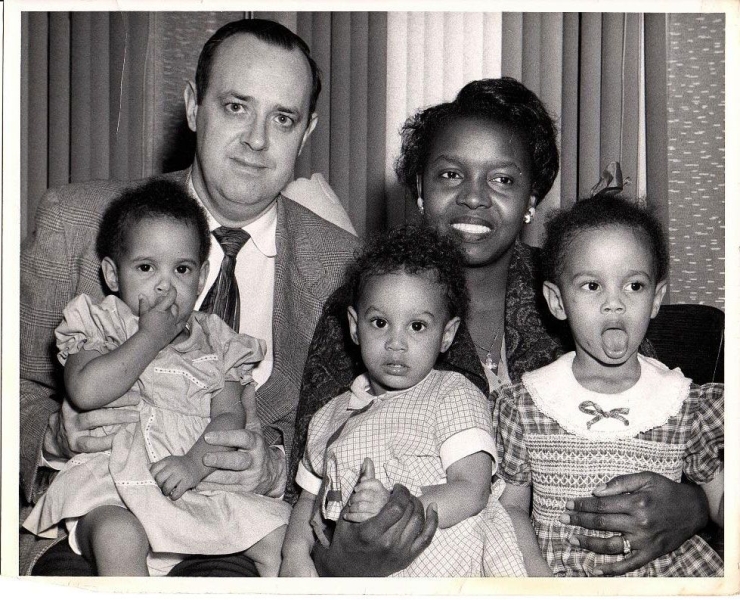
Roberts with her sisters and her parents at their house in Chicago in 1960.
Growing up, a constant presence in Dorothy Roberts’s life was the Book — her anthropologist father’s decades-long project about the lives of Black-white couples in Chicago. The Book was inescapable in the Roberts household: It dominated conversations at the dinner table, brought interesting characters into her home, and was the foundation for her understanding of her own family history. Roberts, one of the most prominent legal scholars of her generation, spent all her life believing that her white father’s academic research on interracial marriages was inspired by his own romantic relationship with her Black Jamaican mother in the 1950s.
But her father never finished his book, and, years after his death, Roberts set out to complete the manuscript. While reviewing his research, she came across a shocking interview transcript dated 1937 — meaning that her father actually started studying the topic of interracial marriage long before he met his wife. The finding shattered the narrative that Roberts had believed all her life. It led her to question her father’s intentions, whether their family was a social experiment, her own feelings around mixed-race marriages, and what it means to be a Black woman with a white father.
She takes us on this journey in her new memoir, The Mixed Marriage Project: A Memoir of Love, Race, and Family. In the book, she blends her parents’ research with reflections on her own childhood as a Black girl with a white father and how these experiences shaped her. Below, we talk about how structural racism impacts people’s intimate relationships, the power of love, and how we make sense of our parents’ lives long after they’re gone.
What drove you to write The Mixed-Marriage Project?
Once I started reading the interviews, I thought I had to write a book about them. They were so fascinating and unique — and I wanted to finish the book my father never published. But as I continued really immersing myself in them, I got more interested in my parents’ story. They seemed to have the most mysteries surrounding them, both professional and personal. I became very intrigued with their lives and also what I was discovering related to my own identity. I decided to write a memoir partly because I wanted to explore those themes for myself.
But the question was, How much do I want to reveal about myself? I thought that if I’m going to write about my family, I have to be willing to expose aspects of myself I’ve hidden for a long time. For much of my adulthood, I didn’t want to reveal that my father was white. And, while I did write about the prohibition of interracial intimacy and marriage as an aspect of white supremacy and racial hierarchy, I had shied away from questions about these marriages’ relationship to the struggle against racism. For all those reasons, it was a big move for me to write this book. It forced me to really grapple with my own identity in ways I never had before and really think deeply about what it means to be a Black woman with a white father.
How would you summarize your father’s decades-long research? What surprised you the most about his work?
My father studied the relationship between interracial marriage and what he called then a racial caste system in America. From when he was a 21-year-old master’s student in the 1930s up till his retirement in the 1980s, he was very committed to speaking with as many Black and white couples as he could possibly find in the city of Chicago. He was devoted to these interviews and to promoting his deep belief that interracial marriage was the answer to racism in America. He deeply believed that if more white and Black people would get married to each other and have children eventually, they would spread the message that there is not a real division between Black and white people, that there’s no such thing as biological races, and that the only thing keeping people apart is a made-up racist hierarchy promoted by powerful people. Not only did he study interracial marriage, but he promoted it and participated by marrying a Black woman.
One of my biggest discoveries, the one that sent me down this path, was finding an interview from February 1937. Up until that moment, I had believed that he became interested in interracial marriage after he had fallen in love with my mother and that he began conducting the interviews in the 1960s. It really upended the understanding I had of my family and of his research.
The other big discovery was that my mother became my father’s co-investigator in the 1950s. I always thought that this was my father’s project and I didn’t realize how involved my mother was in finding and interviewing interracial couples. It helped me to understand why my mother was so insistent that my father write his book. He had many attempts to publish it — that was something else I discovered — and he just could not finish his manuscript. My mother was extremely upset about that, and growing up, I thought that she was mean to him because she was harassing him constantly about getting his book done. Now I see that was her project, too. She put a lot into it — not only throwing all these parties for my father and his colleagues, serving him dinner every night, raising his children, but also actually doing the research with him.
The other major discovery was finding a research folder about me among the interviews with children of mixed marriages and seeing that, to some extent, he thought of me as one of his subjects.
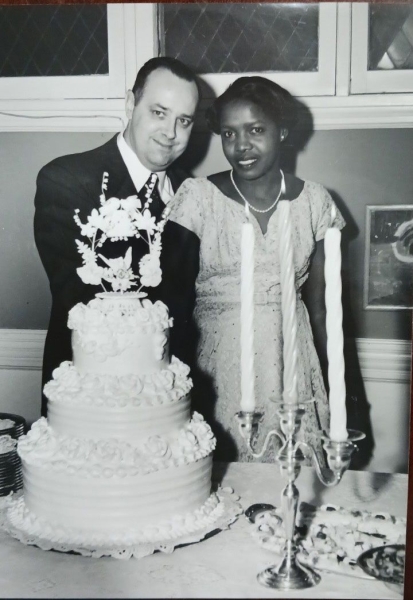
Roberts’s parents on their wedding day in 1954.
Your parents’ research paints a very rich portrait of life in Chicago for interracial couples — the violence and discrimination they faced, the ways in which they came together and were pulled apart by internal and external pressures, how conditions materially changed over the decades and how some things stayed the same. Why was it important for you to include so many of these anecdotes in depth?
They reveal so much about how structural racism operates. Illinois had repealed its anti-miscegenation law in the late 1800s, and yet interracial couples faced so many obstacles. It was not even primarily about animosity and opposition to interracial marriage. It was because there was extreme, racist residential segregation in Chicago. The biggest hardship these couples faced and which they all talked about was that they had to live in what was called the Black Belt, the narrow corridor of neighborhoods where Black people were forced to live — by city policies, by mob violence, by restrictive covenants and other real-estate practices. White people, once they married a Black person, had to live there.
The interviews also reveal a racial hierarchy that puts Black people at the bottom and Black women at the very bottom. Some of these couples would complain to my father, “We have it worse than fully colored people.” One white woman says, “Who are the slaves of the South? White women who marry Black men. Our mixed-race children have it worse than full colored children.” White women from Europe who married Black American citizens thought this would help them assimilate into U.S. culture and then they were shocked by this hierarchy. Even in interracial circles — like the Manasseh Club that was formed by interracial couples in the 1890s — they basically excluded Black women who married white men. They said horrible things about them like, “We don’t like colored women. Their morals are loose. That’s why white men won’t marry them — they don’t have to.”
I also always thought of the Black Belt as being exclusively Black and that white and Black life were separated by the color, especially in their intimate relationships. But there were all these white people my father interviewed who courageously defied the color line out of love for their partners. But, at the same time, their love crossing the color line didn’t dismantle it. They were so confined by it. Many of them did not challenge anti-Blackness at all. Many of them wanted their children to pass as white. Many focused on their loss of privilege instead of challenging the racist practices and structures actually discriminating against them. They wanted to escape the racial hierarchy, but they didn’t want to dismantle it necessarily. Some did, and there were many people who actively fought against racial inequality, especially when we get into the 1960s. But loving and being married to someone of another race didn’t necessarily mean challenging racism in Chicago. It’s a complicated picture!

Click here to preview your posts with PRO themes ››
One of the tensions of the book is that you generally disagree with your father’s thesis that institutional racism and “the barriers enacted by white supremacy,” as you describe them, could be dismantled if more people would marry across race and ethnicities. What do you think is at the core of your intellectual disagreement? You’re not coming at this issue just as his kid and a Black woman, but also as a fellow scholar.
I’m heavily influenced by all the research I’ve done challenging structural racism and racial stereotypes in America, especially the regulation of Black women’s sexuality, reproduction, and caregiving. Now, my father understood the strength and the power of racial hierarchy in America, including Chicago. He saw interracial marriage both as an example of its power and as a way to challenge it. But he focused so much on his belief that interracial marriage could overcome racism that he didn’t pay enough attention to what it’s taken social movements to do in order to weaken the power of white-supremacist structures. I recognized that more than he did.
But one thing I came to realize as I worked on the memoir is how much his deep faith in our common humanity and the potential for human beings to dismantle racism and other unjust structures influenced my work and my activism. Even though we disagreed on the tactics, we deeply agreed on the underlying vision, of a world where racial hierarchy is unimaginable. I know that I got that hope and that commitment from him and my mother.
Your mother was a very formidable, complex woman — she was very much of her time and also ahead of it — and you write about her with so much admiration. Did going over her side of the research make you understand her better?
I always knew my mother was an excellent writer, but reading her notes on the interviews she conducted of the wives during the 1950s was surprising. She was just a brilliant woman who took so much care in helping me to write well, but I thought of her as my writing coach and never as a writer. But her interviews flowed like novels or screenplays. She would also interject a lot of her emotions into them, much more than my father did, and I was just so delighted at her writing. The archive also showed me the side of her before she became my mother. I found photographs where she looked so sultry and mysterious, whether on a road trip with my father or when she was a graduate student. I’d never thought of her that way because she was very discreet and proper. I didn’t really have a view of her as being bohemian.
In so many aspects of her life, she broke all the rules. She left Jamaica when she was 25 years old to move to Liberia and became a citizen. She then left Liberia to travel to the United States to become a college student. She started her work on a Ph.D. in anthropology in the 1950s and would have completed it had she not given birth to me and my sisters. She married in her early 30s — and to a white man, which was extremely rare then. She broke all of these boundaries, and yet she also was very respectable and cared about how people viewed her. She taught me not to do reckless things and taught me never to depend on a man. She was just such a complicated and amazing woman. It’s almost hard to describe her.
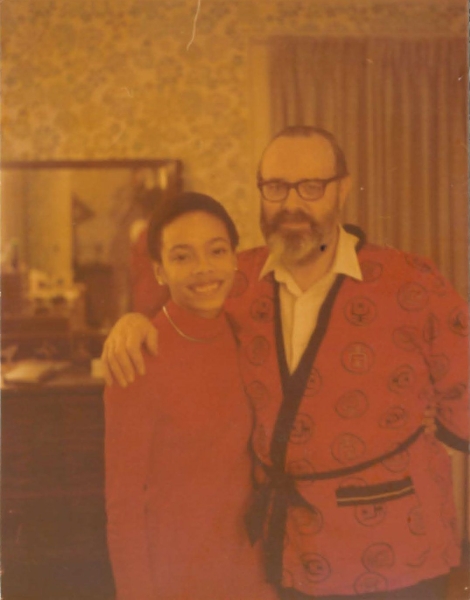
Roberts and her father at home in Evanston in 1973.
At some point, your father turned his lens toward the children of these mixed-race marriages. And again, it really feels like you cannot separate his intellectual curiosity and his political commitment from his own personal life. You write in the epilogue about the shock of realizing that he kept a file on you and that you had been a research subject as well. How did it feel to learn that?
I first thought, Were we guinea pigs to prove his hypothesis that interracial marriage could be successful and produce successful children? It was a shock. But immediately after that, I began to think of how much my father loved us. He wasn’t distant. He was very engaged with me and my sisters. He revered my mother. He praised her every day. There was no way I could keep that thought in my head that we were just created to prove some sociological theory.
Growing up, I felt that I was closer to my father than my friends were to theirs. He spoke with me as if I were an adult and treated me with so much respect even when we disagreed. He never tried to impose his views on me. Because of the deep love we had for each other, discovering the file on me, if anything, made me feel ashamed of how I dismissed him — especially when I was in college. I actually hid him. I didn’t want people to know I had a white father.
In the end, the overwhelming thought I had was that because my father did connect his research to his personal relationship with me, my sisters, and my mother that meant that we were completely woven through his life.
How did your sisters feel about you taking on this project? There are moments in the book where there seems to be friction between you three because your understanding of what you’re discovering through reading the research is kind of different from theirs.
My sisters were very supportive. We had monthly Zoom calls where I’d update them on what I found, and I sent them chapters as I wrote. One of them has an excellent memory, so she was very helpful in remembering details I had forgotten. They did disagree with me on revealing the details about some of the interviews and notes my father took in the 1950s in the chapter called “The Bachelor” (which focuses on the years before he was married, including a weekend he spent at a nudist camp and the time he took two Black women to a party for interracial couples). They thought that my mother would be mortified if she knew that I was revealing some of these details and that it might change our acquaintances’ view of our family. One of my sisters did not want me to include the chapter at all. I felt very strongly I should include it because it was important to understanding my father. We talked about it. Eventually, one of my sisters said, “You may not like the truth, but it’s the truth. Why hide it?” And the other one came around.
You conclude in the epilogue that poring over your parents’ research changed you, and, though you didn’t find definite answers, you still found reconciliation. You use that term very intentionally. What did you mean by that?
When I was reflecting on what the whole project meant for me, it kept bringing me back to this question of how to love each other as equal human beings in a racist society. I’m an abolitionist. The reality is we are constrained by all these racist institutions, and we should recognize that we’re fighting to dismantle them. The reason why we can do it and how we know how to do it is that we can imagine a future without those racist institutions. I don’t think we’re there yet. Racist stereotypes still shape our most intimate decisions and our most intimate lives. What do we do about that? We need a transformative love — one that doesn’t pretend that we can overcome racism just through love. It has to be a love that recognizes the work we have to do in order to dismantle racist institutions and ways of thinking.
After writing this book, I don’t have all the answers. But I feel reconciled with the tensions I had about my own identity. I feel reconciled with my father, my family, and the work he was doing. I also came to reconcile myself to the fact that my whole worldview was deeply influenced by my father’s and my mother’s belief in our common humanity and their deep commitment to treating everyone as an equal human being. So I came to settle with the fact that I am a Black woman who was very much influenced by my white father. That’s not a contradiction. It’s not something I should have to hide.
This interview has been edited and condensed for clarity.