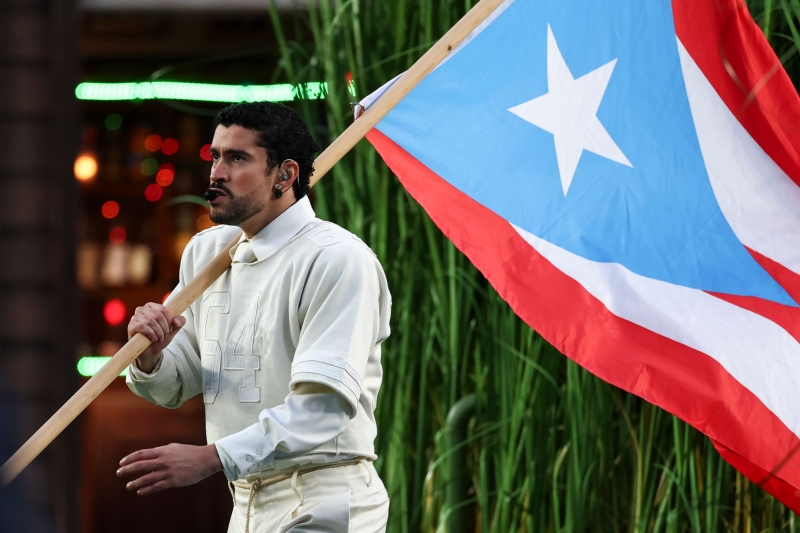
Around halfway through his Super Bowl LX Halftime Show, as I watched Bad Bunny hold up the Puerto Rican flag — the one with the light-blue triangle, the pro-independence one — I thought about all the ways in which the local and federal government cracked down on the movement for decades, the memories passed down to me by my family. The arrests, the massacres, the air strikes, the secret police files, the Gag Law of 1948 — which made displaying la monoestrellada, that exact flag, a crime per the U.S.-appointed governor. My eyes stung with tears as I imagined what my late grandmother Minerva, who spent so much of her life believing in a free Puerto Rico, would have said if she saw Benito Antonio Martínez Ocasio waving it unapologetically on the biggest stage in America.
Many people may have come away thinking there were no overt political gestures in his performance, but look closer: Much of what we saw, in the costumes, the set, the transitions, all spoke to how to be Puerto Rican is to have an inherently politicized identity as colonial subjects. And yes, that it was primarily in Spanish, a first in the Super Bowl’s 60-year history, spoke to it, too.
The performance began with a walk through the island, through past and present life in the American colony: jíbaros cutting down sugar canes and old men playing dominoes, vendors selling coconuts and piraguas. The iconic casita from his historic 2025 residency in San Juan, which resembles the homes of my family and friends, was part of the stage, as were power poles that exploded, a reminder of Puerto Rico’s frequent blackouts and failing power grid. Singing “NUEVAYoL” he nodded to the Puerto Rican diaspora in New York City, with their barber shops and bodegas and, of course, Toñita. Snippets from Tego Calderón’s “Pa’ Que Retozen,” Daddy Yankee’s “Gasolina,” and Don Omar’s “Dale Don Dale” played ahead of Bad Bunny’s “EoO,” a tribute to some of the pioneer Boricua reggaetoneros.
Bad Bunny’s guests also spoke to our culture. He brought out Lady Gaga, dressed in light blue (the dress custom designed by Dominican designer Raul Lopez of Luar) with a flor de maga (the Puerto Rican national flower) in her lapel, for a surprise salsa rendition of her hit “Die With a Smile” in the midst of the show. She performed with Los Sobrinos, a young Puerto Rican band that has collaborated with Bad Bunny in his latest record, DeBÍ TiRAR MáS FOToS, and tour—a passing of the torch to the next generation of musicians in the island. Bad Bunny also brought out Ricky Martin for a rendition of “LO QUE LE PASÓ A HAWAii,” a bolero from the album that directly criticizes the brutal gentrification and displacement that Puerto Ricans are currently experiencing in the island. Then, the rapper sang “CAFé CON RON” with the group Los Pleneros de la Cresta, giving the country a glimpse of the traditional genre of plena that soundtracks our family parties and parrandas.
Towards the end of the show, he said “God bless America” before launching into a roll call of all the countries in the American continent. Performers ran out of the field holding each country’s flag, many of which have been touched in one way or another by U.S. imperialism, in a move that also de-centered the idea of this country as the singular “America.”
This is exactly what we’ve come to expect from Bad Bunnty, an artist who has not shied away from speaking up on issues that matter to him. After Hurricane Maria ravaged the island in 2017 and Donald Trump withheld aid from Puerto Ricans, Bad Bunny criticized the president during a performance on The Tonight Show Starring Jimmy Fallon; it was his first ever appearance on American television. Two years later, when Puerto Ricans took to the streets to demand Governor Ricardo Rosselló’s resignation, the rapper stopped his European tour and flew home to join the mass protests. In 2024, he endorsed La Alianza, the progressive reform-seeking third party and its pro-independence candidate Juan Dalmau, in Puerto Rico’s gubernatorial election.
Still, DeBÍ TiRAR MáS FOToS remains his most political work yet. Like tonight’s show, the album skilfully integrates Puerto Rico’s musical traditions from past and present, and in between lyrics about partying, family, and love, Bad Bunny tackles our second-class citizenship head on and nods at how the United States has oppressed the island. As he sings in “La Mudanza,” he carries the Puerto Rican flag everywhere he goes because people died for the right — a reference to that abovementioned Gag Law. A week ago the record earned him Album of the Year at the 2026 Grammy Awards, making DMTF the first Spanish-language album to ever win the Grammys’ most coveted award. The record also won Best Música Urbana Album and Bad Bunny directly addressed the violence and terror that the Trump administration is inflicting on communities across the United States in his acceptance speech. “Before I say thanks to God, I’m going to say ICE out,” he said. “We’re not savage, we’re not animals, we are humans, and we are Americans.”

Click here to preview your posts with PRO themes ››
The Trump administration’s mass-deportation efforts were a major reason why Bad Bunny did not include mainland U.S. cities in his world tour, with him telling i-D he was concerned that “fucking ICE could be outside” his shows to target his fans. As of November, Homeland Security had apprehended more than 1,430 immigrants in Puerto Rico — a tenfold increase in detentions compared to 2024. Bad Bunny has witnessed these arrests up close. In June, he recorded footage of immigration agents arresting people in the city of Carolina and posted it on his Instagram stories. “Those motherfuckers are in these cars, RAV4s,” he said in the video. “They’re here in Pontezuela. Sons of bitches, instead of letting the people alone and working.”
So it’s no surprise then that Bad Bunny’s politics and Latinidad made him a target of the rightwing as soon as the NFL announced he’d be headlining the halftime show. Trump administration officials threatened to sic ICE on Super Bowl attendees (they have since walked back their comments back), while other conservative slung xenophobic insults and advocated for the artist’s deportation — even though he is a U.S. citizen. The racist backlash extended to Turning Point USA’s All-American Halftime Show. The conservative organization founded by Charlie Kirk streamed the concert, featuring an all-white group of country singers: Kid Rock, Brantley Gilbert, Lee Brice, and Gabby Barrett. “We’re taking the American Culture War to the MAIN STAGE,” the organization said on its website last month. “No ‘woke’ garbage. Just TRUTH. Just FREEDOM. Just AMERICA.” The stream had over 2 million views as of 10 p.m. — a very small percentage of the more than 120 million people on average who tend to watch the Super Bowl. Trump had similar feelings about Bad Bunny’s performance, posting on TruthSocial after the show: “The Super Bowl Halftime Show is absolutely terrible, one of the worst, EVER! It makes no sense, is an affront to the Greatness of America, and doesn’t represent our standards of Success, Creativity, or Excellence.”
With this backlash in mind, Lady Gaga’s inclusion in the show felt almost as a concession to critics enraged by the possibility of an all-Spanish halftime show. But if it was, the rest of the show was a rebuke of them. Between Puerto Rican symbols and shaking ass, Bad Bunny emphasized themes of community and fighting for your dreams. When he first introduced himself to the crowd, he said in Spanish: “My name is Benito Antonio Martínez Ocasio, and if I’m here today at Super Bowl 60 it’s because I never, ever stopped believing in myself and you should also believe in yourself, you’re worth more than you think.” He later repeated this sentiment when he gave his recent Grammy to a young boy watching his acceptance speech on TV, telling him, “Cree siempre en ti” — always believe in yourself.
In the end, before triumphantly walking out to the title track of his album, Bad Bunny raised a football that read “Together, we are America.” It served a dual-purpose: as a reclamation of the name to mean the American continent rather than just the United States and a reminder that we, no matter what this administration may say, we all belong in this country.
But what has stuck with me is his parting message to our island: “And my motherland, mi patria, Puerto Rico, seguimos aquí.” It was a needed reminder that after more than 500 years of colonization, including more than a century under U.S. rule; after attempts to erase our national identity and suppress our fights for a better future; after the man-made crises and natural disasters that have befallen our people; in the face of every challenge, we are still here.