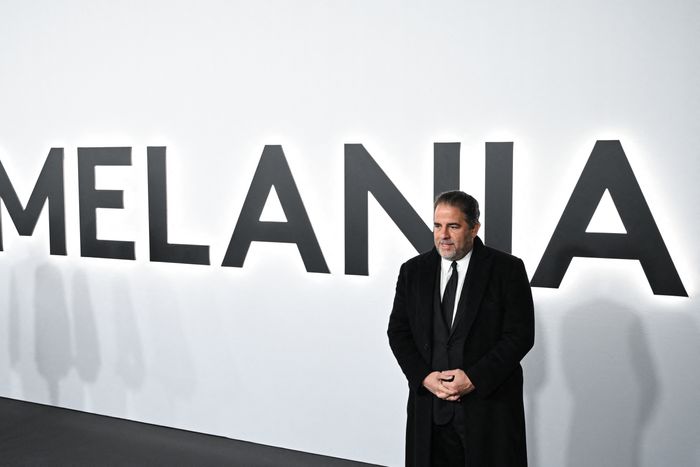
Hollywood isn’t exactly short on disgraced directors — Bryan Singer, Joss Whedon, Max Landis, Woody Allen still, so on, so forth — and in theory, the transactional Trump administration might have turned Melania into an open call for any exiled filmmaker looking to regain currency. This is, after all, a presidency in which the incarcerated openly barter loyalty for pardons; recall that George Santos is happily Cameo-ing from his home in the Poconos instead of serving out a seven-year sentence for wire fraud. But in practice, there was always going to be one true candidate to helm Amazon Prime’s documentary about First Lady Melania Trump.
Once a major Hollywood player, director, and producer, Brett Ratner watched his standing evaporate after the Los Angeles Times published a 2017 investigation in which multiple women accused him of sexual harassment and assault. The allegations were severe and explicit, ranging from forcing women to watch him masturbate to, in Canadian actor Natasha Henstridge’s account, coerced oral sex when she was 19. Yet unlike many of his now-radioactive peers, Ratner has traits that translate cleanly to Trumpworld: long-standing ties to Trump himself and a career built on popcorn spectacle more than critical prestige. It’s little surprise, then, that the Trump team would warm to handing Melania’s project — which went into development after the 2024 presidential election and received competitive bids from Disney, Netflix, and Paramount Pictures — to the director of Dwayne Johnson’s Hercules and one of Fox’s lucrative X-Men installments. Trump reportedly told guests at former Treasury secretary/film producer Steven Mnuchin’s 2017 wedding that he was a fan of Ratner’s work, particularly Rush Hour.
It’s hard to overstate Ratner’s Hollywood prominence in his heyday. At his peak, he wasn’t just commercially successful but embedded into the town’s firmament. He was close with Brian Grazer, the superproducer who founded Imagine Entertainment with Ron Howard, and so Establishment that he was tapped to produce the 84th Academy Awards with Eddie Murphy as host — that is, until he was forced to step down after using a homophobic slur during a Q&A for 2011’s Tower Heist. (Grazer replaced him as producer; Billy Crystal stepped in after Murphy withdrew.) Ratner apologized, calling it “a dumb way of expressing myself,” and the industry swiftly let him back into its good graces. Less than two years later, he received the inaugural “Ally Award” from GLAAD as part of his rehabilitation, having produced a series of PSAs for the organization. By May 2017, months before the L.A. Times report broke, he was delivering the keynote address at the Cannes Film Festival. When he received a star on the Hollywood Walk of Fame that January, he told Variety, “My closest friends are James Toback, Roman Polanski, Warren Beatty, Bob Evans.” Just months later, Toback would become another high-profile subject of Me Too allegations. Polanski had already pleaded guilty to having sex with a 13-year-old in 1977 before fleeing the country.
Ratner’s real power lay less in directing than in financing, a career built on a proficiency for cultivating relationships with powerful men. In 2012, he and Australian billionaire James Packer founded RatPac Entertainment, which secured a co-financing deal with Warner Bros. reportedly worth $450 million. Their first major bet was a hit: Alfonso Cuarón’s 2013 film Gravity, which Ratner later claimed earned him tens of millions personally. The company went on to co-finance 80-plus films that earned over $17 billion in worldwide box office, received 59 Academy Award nominations, and won 25 Oscars. Its offices occupied Frank Sinatra’s old quarters on the Warner Bros. lot. The portfolio was eclectic, stretching from prestige (American Sniper, Dunkirk) to genre hits (It, Annabelle) and an impressive number of movies you probably really love (Mad Max: Fury Road, Magic Mike XXL, Edge of Tomorrow).
But that producing résumé obscures the kind of movie Ratner himself tends to make. The Florida-born director broke out with his debut, 1997’s Money Talks, a very of-its-moment buddy comedy starring Chris Tucker as a hustler and Charlie Sheen as a TV news reporter who gets sucked into escalating criminal high jinks. The movie was critically panned but did modestly well at the box office, a template that more or less defines the Ratner experience. He followed Money Talks the following year by pairing Tucker with Jackie Chan for Rush Hour, which made $245 million on a $35 million budget, kicked Chan’s Hollywood career into high gear, and minted Tucker into a star who’d already appeared in The Fifth Element and Jackie Brown and would go on to feature in Michael Jackson’s “You Rock My World” video.
Rush Hour is exactly the sort of movie you’d expect Trump to enjoy: a broad action comedy built on racial stereotypes of its Black and Chinese leads, material that reads as gauche even by late-’90s standards but still inspires nostalgia among executives who miss making movies without worrying about all that woke stuff. But Ratner has more concrete Trumpworld connections that predate the Melania arrangement. Most notably, there’s Mnuchin, the former hedge-fund investor who served as Treasury secretary through Trump’s first term. Mnuchin founded Dune Entertainment as a side business in 2004, which held a standing deal with 20th Century Fox and helped finance the lucrative X-Men franchise — the same franchise Bryan Singer originated and Ratner inherited for 2006’s X-Men: The Last Stand. In 2013, Mnuchin merged Dune with RatPac, becoming Warner Bros.’ key co-financing partner.

Click here to preview your posts with PRO themes ››
And then there’s Tower Heist, the 2011 comedy through which Ratner first worked directly with Trump. Starring Ben Stiller and Eddie Murphy and produced by Grazer, the film is strange in retrospect. Occupy Wall Street–inflected politics informed its plot, which follows a bunch of workers at the titular tower banding together to rob a Wall Street billionaire, played by Alan Alda, who burned their pensions in a Ponzi scheme. It was among a handful of studio comedies of the moment (see also: The Other Guys) that tried to surf the political winds of the early 2010s. But what’s more striking is how much stranger the project began. Murphy pitched the idea in 2005 to Grazer and Ratner as Trump Heist: an all-Black cast of comedians — Murphy, Chris Rock, Dave Chappelle, Chris Tucker, Tracy Morgan — getting together to rob Trump Tower. Trump would be the villain, “like Alan Rickman in Die Hard,” as Rock later recalled. The film went through at least six writers over five years, including Noah Baumbach of all people, before morphing into its final form with a generic Bernie Madoff–like figure played by Alda. Trump cooperated with the production, lending both Trump International Hotel & Tower and Trump Tower on Fifth Avenue as filming locations. Ratner later said he regretted the title change: “In retrospect, it would have been a bigger hit if it had been called Trump Heist.”
(One more detail about Ratner and Trump’s mutual experiences: Ratner has long considered Alvin Malnik, a Florida lawyer and nightclub owner with documented organized-crime ties, a father figure. Ratner claims he didn’t meet his biological father until his teens and that the man later died homeless, a story he says inspired him to start a nonprofit helping unhoused people in L.A. Trump, who wields power like a mob boss, himself has well-documented daddy issues.)
After the 2017 allegations, Ratner entered the wilderness. Warner Bros. severed ties; Rampage became the final film to bear the RatPac logo. His name disappeared from promotional materials. A planned Hugh Hefner biopic was canceled. An attempted return with a Milli Vanilli film was torpedoed in after Time’s Up released a statement in 2021 demanding that “there should be no comeback” for Ratner. Access Entertainment, a British investment firm co-founded by Ukrainian-born billionaire Len Blavatnik, bought James Packer’s controlling stake in RatPac and folded the company into its operations, while Warner Bros. bought out its library. The industry that had embraced Ratner for two decades pretended he’d never existed — which is how these things tend to work until they don’t. In September 2023, Ratner immigrated to Israel, posting his immigration papers to Instagram with the Hebrew caption “Brett Shai Ratner.” He struck up a friendship with Prime Minister Benjamin Netanyahu; Israeli media reported that Ratner and pro-Israel figure Alan Dershowitz were Netanyahu’s guests during his speech to the U.N. General Assembly that year. The connection wasn’t entirely random: Ratner’s former RatPac partner James Packer is also tight with the Netanyahu family.
Melania is Ratner’s most recent comeback gambit. The doc, over which Trump reportedly retained editorial control, will almost certainly not make money: Box-office projections hover anywhere from $5 million to $1 million for opening weekend, and screenshots of empty seat maps have circulated widely. (Opening around $5 million would put Melania in the running for the biggest doc release in a decade, but that superlative would come with a large caveat: Most docs open in limited release, or fewer than 600 theaters, whereas Melania is unleashing upon 1,500 theaters across the country.) The theatrical market is already struggling to move tickets for traditional movies, let alone an Über-vanity project that’s been called “propaganda” in headlines and Letterboxd reviews. But whether butts fill seats is irrelevant. Trump loyalists flop all the time and live to flop once more.
The bigger question is whether Ratner’s proximity to power will compel an industry already willing to kowtow to the president to officially welcome Ratner back. Amazon paid $40 million to distribute his Melania, plus an additional $35 million to promote it. As Minneapolis burst with protest and rage over the weekend, the White House held a screening, with Ratner in attendance alongside Tim Cook, Andy Jassy, and Mike Tyson. Ratner is reportedly living in an eight-bedroom house at Mar-a-Lago, flying with the Trumps on Air Force One, and filming material for more Trump-oriented projects (Amazon also purchased a Melania-related docuseries). And of course, there is Rush Hour 4, which one of Ratner’s original producing collaborators, Arthur Sarkissian, has been trying to get off the ground for years and which finally got a green light after Trump personally requested it — from Paramount, now controlled by the son of Trump ally Larry Ellison, who is desperately trying to win his war with Netflix to buy Warner Bros. Ratner has always understood that in Hollywood, relationships matter more than reputation. It’s just that now, the relationship that matters most isn’t with a studio head. Only time, and perhaps the midterms, will tell whether that’s enough.