Not all Predator movies are great, but they all exist along some basic spectrum of good. This includes 2018’s much-despised The Predator, which was certainly a mess (the result, reportedly, of endless postproduction tinkering) but still managed a heady charge of irreverent, hyperviolent silliness, and it certainly includes Nimrod Antal’s mostly forgotten but quite terrific Predators (2010), which somehow starred Academy Award winner Adrien Brody. (The thesis does not include, however, Aliens vs.
Predator: Requiem, which is not a good movie, but is also neither a Predator movie nor an Alien movie. In fact, it’s hardly a movie at all.) For my money, the best of the lot is actually 1990’s sweaty, shout-y, sleazy, speedy Predator 2, which inserts the Predator into the middle of a cartoonishly gang-war-riddled Los Angeles and sets first-ballot Hall of Fame screamers Danny Glover, Bill Paxton, and Gary Busey on his tail.
Which brings me to the reason why Predator movies are hard to screw up: The Predator (or a Yautja, as the species has been retroactively identified), that terrifying intergalactic big-game hunter who loves to hoist human skulls as trophies, is a deceptively compelling nemesis — too calculating to be a proper monster, too interesting to be a slasher, and too cruel to be anything resembling a human villain. As we watch him track down and easily debone our fellow Homo sapiens, a slight twinge of recognition might creep up our spines. He’s simply doing to us what we’ve been doing to other creatures for millennia, and he does it just the way we do — casually, without a care in the world. And he does it for fun.
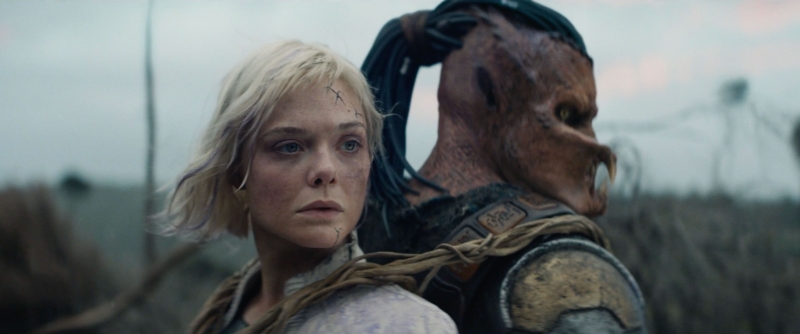
Other movies have toyed with variations on this central dynamic, but Predator: Badlands fully upends the formula. Humans are a non-factor in Dan Trachtenberg’s sequel, which begins at the Predators’ own planet of Yautja Prime, with the chaotic expulsion of Dek (Dimitrius Schuster-Koloamatangi), a Predator who is not quite brave enough or big enough or strong enough to be the big-game hunter his father wants him to be. Determined to prove his worth to his murderous father (whose disapproval generally comes with a death sentence, usually carried out immediately), Dek heads to the “death planet” of Genna, home to the elusive and terrifying Kalisk, a creature even the most feared Yautja have been unable to kill. If this is starting to sound eerily like the plot of How to Train Your Dragon, you’re not entirely wrong: Those who were worried that Disney’s purchase of Fox would lead to the Disneyfication of the Predator franchise might find plenty to concern them early on in Badlands. (And yes, I know that How to Train Your Dragon is DreamWorks Animation, not Disney. Seek help.)
In the relentlessly hostile world of Genna, among the killer tree roots and the deadly telepathic worms and the exploding prickly bubble flower thingamabobs, Dek comes across the sassy, chatty Thia (Elle Fanning), a “synthetic” who’s missing the lower half of her body. She can speak his language and has important information about this planet; she wants her legs back, and he wants to find the Kalisk, so they start working together. Thia was part of a research operation led by another robot, the far more ruthless Tessa (also Fanning), working for Weyland-Yutani, the all-powerful intergalactic company that is also the chief corporate villain of the Alien franchise. Weyland-Yutani wants the Kalisk for its own nefarious weapon-building purposes, and soon Tessa and her army of anonymous androids are hunting down Thia and Dek, who slowly build a bond of sorts. Also tagging along with our heroes is an adorable little monkeylike critter they name Bud.

Click here to preview your posts with PRO themes ››
Predator: Badlands might have a badass title, but it has a goofy heart. Thia tries to get Dek to understand jokes and to appreciate the beauty of the world around them. Because he was raised by his stoic killer-king father, Dek insists to Thia that things like cooperation and sensitivity and grief are signs of weakness — even though the evidence of such weakness was precisely the reason why his own father wanted Dek killed. Some will surely bristle at the idea of a Predator movie about toxic masculinity — I get it, it sounds like maybe the worst idea in the world — but for all the film’s humor, Trachtenberg doesn’t treat his premise as a joke. He comes up with clever action sequences, including one in which Thia’s severed torso and severed legs team up to deliver a beatdown to their robot pursuers. (There’s less conventional gore this time around, since most of what’s getting killed are synthetic humans.)
The always radiant Fanning brings a glazed-eye sweetness to Thia; despite being artificial, she has been programmed with enough sensitivity and humor to disarm the creatures she is studying. The part requires the barest hint of a heart, just enough to win us over without undoing the irony of her situation: that she’s making friends and bargaining with a supposedly ruthless Predator. The whole film is a great demonstration of the actress’s range, since Fanning then turns around and gives our nemesis, Tessa, a convincing iciness. The fact that both hero and villain look the same adds an extra layer of filial angst to the story. The obvious comparison is with Dek’s father, the uncaring alpha Predator who tried to kill his son for not being vicious enough. But Tessa is also, of course, at the beck and call of MU/TH/UR, a.k.a. Mother, the artificially intelligent taskmaster of the Weyland-Yutani corporation. They should have called this movie Predator: Father Mother Sister Brother.
Is something like Predator: Badlands sustainable? Some superfans will surely gripe that a movie in which a Predator is the hero and central protagonist represents a betrayal of what has always been a pretty dark, gory, and nihilistic action franchise. But one might argue that the classic concept itself was ultimately unsustainable. (Earlier this year, Trachtenberg released Predator: Killer of Killers, an animated film that plays less like a finished feature and more like a series of proof-of-concept shorts for Predator movies that never came to be: Predators vs. Samurai, Predators vs. Vikings, and so on. The film had its moments, but it was also hard to get over the general sameness of each episode.) Most important, the director (who was also responsible for 2022’s streaming-release Predator entry, Prey) has clearly embraced this whole universe and thought its details through. The Predators … sorry, the Yautja, are more real to him than they will ever be to the rest of us. Predator: Badlands is a charming surprise. He may surprise us yet again.
Sign up for The Critics
A weekly dispatch on the cultural discourse, for subscribers only.