Spoilers ahead for the plot and ending of Marty Supreme.
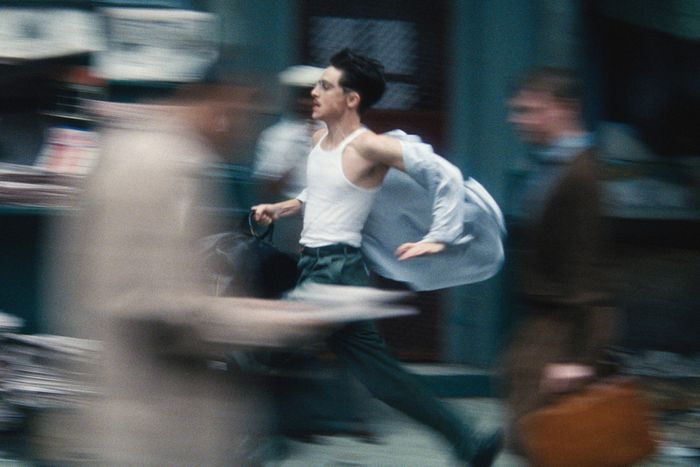
Marty Supreme is a film set in the present tense, a breathless sprint that spans the globe but for one flashback scene. When Marty (Timothée Chalamet) and his friend and coach, Béla Kletzki (played by Son of Saul star Géza Röhrig), first sit down with predatory Über-capitalist Milton Rockwell (Kevin O’Leary), the three men bond over the still-fresh wounds of the Second World War. After Milton learns that Béla is a Holocaust survivor, he confesses that he and his actress wife, Kay Stone (Gwyneth Paltrow), had a son who was killed “liberating you people” (meaning Jewish people). Béla, however, was not just any Auschwitz prisoner: the Nazis, as Marty explains it, recognized his Ping-Pong prowess and gave him a job disarming bombs in the woods. On one such outing, Béla came across some beehives and smothered his chest in honey so that when he returned to the bunks, his fellow prisoners could lick the honey from his body.
It’s a visceral, strange, and endearing image, one that drew a smattering of uneasy laughter in the showing I attended. The story exists in the same kind of gritty unreality where Marty is set: a world in which anything, no matter how absurd or cruel, is possible for those who can dream of it. We’re left with this striking image of Béla in the dark, men flocking to him for honey. Maybe Marty and Béla share this story to prove their humanity to Milton, who otherwise harbors resentment toward Jewish suffering. Marty is clearly impressed and moved by what his friend did, but it feels as though we’re given this story as a totem of the film’s “aboutness” — a gesture toward some greater idea or thesis behind Marty’s breathless high jinks. Why is this the story that Marty shares with Milton? Is it meant to endear him to a latent antisemite, or is it something closer to a parable?
While the part about the honey is, for all intents and purposes, fictional, Béla is based on a real person: Alojzy Ehrlich, a Hungarian Jewish Ping-Pong player who disarmed bombs in the camps. Writer-director Josh Safdie told The Guardian that he learned more about the Holocaust from Ehrlich’s story “than from some movies that are only about the Holocaust.” Röhrig’s casting in the role feels like a wry hat tip or dark Easter egg — remember this guy? Here is one of the most important faces in Holocaust cinema of the past decade regaling two men with the story of his survival. But like Marty, Safdie does not elaborate on what exactly we can or should learn from this story.
Jewish identity sits at the heart of Marty Supreme, much of which is set in 1952 in New York. Marty’s family lives in tenement housing with several other Jewish families, establishing the sort of secular livelihood that many did when they left Europe. Marty’s aspirations, however, have little to do with family and obligation. He is singularly focused on himself, content to ignore the collective in favor of personal glory. Some of that — like his conversation and eventual uneasy partnership with Milton — involves the sublimation of the Jewish self in favor of assimilation. In post-WWII America, specifically New York, it was easy to maintain the concept of a “Jewish life” without practicing faith, especially after the horrors of the Holocaust. Marty does not have to keep kosher or sit for Shabbat dinner so long as he remains enmeshed in the lives of his family and neighbors. Marty has no interest in tradition, nor does he strive at Ping-Pong to better his family members’ lives. He capitulates and wiles his way into goyish spaces — the Ritz-Carlton in London, a Waspy bowling alley, and eventually an uptown soirée — often at the expense of his own dignity. Part of what is most compelling about Marty is his willingness to change and shift depending on the circumstances of any given situation, sacrificing that which keeps him unique so he can keep moving and hustling. Nothing he does is for the benefit of others so much as it is self-preservation. When Milton eventually subjects Marty to a spanking, he takes the beating with grit teeth, suffering for his ability to keep going and going.

Click here to preview your posts with PRO themes ››
Part of what Béla’s story from Auschwitz exemplifies, however, is selflessness — an act of pure humility and generosity. When he’s granted reprieve from the dangers of the camps, he does what he can to share his good grace. It’s an act, perhaps, that Marty sees as both the ultimate mitzvah and a sign of what holds Béla back from greatness as an individual player. In telling Marty the story, Béla perhaps hopes to impart some kind of goodness. But Milton, who built his pen empire by being a ruthless businessman, may never be able to understand the anecdote. When he calls himself a vampire toward the end of the film, that metaphor sits in direct opposition to what Béla did at Auschwitz by literally giving away the sweetness of his body in an act of sacrifice. As our critic Bilge Ebiri wrote in his review, “The world runs on and for those who go fast, break walls, and never look back,” but Béla’s story is one of stopping, pausing, and sharing. The closest Marty gets to doing the same is in the film’s conclusion when he meets his newborn child. He stands still as he reckons with something beyond him for the first time, and the thought moves him to tears of joy and horror.