Contents

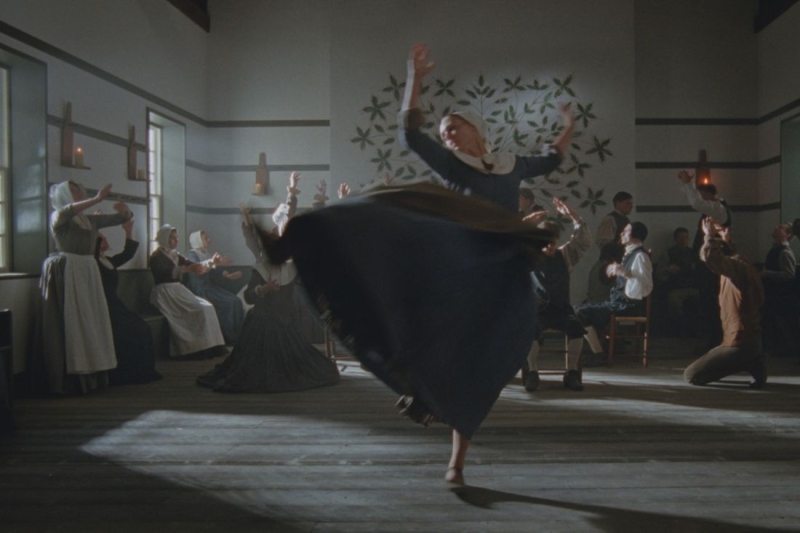
It’s impossible to talk about The Testament of Ann Lee without mentioning the way its songs and dances are staged — as expressions of both riotous, ritualistic joy and somber, meditative reflection. The film is simultaneously a documentation of religious epiphany and persecution and a bold modern-dance experiment whose musical sections communicate so much about how the Shakers lived their lives. Vulture’s Bilge Ebiri noted that The Testament of Ann Lee is like nothing he’s seen before, and much of the credit for its singularity is owed to choreographer and dancer Celia Rowlson-Hall.
Some time ago, filmmaker Mona Fastvold came to her close friend Rowlson-Hall with an idea. She was thinking of making a movie about the Shaker religion and its founder, Ann Lee, who was as ardent about celibacy as she was about God. Seven years passed before Fastvold (who co-wrote the Oscar-winning The Brutalist with her partner Brady Corbet) came back with the script for The Testament of Ann Lee. Rowlson-Hall didn’t even read it before agreeing. She took demos of composer Daniel Blumberg’s original songs and went into a studio for a week in May 2024 to design the choreography for each sequence in the film. Historical illustrations of the Shakers shaped many of her ideas about how they moved. “In the image, you had the men in one circle, the women in the other, and then they come together. That felt like the completed puzzle, and then now you undo it,” she explains.
Other references and inspirations included the Shakers’ architecture and their methods of woodworking and joinery that included “nothing jagged or anything sharp” (“I wanted the choreography to feel very rounded and defined”). She choreographed about two songs per day, then began to work directly with Amanda Seyfried, who plays Lee, and the other actors. “They all had their own movement vocabulary and choreography, so it felt as wild and diverse as possible,” she says. Here, Rowlson-Hall breaks down the six dance movements that were most important to the film’s choreography and explains how certain sequences changed on the fly. “We shot on location for everything; nothing was a stage,” Rowlson-Hall says.
1. “The Martha”
The film begins with the song “Clothed by the Sun” and a sequence in the woods led by Lee’s disciple Mary Partington, played by Thomasin McKenzie, in which the convened women swoop their arms up and kick their legs out in prayer. “Oh, that just feels so good on the body,” Rowlson-Hall says when mimicking the arm swoops. The sequence was shot on location in woods an hour outside of Budapest.
The No. 1 thing the movement comes from is prayer. It’s all about, What am I giving and what am I receiving? There’s a real force to it. I imagined the love that one has received from God exists outside of the body. There’s something about scooping up this love and presenting it and having gratitude for it. I remember telling the dancers, “Imagine there’s texture,” like they’re not just putting their hand through air. It’s almost like water or fog, or a thickness, but there’s also a brightness. They’re opening their chest, they’re opening their heart, into this place of receiving and giving. Their arms are as wide as possibly can be, but there is that curvature to show the holding nature of this love. For the kicks, it’s a little scoopy. They do a little attitude with the kick back. What Mona wanted to make sure is that people right off the bat, when they see the first moments of this film, are very aware that this has dancing and singing. Not in the ways you would expect, but we are gonna move. I called the kick “the Martha”; it’s very Appalachian Spring. This is modern dance, and this is a modern musical, and this is going to be modern movement. I thought it was nice to have this little homage to her and to her incredible vision.
It was the only thing that we couldn’t rehearse on location because it was an hour-plus away from Budapest. We got into the woods and they set up the crane that was going to follow along. The dancers got hidden behind the trees, and I had to rechoreograph, on the spot, that entire thing. It’s 25 dancers. And as much as we tried to clear the ground, they’re tripping over sticks or slipping on the leaves. It’s like 90-something degrees out, the August summer, and everybody’s in wool period clothes. They were miserable. Then I got food poisoning and I was vomiting for the rest of the day. I can tell you about my days of pure joy on set, but that was a rough one. Mona really wanted a oner from the top, and I wanted to give it to her, but once I saw the frame, I saw I didn’t have it. Thank God they had the camera going at the same time on the other side to get the profile of Thomasin, because that really saved us in the edit. That was a hard day.
2. The pull down, push out
All throughout the film is a two-part movement where the Shakers thrust their arms up above their heads toward the sky, and then pull their arms back down to their bodies, sometimes all the way down to their waists or sometimes slapping their chests, before repeating the motion. The most important part of this motion, Rowlson-Hall says, was a sense of honesty.
To me, if there’s one movement that is the film, it is that movement. There were different ways that you could do it, in terms of you were either asking and receiving or giving away. Do you have to give pain away? Do you have to give sadness away? How do you release it out of the body? How do you bring more love in? What questions do you have, and what answers? That determines the pacing.
I asked each dancer and each actor to be very honest in this moment. There is no set timing to this. If you need a moment where you just need to receive, then let it come in and let it linger as long as it needs to. Or, if you need to get that thing out, keep going, and go as fast or as slow as you need to go. What I really wanted is for people not to think, I’m doing a dance move now. Instead, it’s, I’m actually, truly, honestly, in this moment trying to have some dialogue and communication with God, with love, or with oneself. I could very much tell when people were just doing it as a movement or were really in it. The quality is so different.
3. “A chorus of angels”
Before Lee comes to lead the Shakers, she becomes pregnant four times and loses all four babies. The film shows both the labor sequences and the postpartum depression and physical pain Lee experiences after each one. “Beautiful Treasures,” adapted from a Shaker hymn, plays over the montage, for which Rowlson-Hall developed a specific movement to show the connection between Lee and the women tending to her during childbirth.
There is this one moment where I told them they were, like, gathering a chorus of angels. Amanda does it, too, and the women behind her. With both hands, they’re doing this conjuring thing right behind her. I imagined this was the dance they did in the privacy of their home while she’s in her hours of labor. What can they give her? Can they give her strength? Can they give her light? Can they give her ease? What I imagined in that moment was she needs all the strength of the angels to actually give birth to a child that lives. I was like, “Call on a chorus of angels in this moment.” The way that Amanda does it in the film is so beautiful because it starts to lose a little bit of reality. She’s going into that space that is so near and so far. I like that moment because especially in that world, everything has a real intensity and rigidity to it, almost an aggression to it. This movement is a full letting go. I told the actors, “Imagine you’ve got light dancing between your fingers.” There was almost an effervescent nature to it, which plays in contrast to the rest of the movement in that section.

Click here to preview your posts with PRO themes ››
4. The golden cloak
After Lee is arrested, she experiences visions while in jail that persuade her to reject sexual activity, even with her husband, in order to be closer to God. During “Hunger and Thirst,” Lee sees herself as covered with gold fur and levitates off the ground; when she’s released, she recounts what she experienced and announces that she’s the second coming of Jesus Christ, inspiring her followers to join her in the Shaker religion.
There’s a nice moment in “Hunger and Thirst” before she levitates. How is someone going to levitate? And I thought, Well, you’ve got to take off. You have to take off the burden of the carnal body. I had Amanda imagine that she was pulling on a golden cloak. In the choreography, you watch her trace her body as she puts on this cloak, and then with the next hand, she opens up her arm. I was like, “Peel your skin away and throw it to the ground. That allows you to rise up.” We stay so tight on her face for that, but you still see that movement. Amanda loved that movement because it was so clear to her: “Putting on the golden-light cloak, peeling off the human skin — let’s go!”
I wanted to think of Ann’s journey as this searching and this ecstasy, and this passion and this feral nature. I tried to empathize and think about what my body would be doing if I had gone through four losses of children, and then you can’t move. How do you not move but still dance? I wanted to make sure that Mona could continue the storytelling through the dance and that it was not a break from the narrative, but that it brought more feeling to it.
5. The dance circle
In the film’s final third, Lee and her followers leave Manchester and sail to America to build a permanent home for the Shaker religion and grow their flock. While on their monthslong journey, they pray on the ship’s deck through snow, rain, wind, and other extreme weather conditions, and their devotion eventually quiets the other travelers who at first dismiss them as annoyances and zealots. The montage, set to “Worship,” was filmed on Sweden’s docked Götheborg, a replica of an 18th-century ship. Overhead shots focus on the circles created by the group as they dance and move together.
They were like brothers and sisters, and there was an innocent nature to how they hugged each other and touched each other. I wanted the movement to have this intensity that felt like the physicality they are not getting out in other ways, they’re going to still get when they hold onto their people. I thought that was going to be beautiful to watch, with them huddling together and hugging passionately. When you start running together in a circle, when you’re physically doing it, if somebody falls out, everybody falls out. You wouldn’t believe how long it takes to just practice running in a circle together. You have to stay together or someone bites the dust, basically. So much of prayer is a solitary experience that it was nice to see them come together and pray together and really highlight that as an important aspect.
The boat dance was one of the best shoot days ever. We’re in Sweden, we’re on the actual docked boat. It was a four-by-four-foot dancing space. It was so tiny. We had to rechoreograph. The good thing is the actors got to rehearse the day before. I was like, “There’s this moment when your hands go down, and … actually, you’re going to get a splinter because we’re on a wooden boat now. So I’m going to change it. Push into your elbows so that then your hands can slide across and you won’t get a splinter.” It was little things like that. They rehearsed in their shoes because the period-accurate shoes are so slippery on the bottom, and they had to make sure they’re dance-ready. We shot the dance in sunny, windy, and snowy conditions, and then ended in rain. There are these moments in the edit where they’re intimate and hugging each other and sitting side by side. I didn’t choreograph that, but then I had to on the day. I figured, “We just need you to find each other and embrace each other and protect each other from the elements,” and it ended up being my favorite part of the choreography.
Will and Mona and myself, we knew exactly how we were shooting this. This was the only piece of choreography for all of us, for me and Mona in particular, where it needed to be perfect, and then we could move on. When they’re in Manchester, if someone does something different, you’re really not going to notice, because there are so many things happening. But I wanted there to be an exactness to this. I wanted to feel like they are doing this every day for months on end. It is so rote in the body that there’s no question and no hesitation inside of the movement. It was beautiful to watch. They always sang live on set, and hearing that song was a “This is why we make movies” moment.
6. Let your finger lead the way
When the Shakers travel to the U.S., they need to find somewhere to build their commune, and their patron John Hocknell, played by David Cale, finds himself touched by God’s hand. During “John’s Running Song,” Hocknell is pulled forward by his finger deep into the New York woods, to a remote location outside Albany that’s perfect for the Shakers to build their settlement Niskayuna. Perhaps the most slapsticky sequence in the film, it focuses on Cale’s practically possessed physicality.
I choreographed that as a dance. They used a body double for one little stunt. But I worked with David in the studio to find how the hand first shakes and then finds this pointing gesture. I wanted him to feel like it was leading him, and his body follows. We worked on that physicality a lot: Is it leading you down to the ground? Is it leading you up? Is it leading you to the side? Then when they shot it, my choreography ideas went away because it was more like, what are the elements that they’re facing? You know, jump over this large rock or tree or whatever. But to me, a finger can be dance. A hand can say everything you need.