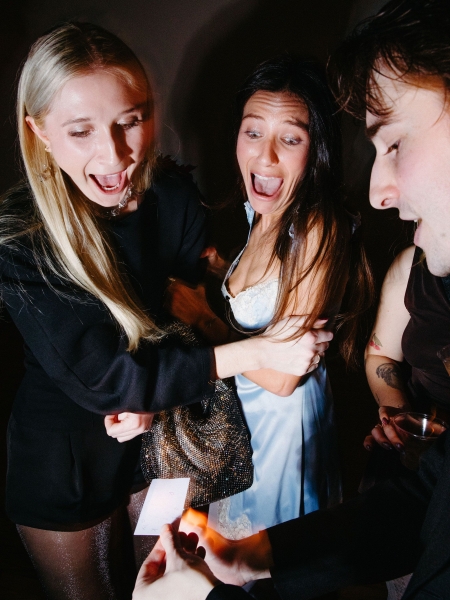
Eleanor Kaestner and Ali Royals react to a trick performed by Jacob Greenwald at a Christmas party. Photographed in New York, November 2025.
The magic found me first. Last summer, I was in the bathroom line at a friend’s birthday when I got a text: “A magician is here!!!” Abandoning my post, I darted through the sweaty loft, looking for a man in a top hat, perhaps a cloud of birds. A woman with long, dark hair sidled up and gave me a head nod. “Want to see a trick?” Hell yes, I did.
Your odds of bumping into a magician on a New York night out have never been higher. What used to be a staple of corporate holiday parties and elementary-school birthday parties is … still a staple of corporate holiday parties and elementary-school birthday parties. Now, as tricks and illusions go viral on TikTok, close-up magicians have also become the (paid) guests of honor at parties that land on BFA, Deuxmoi, and your coolest friends’ Instagram Stories.
In a city full of marks, magic reappears as a fad every few decades. When Houdini started to make serious money in 1904, he bought a house in Harlem, where he lived until his death in 1926. Mayor Fiorello La Guardia appointed an official city magician, Abraham Hurwitz, to lift New Yorkers’ spirits during a hellish Great Depression. In 1983, David Copperfield made the Statue of Liberty disappear on live TV. David Blaine pulled card tricks on unsuspecting Manhattanites in Street Magic, the 1996 special that made him a national star. In good times and especially bad, we love to be dazzled.
At the moment, we’re not minting household-name magicians. Ours blend in with the stylish guests they perform for. At Joe Jonas’s birthday at Polo Lounge in August, “Magic Mike” Jacobson dazzled celebrities with sleight of hand and mentalism, which practitioners claim uses “psychological techniques” to read minds. A fall cocktail party co-hosted by ShopMy and Laura Reilly’s Magasin at Pierre Augustin Rose Gallery also featured a mentalist, who astounded fashion types amid waiters dressed in custom Colbo. At Zohran Mamdani’s Election Night party at Brooklyn Paramount, an illusionist kept excitement up as votes poured in. A24’s holiday party at Public Records included a magician who sometimes asks guests to check his Instagram bio to reveal a name they’re thinking of.
December is the busiest season for magicians-for-hire, so I decided to conduct an experiment: During a week of nights out, how many parties doubling as magic shows could I hit? More importantly, would I see anything truly beyond explanation?
My magical party crawl began on the Lower East Side. Warner Chappell’s director of A&R, Sofia Rasmussen, and music manager Dylan Shanks were hosting a holiday party at Apollo’s, the private-events space. A crush of people blocked its coatrack, clustering around magician Hebah Sahibzada, who looked Bushwick Matrix in a black suit vest, trench, and lip piercing. Shuffling cards in midair, Sahibzada returned the nine of clubs to the musician Omar Apollo. He burst out laughing, saying, “That’s fucking crazy.” Sahibzada drifted to two men in suits and earrings, who picked cards and returned them to her deck. As she flipped their selections into her teeth to reveal them, people did shots out of a gingerbread-man–shaped ice luge nearby.
“The last time I was at a party with a magician, I was a kid,” said Rosa Einmann, a model with soft blonde curls, in town from Berlin for an Urban Outfitters shoot. “I thought it was going to be some lame card trick, but it was cooler than I expected. It’s definitely a conversation starter.”
At midnight, Sahibzada was off the clock, smoking cigarettes on the roof with guests and answering questions about work. She learned card tricks off YouTube when she was 9 after seeing an SNL skit about David Blaine and looking up Street Magic. She picked sleight of hand back up in 2020 for a college film project and entered the party circuit in 2022, working on the side as a substitute elementary teacher. At school, she tries out new tricks on the kids, her most brutally honest audience.
“This last year has been the busiest I’ve ever been,” Sahibzada said. As to what makes a magician successful among jaded partiers, she had a theory: “It’s all about personality, because everyone knows how to do the tricks. The secrets are out, so it’s about how you deal the cards. I try to be like a black cat,” she said. “The more I started being myself, the more gigs I got.”
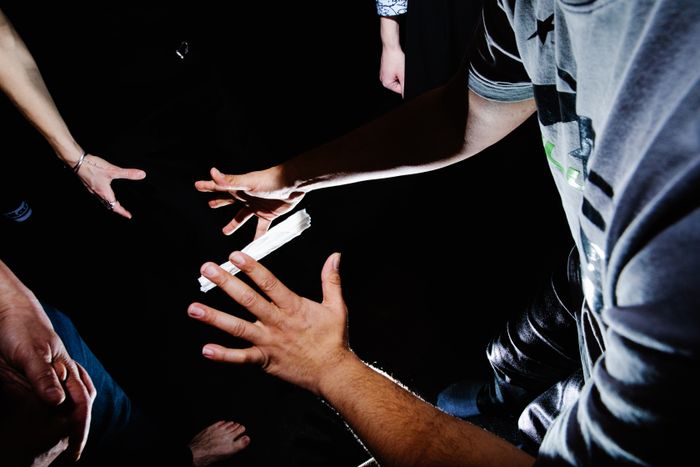
Erik Blackwell levitates a napkin at a Christmas party.
A few days later, I descended into a Broome Street basement for a party thrown by Mad Realities, a social-content studio. Magician Rachel Wax showed up straight from another gig — she’s worked 35 parties this month, including a 1,500-person event for PwC Consulting at Cipriani in Tribeca and a birthday in a West Village apartment, plus regular nights at Speakeasy Magick and the Slipper Room, the Lower East Side burlesque bar.
Conditions seemed less than ideal for holding guests’ attention: a hyperpop-obsessed DJ, low lighting with the occasional blinding strobe, and the surprise presence of another magician who wasn’t technically booked but showed up anyway. But Wax found an audience in a booth full of baby-faced gays, who complimented her “fierce” look. They watched raptly as she made their cards teleport to the top of her deck, dancing in their seats to the ’90s ballroom track “Walk 4 Me,” by Tronco Traxx.
“How did that get there?!” asked Ethan Poisson, a recent theater-school graduate, when his card appeared in Wax’s hand.
“I don’t know, it’s very upsetting,” Wax deadpanned.
“At first, I was scared, but then I saw that she’s a white girl who looks good in a red lip and realized everything would be okay,” said Walter Higginbotham, a friend of Poisson’s. “It’s American Horror Story: Coven in here, and we love that season.”
At 11 p.m., Wax was scheduled to perform on a stage, but it was occupied by a couple making out and girls jumping to SOPHIE. Alice Ma, Mad Realities’ 30-year-old CEO, was undaunted. “The magic show is about to commence! Please join me in the room with the ice luge,” she shouted. (Ice luges are also having a moment.) The crowd was encouraged to sit on the sticky bar floor — and did so without grumbling. I was astonished before the show even began.
“I got into magic because I have a Jewish mom and I wanted to upset her, so it was either this or get a lip ring,” Wax said as she pulled out three different phone chargers. The bit was a contemporary spin on a classic “three ropes” magic trick, where different lengths of rope appear to change size. Wax’s chargers connected and separated, growing and shrinking, while Wax offered relatable commentary on why you’d have so many chargers — like, you accidentally bought the super-long one online because you didn’t know what three feet looked like; you got the teeny-tiny one at the airport for $97 because you were in a bind.

Click here to preview your posts with PRO themes ››
The audience cheered along. “Fuck David Blaine!” shouted a woman in a furry white bucket hat. “Yeah, he’s a sex pest,” Wax replied, returning the chargers to their normal lengths with a flourish. “Now go do shots.”
At coat check, I spotted the renegade second magician, Sha’king Branch. (The fedora gave him away.) He placed a red foam ball in my hand and told me to squeeze, and it multiplied. “Isn’t that just stuck inside the other one?” I asked. He said no and moved on, prompting me to imagine something I really wanted. I thought about French fries, daring to hope they might appear — it was after midnight, and I was hungry. When I opened my hand, I found a foam penis. “Is that what you want?” I said no and headed home to my girlfriend.
I set out to finish my week of magical nightlife with a party in Ridgewood, the launch of a holiday market organized by the interior-design company Studio S II at its showroom. It’s inside the home of its owner, Erica Sellers — the only black rowhouse on the block. The interior was minimalist goth, too: dark pine floors, chain-mail curtains, leather and mesh outfits on guests.
Tali Kamionkowski, a freelance consultant who helps first-time collectors buy artwork, told me that she had to leave early for another party, hosted by friends who work at Hauser & Wirth. She couldn’t be late — there was a magician coming. I told her that, actually, there was a magician on their way to us too.
On cue, Erik Blackwell arrived in leather pants, a Hellstar T-shirt, and gray socks — the party was shoes-off. He was fatigued after flying in from L.A., so he beelined for the kitchen to eat a slice of pizza and open a bottle of red wine (using the corkscrew normally, to my disappointment). He strolled to the dining table, hunting for props among a spread of barbell necklaces and other slick jewelry from Bond Hardware.
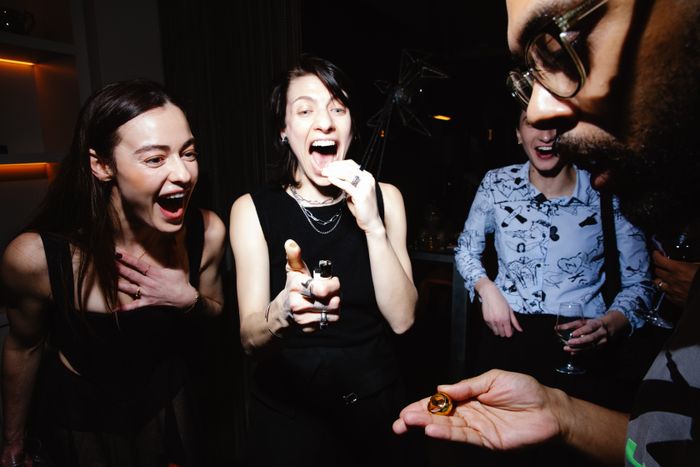
Tiana Tuttle and Erica Sellers react to a trick performed by Erik Blackwell.
“What would you call this?” he asked the brand’s founder, Dana Hurwitz, brandishing what was clearly a gold ring. “A ring. What would you call this?” she replied. “A ring …” Blackwell trailed off, throwing it up into the air. It disappeared, only to reappear in his other hand, vanish again, and pass through his index finger. He used a lighter to burn a rolling paper in a flash, revealing the ring. From there, Blackwell moved through tricks quickly, wiggling his glasses around without touching them, then floating numbers from one iPhone calculator to another. “My 8-year-old self is screaming,” said Sellers.
“My 30-year-old self is screaming,” replied artist Jeremy Martin, whose watercolor-painted sculptures rested on a shelf nearby.
My night wasn’t over after all — I’d heard two magicians were going to a launch party for the magazine Byline back at Apollo’s, bringing my magic-party count to four. At 11 p.m., Gen-Zers held latex flowers and swords made by a balloon artist earlier in the night. A bathtub full of ice and wine bottles was almost empty, but the open bar was still going strong, and every surface was strewn with tins of nicotine mints from the party’s sponsor. Loud pops punctuated the music as people stepped on balloons.
I now knew to just follow the shrieks. One of the party’s mentalists, Nadav Roet, asked me to picture a famous person, go across the room to look up and memorize their picture, and return. Attempting to come up with someone unexpected, I Googled Steve Buscemi. When I got back, Roet scrawled a name on his business card. When I saw that he was writing “Steve,” my pulse jumped before he’d even turned the card around.
Theorizing wildly, I came up blank. Roet never touched my phone, and I kept my back to the wall while looking up the photo in case Roet had an undercover spy nearby. Does everyone say Steve Buscemi? Roet wasn’t giving me any clues — just a frustratingly enigmatic smile. He turned to a brunette, Amanda Gosio, and asked her to pull four cards from the deck. “Each card corresponds to a number,” he said, then guessed the last four digits of her credit-card number. Gosio walked across the loft to get her wallet, then returned with a hand clapped over her mouth. More screaming ensued.
“I have multiple cards. That’s the one I use every day,” Gosio said. “In New York, I believe in the energy of people, and even though it’s absolutely insane, it makes sense here. What an insane way to make a connection with people.”
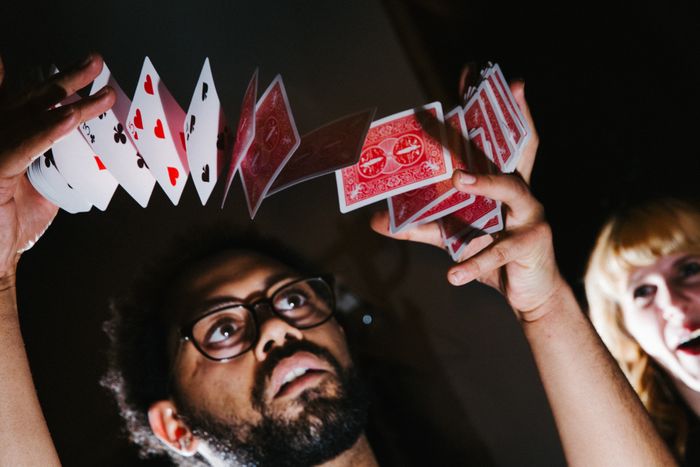
Erik Blackwell shuffles cards at a Christmas party.
In the kitchen, mentalist Jacob Greenwald caused another stir. Earlier, he’d given two friends, Eleanor Kaestner and Ali Royals, a sealed envelope, which they tucked into a bra, then a bag, and forgot about for a few hours. Greenwald prompted Royals to visualize texting someone close to her a significant word, maybe an inside joke. “Imagine this person is here right now. Think of the first letter, but say nothing out loud,” he says, writing the name “Sarah” on his palm in Sharpie to a chorus of, “No! No! No!”
“That’s not even the crazy part,” Greenwald said. He asked for the envelope and withdrew a card covered in letters, which he burned away with a lighter to reveal a word: “Pill.”
“Sarah” is Royals’s best friend since childhood; “Pill” is their nickname for each other. The party’s energy tipped into mania. Everyone gave up on figuring out how it all worked. Instead, we leaned into the belief that, actually, magic is real.
In a year when misinformation was everywhere and so much felt both inexplicable and beyond our control, party magic offered a low-stakes way to surrender to the con and find something like awe. Sure, telepathy isn’t “real.” But as I watched the impossible unfold at arm’s length in a room of chic, drunk, wonderstruck strangers, the rational world (or whatever’s left of it) felt irrelevant.
Kaestner was still searching for answers, though. She scanned the room. “I’m gonna ask the magician my future husband’s name. Is he at this party?”