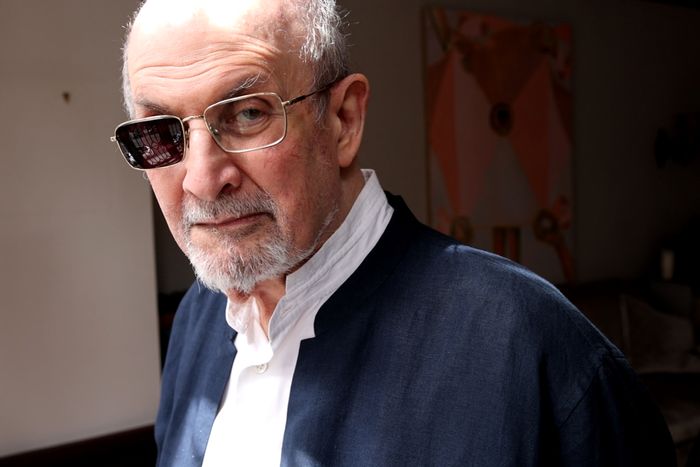
Alex Gibney’s new documentary, Knife: The Attempted Murder of Salman Rushdie, premiered at Sundance yesterday, with Rushdie himself in attendance and an understandably heightened security presence around the festival screening. Such an event was bound to be emotional — the picture features blood-chilling footage of the 2022 stabbing attack that nearly killed the author and left him blind in one eye — and the audience was clearly shaken and moved by the film. But Knife deserves credit for more than just its compelling depiction of a horrific recent event. It artfully interweaves multiple threads from Rushdie’s life and career. The film works as a biography as well as an important history lesson.
The stabbing attack at the Chautauqua Institution, where Rushdie had just taken the stage to speak, obviously made news all over the world in 2022. But at the time, most people were probably ignorant of the long history predating the incident, or simply regarded that past as a quaint, distant memory. So, let’s briefly summarize: In 1989, Iran’s Ayatollah Khomeini called for the assassination of Rushdie and anyone who had helped publish his 1988 novel, The Satanic Verses. This declaration, this fatwa, had not been an empty one: Bookstores were set on fire; newspaper offices were bombed; Rushdie’s Japanese translator was killed, his Italian translator was stabbed, and his Norwegian publisher was shot. A hotel in Sivas, Turkey, was set on fire by a mob enraged at a conference where Rushdie’s Turkish translator, the great author Aziz Nesin, was due to speak. Thirty-seven people, mostly artists and scholars, died in the conflagration. (I still vividly remember watching this news come in. I was in Turkey that summer and had been enamored by Rushdie’s work for some time; I was also shocked to discover that a couple of my friends felt the attack was, on some level, justified.)
Knife concisely summarizes this history, while using Rushdie’s recovery (initially filmed by his wife, Rachel Eliza Griffiths, to record his injuries and his recuperation) as a framing device. The images of Rushdie’s wounds are truly shocking: staples in his neck and torso and a raw, dead, red eye. We get extensive, agonizing footage of his recovery, including attempts to walk again, to regain motion in his hand, and to move independently. He notes that he wishes he could just go to the bathroom without needing someone else’s help. As his mind ruminates on the attack and its aftermath, Rushdie imagines moments from movies, some of which simply invade his anesthetized dreams: the figure of death from Ingmar Bergman’s The Seventh Seal; the knives from West Side Story, Knife in the Water, Psycho, and 12 Angry Men; all the monsters guarding the Golden Fleece from Jason and the Argonauts. This jumping between the playful and profound, the inane and the telling, makes for an effective reflection of the author’s multivoiced style.

Click here to preview your posts with PRO themes ››
Naturally, the grim scenes of the novelist in recovery serve as a sharp contrast with images of Rushdie in earlier years — as an up-and-coming novelist, as a Booker Prize–anointed celebrity, and then, of course, as a controversial figure in hiding. It’s hard for people to remember this, but there was a time when many of us assumed Salman Rushdie would never be seen in public again, that he would spend his life as a literary fugitive. As the author himself notes in the film, that was one reason why he became so visible once the threat seemed to have dissipated: He moved to New York, attended just about every movie premiere or museum opening or black-tie gala. He became something of a social goofball, making up for all those years spent not being able to do anything.
The film works as a companion piece to Knife: Meditations After an Attempted Murder, the short 2024 memoir Rushdie wrote about the attack, and Gibney uses passages from the book throughout. Some sequences, including an imaginary jailhouse confrontation between Rushdie and his attacker, are direct recreations of chapters from the book. But the movie goes deeper, too, charting how Rushdie reconnected with his homeland of India after an early, frustrating career in advertising, and how that revitalized his career. His work has thus always been an amalgam of influences, forged by an immigrant imagination that is hard to pin down or quantify, even now. That’s probably another reason why the fatwa felt like such a betrayal. Rushdie was a secular artist, but he was conversant with tradition and religion, and used these elements — myths, divine figures, ancient ideas — in his work.
Knife is a simple documentary on its surface — and, as Gibney noted at the premiere, he came onboard after Griffiths had already shot much of the footage — but that simplicity is one of its virtues. Rushdie’s life and career, which the author himself breaks down into four life-altering stages and which he admits has been filled with existential unease, has been a deceptively complicated one, influenced by personal challenges as well as geopolitical movements. Tackling so much material could have easily resulted in an inchoate mess. Gibney handles it with elegance, resulting in an informative, moving, and, yes, occasionally infuriating work.
Sign up for The Critics
A weekly dispatch on the cultural discourse, for subscribers only.