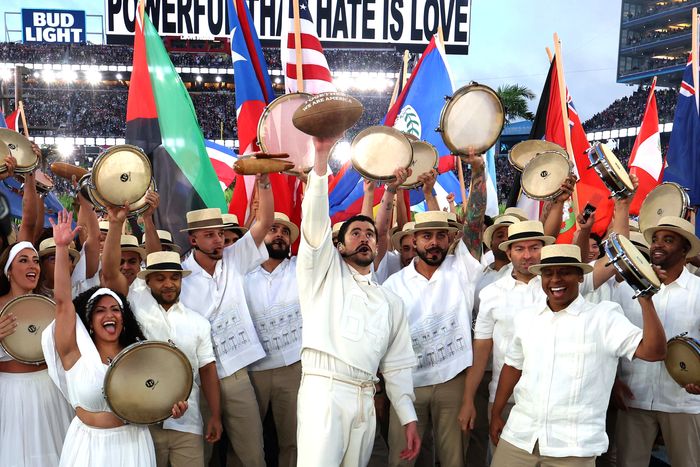
For a window into how badly the discourse around Bad Bunny’s Super Bowl halftime show was gamified by ambitious political actors, poke around the 1,300 complaints the FCC received in 2020 when the Puerto Rican star first appeared at this event as Shakira and J.Lo’s special guest. Most people didn’t write in about the immigration-reform message in Lopez’s “Let’s Get Loud.” They weren’t that concerned with lyrics being sung in Spanish. Their tiffs were almost entirely about women dancing suggestively on prime-time television. The outrage infrastructure that has cropped up around the game since then conveys a totalizing hunger for culture war. Bad Bunny’s announcement as this year’s headliner ignited endless rhetoric from MAGA pundits and influencers; there was a whole counterprogramming effort by the conservative organization Turning Point USA, which booked country-rap elders Kid Rock and Brantley Gilbert for a rival “All-American” halftime show.
The notion that Bad Bunny’s performance, as an idea, was appalling is rooted in his notable 2024 endorsement of Kamala Harris. It followed a wave of endorsements from Latin artists horrified by Tony Hinchcliffe’s set at the Republican National Convention, where the comic called Puerto Rico a “floating island of garbage.” The next Bad Bunny album, last year’s history primer and musicology master class DeBÍ TiRAR MáS FOToS, pointedly tapped local artists and recording facilities to address centuries of displacement in Puerto Rico as well as a long-standing nebulous status as an unincorporated territory of the United States. The flap over news that this would be the NFL’s halftime entertainment is emblematic of the MAGA movement’s naked disinterest in much beyond a deciding say in the messaging of America’s largest platforms. The Bayamón crooner born Benito Antonio Martínez Ocasio is in his prime as one of the most popular and acclaimed artists on the planet, but the villainizing culture-warrior class doesn’t care enough about mainstream music to know its “WAP” from its “Big Foot.” Suddenly, it became an attack on American values to have a Super Bowl performer sing in Spanish, this being the lone bit of reliable information agitators had on Bad Bunny. But the responsibility for Puerto Rican music at the big game rests with Woodrow Wilson and the 1917 Congress that explicitly enshrined Puerto Rico as American.
The message of the show was that simple: You can’t relish Puerto Rico as a vacation and tax hideaway and disclaim the music of Bad Bunny, his special guest Ricky Martin, or Daddy Yankee, whose “Gasolina” briefly played during the set. Like the studio album, the halftime show invited its observers to party and learn a little if even by accident. It’s a towering achievement in a career that has felt death-defyingly uncompromising. Bad Bunny got to the Super Bowl on his own terms and left many viewers wanting to translate what they could recognize as an all-time halftime spectacle regardless of the language barrier. The game was a chance to luxuriate in history in the making: A Latin-trap luminary getting the run of this show would’ve been unfathomable even a handful of years ago.
The scene at Levi’s Stadium in Santa Clara for Super Bowl LX felt like an extension of Bad Bunny’s San Juan residency last summer. Like “No Me Quiero Ir de Aquí” at José Miguel Agrelot Coliseum, the halftime break from the Patriots’ drubbing planted the artist in sugarcane fields reminiscent of home as workers, lovers, and fighters buzzed in and out of frame. A busy staging took advantage of the skills he accrued during a stint in the WWE — Bad Bunny is a singer you can toss through the roof of a house, who makes scaling makeshift power lines feel fluid and fun. Every moment dripped with detail; the malfunctioning roof and power lines echoed the snark about pothole-riddled streets in FOToS’s “Bokete” and nods to an unreliable electrical grid in “El Apagón” from 2022’s Un Verano Sin Ti. Several cool props gestured to historical infrastructural neglect and botched Hurricane Maria recovery efforts. Relatedly, the green cane stalks signified an early Caribbean sugar industry run on slave labor. Bad Bunny’s party acknowledged the pain of the past without being consumed by it, just like the grief-stricken rager detailed in “DtMF.” A legitimate wedding was officiated on the field, and a dance around a pickup truck for FOToS’s “EoO” honored the party circuit that was instrumental to the birth and proliferation of reggaeton decades ago.
Like Kendrick Lamar’s 13 minutes last year, which followed the distinctly Californian GNX with a maze of loving references to L.A. art and history, the Bad Bunny show put viewers face-first into a local expression of western culture. He didn’t want it lost on the casual observer that the conversation about what makes America great operates on too small an idea of it. “God bless America,” he shouted after “Café Con Ron,” a booming ode to rum-spiked coffee, proceeding to name every country in the continents and the Caribbean, from Chile and Argentina to Cuba, Haiti, and the Dominican Republic to the United States and Canada. His band spilled out into the streets outside the stadium (where an ICE Out rally rebuffed recruiting ads for the agency nearby) playing “DtMF,” urging viewers to surrender to reality and accept being part of something larger than populist division.

Click here to preview your posts with PRO themes ››
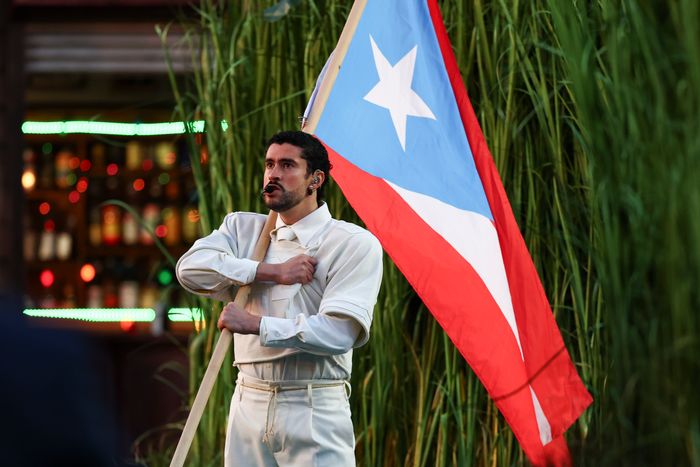
His set strove for a truer understanding of Puerto Rico. Photo: Kevin Sabitus/Getty Images
The star didn’t zip around on wires and floating platforms to make sure big spenders in the stadium got an unobstructed view. He remained among the people, sharing this triumph with the entire island just as his acceptance speech last week upon winning the Grammy for Album of the Year began with a tearful “Puerto Rico …” The audience was treated to the sight of these people making do, moving through stations of dance-floor lust, workday aches, and marital bliss. Introducing himself by name during a slice of the gruff “Mónaco” from 2023’s Nadie Sabe Lo Que Va a Pasar Mañana, Bad Bunny leaned in close to the camera to say in Spanish that he got where he is today by refusing to stop believing in himself and that we should try it for ourselves. This charm, a production so intricate that many trees turned out to be people in costume, and a joyful feeling of hard-won generational achievement will be the lasting takeaways from the performance.
FOToS’s threading of incisive politics and enthralling hooks left noisier messaging in plain sight for anyone who grasps the significance of Ricky Martin, shining star of our late-’90s pop-culture obsession with Latin music, singing the portion of “Lo Que Le Pasó a Hawaii” that decries Puerto Ricans losing homes to resort development. “Café Con Ron” is not just about hot coffee and screaming hangovers but also seeking a sense of connection with the Taíno people who were massacred, enslaved, and chased into the mountains in the 1500s. The song choice and the set grappled with atrocity and injustice as much as interwoven strands of musical history, if you accept FOToS’s alluring invitation to strive for a truer understanding of Puerto Rico.
But if, like opening-ceremony performers Green Day, Bad Bunny left his sharpest political critique for other venues, reviving his Grammy line about kindness — “The only thing that is more powerful than hate is love” — on screens in the stadium instead of the “ICE Out” rhetoric, the net effect was defanging arguments that his performance is divisive and un-American. His final word was simply that we should love, accept, and enjoy one another. This is what conservative talking heads are standing against, though many are falling back on Bush-era anti-sex finger wagging and hypocritical disdain for the morality of a territory we controlled since the (first) Gilded Age. It’s a delicate ideological trap for the culture-war gaze. The alternative to appreciating the fact that one of the most listened-to artists on the planet is also a breathtaking showman with an altruistic heart is pretending that Kid Rock had the more impactful evening.
This attention-starved Tale of Two Halftime Shows subplot notwithstanding, the pundit peanut gallery will probably move on in a few days. There’s no combative clip to rage about, unless they want to self-identify as the “hate” in the onscreen proverb; you have to really work to demonize the sunny, stately salsa duet version of Lady Gaga’s “Die With a Smile,” though it did feel she was there in part to insulate the show from complaints it would eventually receive that white English-speaking viewers got nothing all night. The Turning Point counter-broadcast hovered under 5 million concurrent viewers on YouTube. And the president didn’t appear to tune in to see Kid Rock play his 1998 nü metal standard “Bawitdaba,” lazily lip-syncing lines about meth and hookers on a church network to then beckon viewers to Jesus in the next song. Trump called Bunny’s special an “affront to the greatness of America” that “doesn’t represent our standards of success, creativity, or excellence,” asking his followers to deny what their eyes and ears have shown them, as per usual. They’ll all get distracted and forget how much they cared about this, but the people whose plights were honored at every turn of this technical achievement of a show will not.
Correction: A previous version of this story misstated that Bad Bunny voted for Kamala Harris.
Sign up for The Critics
A weekly dispatch on the cultural discourse, for subscribers only.