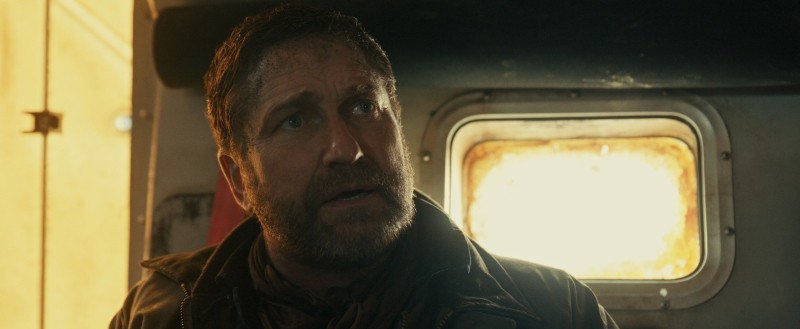
On a recent episode of the basketball podcast The Mismatch, one of the hosts loudly speculated that the 2020 movie Greenland might not actually exist. “They’re promoting Greenland 2 right now, and I’ve never heard of Greenland 1,” he confidently blared with classic sports-guy obliviousness, before describing its plot as “Russell Crowe saves the world.” Now, Russell Crowe does not star in either Greenland movie, nor does anybody save the world in them, but this gentleman’s ignorance was sadly understandable: Greenland was one of those films that had the unique misfortune of coming out during a global pandemic, when movie theaters were shuttered, and while it actually did decent business in relative terms — it topped the box-office charts in many countries where cinemas had reopened — it didn’t get a proper theatrical release in the U.S., instead going straight to digital pay-per-view and eventually to streaming.
I mention all this because, believe it or not, Greenland was one of the best pictures of that cursed year, and it wasn’t hard to imagine a world where it might have made more of an impression with a proper release. Though marketed as an old-fashioned, rough-and-tumble sci-fi disaster flick starring the retro-Crovian Gerard Butler and a big-ass comet named Clarke, Greenland turned out to be something far more interesting: a portrait of humanity confronting its demise, with some falling prey to their worst instincts and others finding ways to cooperate and sacrifice in the face of near-certain destruction. Without skimping on the action, director Ric Roman Waugh and screenwriter Chris Sparling elevated the material far above the disaster porn most of us were expecting: As John Garrity (Butler), his estranged wife Allison (Morena Baccarin), and young diabetic son Nathan (Roger Dale Floyd) anxiously made their way up an increasingly devastated Eastern Seaboard while the extinction-size Clarke hurtled toward the Earth, they found that some people still held onto their decency and dignity. This made the film upsetting at times; suddenly, the humans dying onscreen began to feel real. The fact that we were all going through an actual planet-wide calamity at the time might have also had something to do with that.
So now we have a sequel, Greenland 2: Migration, which picks up the action five years after Clarke hit. The Garritys and a large community of survivors have been living inside a giant military bunker in Greenland. Massive radiation storms, earthquakes, and other calamities continue to make the outside world highly dangerous. When John goes out on one of his occasional missions to salvage supplies from some lifeboats and ships that have washed ashore, he must wear protective gear and breathe through a mask, and he still almost gets himself killed. Alas, the bunker is destroyed, and the Garritys (Nathan this time is played by Roman Griffin Davis) wind up in the wilderness again, now trying to make their way to Western Europe, where rumors have emerged of a stable, life-sustaining ecosystem growing inside Clarke’s giant crater.
The resulting film feels like a jankier version of Greenland, which had the benefit of being set at a time when the world was just beginning to spin out of control and thus still resembled itself. Now, as the Garritys cross the North Atlantic to a flooded Liverpool, through a devastated Britain, and across what was once known as the English Channel but is now just a desert of ash and igneous rock, the film presents us with a travelogue of survivor scenarios. There are chaotic military bases and open-air markets and mad prophets and scavengers and snipers and some people who’ve managed to establish some twisted sense of normalcy. Unfortunately, the film rarely spends enough time with these elements for them to qualify as anything more than narrative contrivances. Greenland 2 mostly offers a cluster of scattershot ideas instead of any coherent vision of the postapocalypse.

Click here to preview your posts with PRO themes ››
That chaos might be the point, of course, but not when it’s rendered with such little imagination or conviction. Everything is resolved too speedily, too tidily. A brief scene at an army-base gate involving clearance badges feels like a weak attempt to re-create one of the earlier film’s more suspenseful set pieces, and it’s abandoned quickly. Potentially interesting characters show up, only for us to realize that they’re just there to serve blunt narrative purposes. Not unrelatedly, our heroes have remarkable luck finding transportation: Either someone dies and leaves them their van, or they just keep running into people who will flat out give them their vans; when they beg and plead their way onto a crowded military bus in a war zone, there are empty seats waiting for them. When this sort of thing happened in the first film, it felt suspenseful, consequential, like a last-second reprieve from certain death. Now, it just feels like a lazy way of getting from one scene to another. The original movie’s ticking-clock narrative added urgency to everything. This time, the filmmakers attempt to replicate that with a major character’s illness, which does add some emotional heft to the characters’ journey, but it all feels too loose and vague.
Still, Greenland 2 has its moments. A visit with a family friend who has managed to stay behind to take care of Alzheimer’s patients (who live with the bliss of not remembering the horrors of the comet strike) offers another promising glimpse of generosity in the face of catastrophe, even though that sequence too leaves us with a lot of unanswered questions. One genuinely breathtaking set piece involves a precarious, handmade rope bridge buffeted by gale-force winds and earthquakes, and it reminds us of the type of thrills the first film achieved. And through it all, Butler’s rough-hewn charm remains intact. Seemingly incapable of insincerity, he remains modern cinema’s everyman action ideal: the ordinary guy caught in extraordinary situations. When he looks on his wife and child, with that heavy, asymmetric face of his, we believe that this man will do anything for them. Greenland 2 rarely coheres as a successful disaster picture — especially when compared to the wonderful original — but we do wind up caring for these characters, which feels like some sort of small victory.
Sign up for The Critics
A weekly dispatch on the cultural discourse, for subscribers only.