Wuthering Heights is an incredibly moist movie, and that’s without even taking into account how often the characters get caught in or choose to stride out into the rain (all the better to make their outfits cling). A snail leaves a languid slime trail across a window pane, a housemaid squishes shiny dough provocatively between her fingers while making bread at the kitchen table, a scarred back is shown beaded with sweat in a loving close-up — Emerald Fennell’s take on the 1847 Emily Brontë novel practically glistens with fluids. When Heathcliff, a foundling, discovers that Cathy Earnshaw, the daughter of the impoverished Yorkshire lord who’s taken him in, has played a prank on him by putting eggs in his beds to be crushed, the boy plunges his fingers into the slippery puddle of yolk and albumen left behind. And just when it seems like all this oleaginousness is Fennell’s way of visualizing Victorian subtext, repressed lust oozing out in the form of other sorts of lubrication, we get a scene in which a grown Cathy, played by Margot Robbie, is caught masturbating out on the moors by Heathcliff (Jacob Elordi), who promptly grabs the hand she’s trying to embarrassedly wipe on her skirt, sniffs, and then licks it. Who needs repression when you can have foreplay?
Wuthering Heights is Fennell’s dumbest movie, and I say that with all admiration, because it also happens to be her best to date. Fennell has an incredible talent for the moment, for extravagant scenes that bypass all higher thought functions to spark a deeper lizard-brained pleasure, and for pop-music-scored montages of such lushness that they could levitate you right out of your seat. But thematic incisiveness has not proven to be her strong suit nor something her heart is in. Promising Young Woman, her directorial debut, got off to an electric start before eventually collapsing under the weight of its own attempts to delve into rage at a world that normalizes and trivializes rape. Saltburn was a collection of delirious imagery that featured some incoherent aspirations toward class commentary. In Wuthering Heights, she throws off the burden of trying to say something significant as one would a crushed velvet cloak when the sun’s finally come out. Fennell surveys Brontë’s saga of doomed passion, obsession, and multigenerational resentment and sums it up as the story of two incredibly messy bitches who can’t stay away from one another. That she’s onto something in terms of the work’s essence makes the smooth-brained sensuality of her third feature even better.
Like most Wuthering Heights adapters, Fennell sticks to the first volume of the book, focusing on the unshakeable bond that starts forming between Cathy and Heathcliff during their childhood together in the drafty farmhouse of the title, and that threatens to destroy them as they grow into adults separated by expectations surrounding their social status. But she streamlines things further, excising not just the complicated second generation of Earnshaws, Heathcliffs, and Lintons, but also the framing story, as well as the presence of Cathy’s older brother, Hindley. When the film begins, Cathy, played when young by Charlotte Mellington, lives with Nelly Dean (Vy Nguyen), who in this incarnation is the illegitimate daughter of an aristocrat who’s been hired as her companion, as well as a handful of servants and her mercurial, gambling- and alcohol-addicted father (Martin Clunes). When the Earnshaw patriarch impulsively saves an urchin (Adolescence’s Owen Cooper) from the streets of Liverpool and takes him in, he assigns the wide-eyed boy to Cathy, who provides him his name, as her “pet.” “I shall be very kind, unless you are bad, and then I will pinch you,” she informs him gleefully, and, to Heathcliff’s great misfortune, this worrying statement earns her his unending devotion.

Click here to preview your posts with PRO themes ››
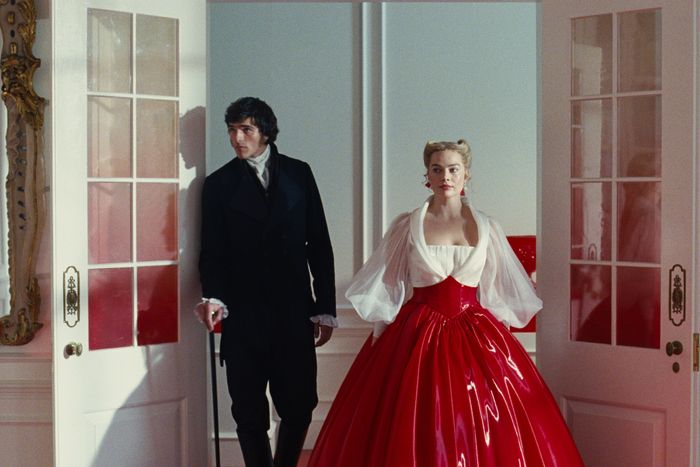
Wuthering Heights has the tunnel-vision horniness and girlish aesthetic sensibility of a high-school freshman who’s been assigned to read Brontë in class while tearing through a pile of explicit bodice-rippers under the covers at home. For instance: Heathcliff at one point grabs Cathy by her corset in order to hoist her up one-handed to kiss her, which is the kind of logistically impossible move that feels lifted right out of a hormonally overheated daydream. Cathy is only ever in outfits that billow, whether that involves veils, dresses, or the full red skirts she starts wearing after marrying Edgar Linton (Shazad Latif), the wealthy bachelor next door who’s a more sensible match than the societally inappropriate Heathcliff. Heathcliff, after disappearing for years when Cathy spurns him for the other man, reemerges dramatically out of the mist as a fuckboy version of Mr. Darcy in riding boots, a cravat, a hoop earring, and gold tooth. Edgar’s luxurious estate, which he shares with his childlike ward, Isabella (Alison Oliver), has red lacquer floors and a fireplace formed out of dozens of plaster hands, and has as much in common with Lily Allen’s late Brooklyn brownstone as it does with anything period appropriate. Is this all delicious? It sure is, in the way that feels like it’s definitely going to make your stomach hurt afterward.
At the chiseled core of it all are Robbie and Elordi, but also Hong Chau, who plays the adult Nelly, and who accompanies Cathy in her move to the Linton household. Elordi — who, on the much-discussed spectrum of Heathcliff’s ethnic ambiguity, occupies the “white, but capable of tanning” side of the scale — understands the assignment best of all, though his is admittedly the easiest. His Heathcliff isn’t a character so much as he is the embodiment of a dozen conflicting, sometimes contradictory desires — a hulking brute who, especially in the beginning, is not that far off from the hot Frankenstein’s monster that nabbed the actor his first Oscar nomination, but who in other times is a wounded, sensitive soul tormented by longing, or a smirking, dominant seducer who appears to know everything the women he encounters want. Robbie is a little too gentle on Cathy, who can be imperious and vindictive, but only ever in ways that are meant to be understandable, because the movie needs her to be a martyr to this all-consuming connection that can’t be denied.
It’s Chau who, in a funny way, becomes an audience surrogate, watching this grand affair but also rolling her eyes and, increasingly, meddling impatiently in it, like someone who’s gotten tired of dealing with the endless cycle of makeups and breakups between two members of her friend group and just wishes they’d both move on already. In a movie that finds the idea of dying for love as romantic as living for it, she provides a necessary balance — not skeptical of the epic emotions the lovers feel, but a wry reminder of how tiresome it would be to have to live with two people so convinced of their main-character energy.
Sign up for The Critics
A weekly dispatch on the cultural discourse, for subscribers only.